A Biker Pulled a Priest From His Coffin During the Funeral—Then the Entire Church Heard the Sound Everyone Else Had Called Settling Wood
The biker shoved past grieving mourners, tore open the priest’s coffin, and pulled the body toward him while the congregation screamed—because he was the only person in Saint Matthew’s Church who had heard three weak knocks beneath the hymn.
My name is Claire Bell. Father Elias Bell was my uncle, my employer, and the closest thing I had to a father after my parents died. At forty-one, I had spent nearly half my life managing his parish office in Gallup, New Mexico.
I planned his funeral myself.
That Friday morning, Saint Matthew’s was filled beyond capacity. Winter sunlight passed through old stained-glass windows. Incense hung above the pews, the organ played softly, and parishioners stood shoulder to shoulder beneath the dark wooden rafters.
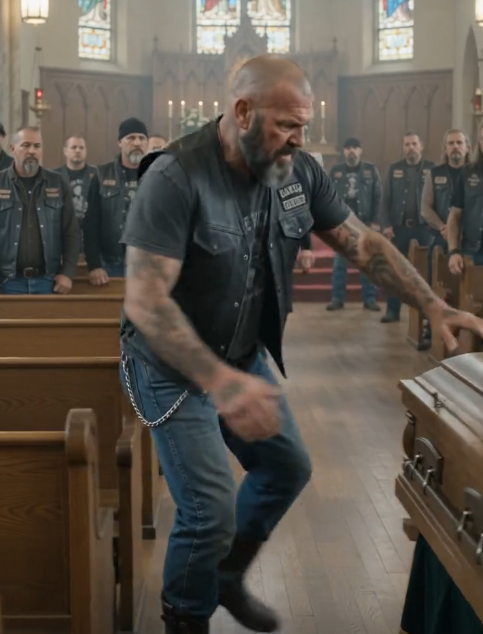
Thirty bikers occupied the final six rows.
They came because Father Elias had spent twenty-four years serving as volunteer chaplain to riders nobody else wanted inside a church. He officiated their weddings, sat beside hospital beds, visited jail cells, and conducted funerals when families refused to claim the body.
At the center of them stood Ray “Hammer” Dawson.
Hammer was fifty-six, six feet four, nearly 285 pounds, with a shaved head, thick black-and-gray beard, tattooed forearms, scarred knuckles, faded jeans, motorcycle boots, and a plain black leather cut. He looked like a man hired to remove trouble.
That morning, he became it.
My uncle’s coffin rested below the altar. He had requested a simple green burial, so there had been no embalming. The lid remained closed because the funeral director said the cold and the delay in transport had caused changes the family would not want remembered.
Halfway through the final hymn, Hammer lifted his head.
The rest of us kept singing.
He stepped into the aisle.
Leon Brooks, a large Black biker seated beside him, caught his arm and whispered something. Hammer shook free and walked toward the coffin.
I thought grief had broken him.
“Ray,” I warned.
He raised one hand.
“Stop the organ.”
Nobody obeyed.
The congregation turned. The organist continued playing because she assumed the interruption was part of some biker ritual.
Hammer struck the side of the coffin with his palm.
A woman screamed.
The funeral director hurried forward. Two ushers blocked Hammer at the first pew. I grabbed his vest and demanded that he leave.
He did not fight us.
He only said, “Quiet.”
Then the hymn ended.
For three seconds, the church became still.
Tap.
Tap.
Tap.
The sound was so faint I felt it before I accepted hearing it.
The funeral director said the wood was settling. An usher said it came from the heating pipes. Someone behind me called Hammer a drunken animal exploiting our grief.
Hammer put his ear against the lid.
Another sound came from beneath it.
Scrape.
Pause.
Two taps.
Hammer reached for the coffin latches.
People surged toward him. Leon and two other bikers moved between Hammer and the congregation, not threatening anyone, but preventing us from dragging him away.
“If I’m wrong,” Hammer said, “arrest me afterward.”
He broke the first latch.
The funeral director shouted that he was desecrating a body. I slapped Hammer across the face.
He took it.
Then he tore open the second latch and lifted the lid.
My uncle lay in white vestments with his hands folded across his chest. For one terrible second, nothing changed.
Then his right index finger moved.
Hammer reached inside, slid one arm beneath Father Elias’s shoulders, and pulled him upright. The priest’s head fell against the biker’s leather vest.
The church erupted.
I screamed at Hammer to put him down.
He turned my uncle’s face toward me.
Father Elias’s lips parted.
A sound escaped them—not a word, barely even breath, but enough to stop every voice in the building.
Hammer pressed two fingers against his neck.
“Call an ambulance,” he said.
The funeral director backed away.
Beneath my uncle’s folded hands, his medical-alert bracelet had been turned inward. A glucose monitor attached near his ribs blinked weakly through the burial garment.
Father Elias was not dead.
But that was only the first truth hidden inside the coffin.
The second involved a collapsed motorcycle garage twenty-seven years earlier, when a younger Hammer Dawson had survived because Father Elias refused to believe three knocks beneath concrete were only cooling pipes.
Want to know why Hammer recognized the tapping and how a living priest reached his own funeral? Drop KNOCK in the comments — I’ll share more soon.
Part 2 — The Priest Who Chose a Wooden Coffin
Father Elias Bell was sixty-eight when we believed he died.
He had lived with Type 1 diabetes since his twenties. He managed it carefully, carried glucose tablets in his coat, and wore both a continuous glucose monitor and a medical-alert bracelet. Most parishioners never knew because he disliked making his health the first fact in any conversation.
The week before his funeral, northern New Mexico was struck by an ice storm.
Power failed across several neighborhoods. Saint Matthew’s rectory lost heat during the night, and the backup generator refused to start. Father Elias stayed behind because the church shelter had opened its doors to twenty-three people whose homes were colder than his.
He gave his last space heater to an elderly couple.
At 4:12 in the morning, I spoke to him by phone. He sounded tired but coherent. He told me the generator was “possessed by a minor demon” and asked me to bring coffee when the roads opened.
At 7:40, a volunteer found him unconscious in the rectory pantry.
The room was cold enough that frost had formed along the bottom of the window. Father Elias lay beside an open container of glucose tablets. His skin was chilled, his breathing too shallow for the frightened volunteer to recognize, and his pulse extremely weak.
Emergency services were overwhelmed by storm-related calls.
What followed became the subject of a state investigation, licensing hearings, and two civil cases. No single failure placed Father Elias inside the coffin. Several did.
The first responders did not use all available monitoring long enough to distinguish profound hypothermia and severe hypoglycemia from death. A temporary physician covering the rural district relied on incomplete observations relayed by phone and authorized a pronouncement.