The first thing Alicia Monroe noticed was that nobody offered her champagne.
It was a small thing.
So small that under ordinary circumstances she would have forgotten it before reaching the first display case.
Prestige & Co. did not technically promise champagne to every person who walked through its doors. Employees were trained to use judgment. Bottled water was standard. Espresso was available. Champagne was reserved for appointments, returning clients, major purchases, bridal consultations, and moments when the sales associate believed the gesture would improve the experience.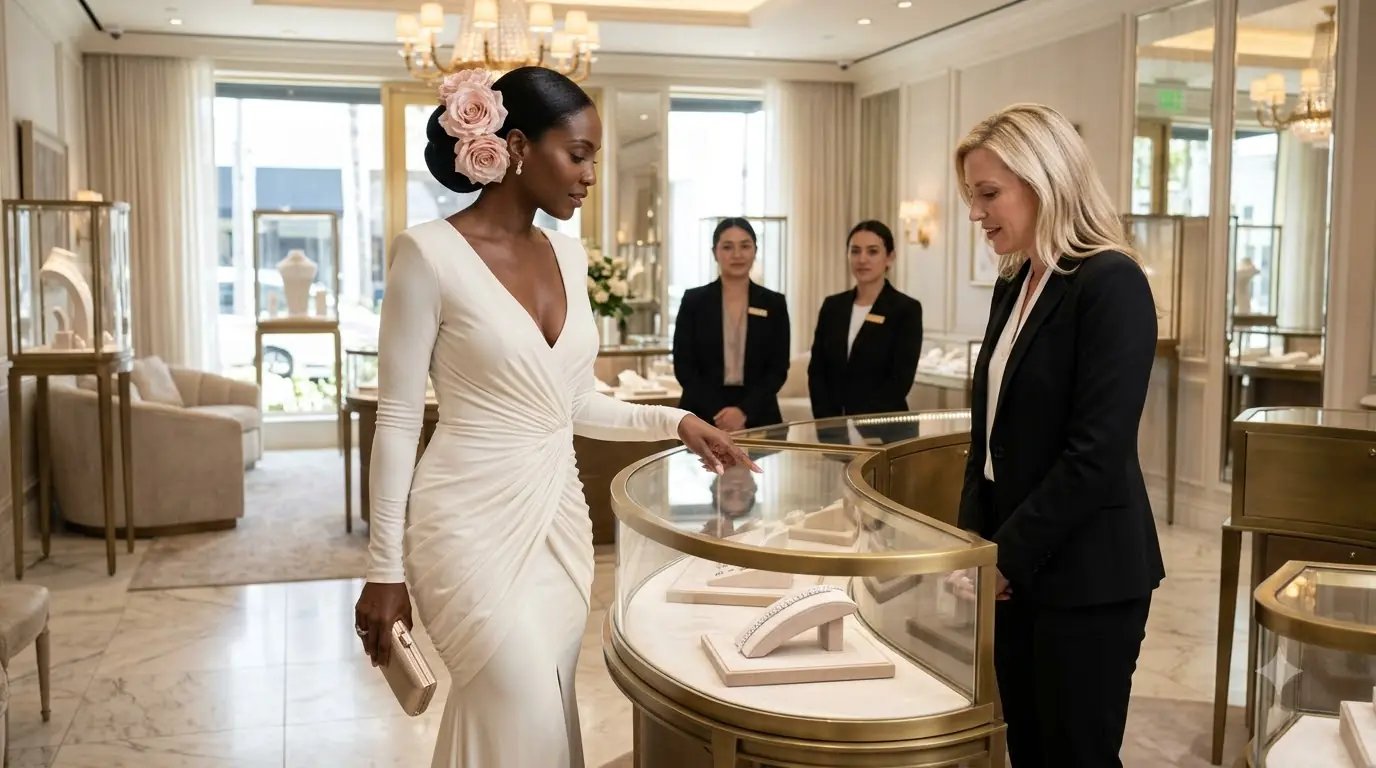
That was how the hospitality manual described it.
But Alicia had spent the previous six weeks studying customer-service reports from every Prestige & Co. location in the country.
She knew exactly how often champagne appeared in Beverly Hills purchase notes.
Very often.
She also knew the white couple who entered less than thirty seconds behind her received two crystal flutes before Alicia had even been asked whether she needed help.
That was the second thing she noticed.
The third was the manager.
Vanessa Whitfield did not approach Alicia immediately.
She watched first.
Alicia saw the assessment happen from across the boutique.
It was brief.
Efficient.
Almost practiced.
Vanessa’s eyes moved from Alicia’s face to the ivory gown she wore, then to the metallic clutch in her left hand, then to the floral arrangement pinned into her sculpted black updo.
Her expression did not register admiration.
It registered uncertainty.
Then suspicion.
Alicia almost found that interesting.
She had deliberately chosen not to arrive in a corporate car.
No assistant.
No driver.
No regional executive waiting at the door.
No advance warning beyond the fact that corporate ownership representatives were scheduled somewhere in the district that week.
She had not even planned to wear the gown.
The dress belonged to a designer whose museum-fundraiser luncheon Alicia had attended across town earlier that afternoon. Her schedule had originally allowed forty-five minutes to return home and change into jeans before visiting the store.
Los Angeles traffic had destroyed that idea.
So Alicia arrived directly from the luncheon.
If anything, she looked more like the sort of customer Prestige & Co. employees were trained to court.
That made what followed harder to explain.
The Beverly Hills boutique occupied one of the most expensive corners on the street.
Cream limestone exterior.
Tall glass windows.
Polished pale floors.
Curved cases containing diamonds set under lighting so carefully designed that every stone seemed to produce its own private sun.
The company had spent almost four million dollars renovating the location eighteen months earlier.
The flagship store was important.
Not merely for revenue.
For image.
Prestige & Co. had been founded in 1948 by two brothers who made wedding bands behind a pawnshop in Philadelphia.
Seventy years later, it had become a national luxury jewelry chain with twenty-three boutiques.
Alicia’s company had acquired it eleven months earlier.
Technically, Alicia did not own the store in the simplistic way newspapers liked to describe corporate ownership.
Monroe Heritage Group owned eighty-two percent of Prestige Holdings.
Alicia was founder, chief executive, and controlling shareholder of Monroe Heritage Group.
But if somebody asked who ultimately had authority over the Beverly Hills boutique, there was no serious confusion.
Alicia did.
Most employees simply had never met her.
That had been intentional.
She hated ceremonial ownership tours.
Executives arrived.
Employees were warned.
Floors polished twice.
Managers stood straighter.
Problem employees became invisible.
Everyone behaved beautifully until the executive left.