A Sergeant Tore Open a Federal Auditor’s Sealed Packet — Then He Found His Own Name on Page One
The first thing I noticed was not the sergeant’s hand.
It was the clock.
11:43 a.m.
I remember that because the instructions clipped inside my briefcase said the federal courier would wait beside the east entrance until 11:50, and because eight months of work had taught me that in Harland County, seven minutes could be enough time for a document to disappear.
I was three steps from the courthouse exit when the sergeant moved in front of me.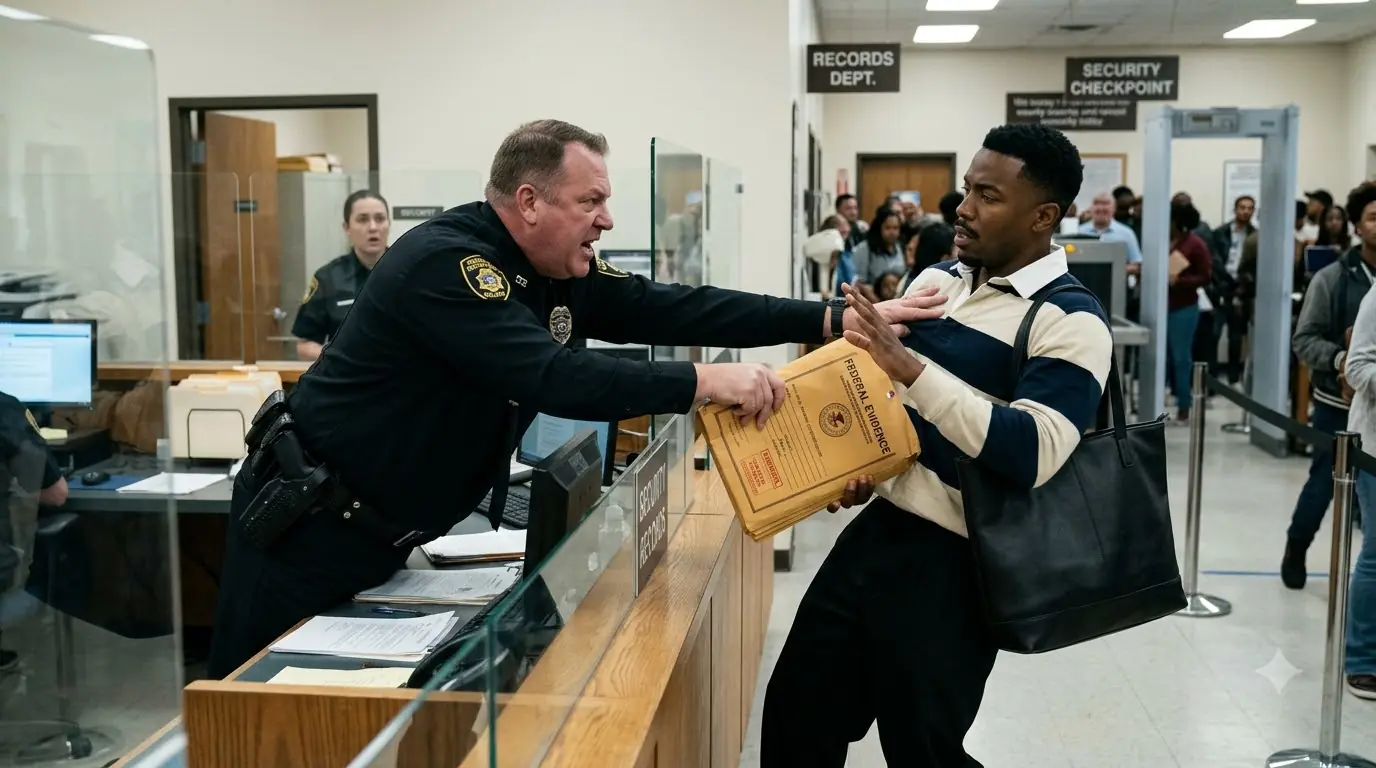
He was a broad white man in his early fifties, heavy through the shoulders, with close-cropped graying hair, a thick mustache, and the comfortable physical confidence of someone who had spent twenty-one years watching people move when he entered a room.
He wore three gold chevrons on his sleeves.
A polished badge.
A radio.
A duty belt heavy enough to tilt slightly when he walked.
I carried a black leather shoulder bag, a compact camera, and one thick manila packet pressed against my ribs.
The packet had a red evidence seal running across the flap.
The seal was not decorative.
The printed language beneath it identified the package as material prepared for transfer under federal grand-jury process.
The sergeant looked at the envelope before he looked at me.
“Where are you going with that?”
I stopped.
“Outside.”
“I can see that.”
He held out his hand.
“What is it?”
“Not yours.”
His mouth tightened.
That answer was deliberate.
Not provocative.
Precise.
For almost a year, I had learned that giving this man more information than necessary was usually a mistake.
He glanced toward the records counter behind us.
Two county employees sat there.
One looked away immediately.
The other, a young deputy clerk, watched with the expression people wore when they had seen this particular sergeant become interested in something and knew interest usually turned into authority.
He gestured again.
“Give me the packet.”
“No.”
His eyebrows rose.
It was a small movement.
But the entire lobby noticed it.
I shifted the envelope beneath my arm.
“This is sealed federal material scheduled for direct courier transfer.”
“I run the records wing.”
“This didn’t originate from your records wing.”
“It contains my department’s records.”
“That doesn’t change custody.”
His hand remained out.
“You’ve been digging through county evidence for eight months.”
“Yes.”
“You don’t walk out of here with county material without logging it with me.”
“It’s already logged.”
“Not with me.”
“That is intentional.”
Behind him, the young clerk stopped typing.
The sergeant’s face reddened.
“You think because some federal attorney handed you a consultant badge, you can ignore county procedure?”
“I’m not ignoring procedure.”
I looked at the packet.
“I’m following the procedure that applies to this.”
His eyes dropped to the red seal.
“What’s inside?”
“You are not authorized to open it.”
He took one step closer.
I did not step backward.
That probably bothered him more than it should have.
For months I had watched people perform tiny acts of retreat around him.
A clerk lowering her voice.
A deputy closing a file.
A prosecutor changing the wording of a question.
An evidence technician apologizing when he was the one who had been interrupted.
None of those actions proved corruption.
Power creates habits even around honest people.
But the habits around this sergeant were unusually consistent.
He said:
“I asked what’s inside.”
“And I told you what you need to know.”
“That’s not your decision.”
“It actually is.”
His jaw flexed.
Someone behind the counter whispered:
“Sergeant…”
He ignored her.
Then he reached.
I moved the packet away.
“Do not touch this.”
His hand stopped.
The lobby went completely quiet.
That was warning one.
He smiled without humor.
“You giving me orders?”
“No.”
“I’m preserving custody.”
“I told you not to touch the federal seal.”
He took another step.
“Nothing leaves my records wing without my permission.”
“This did not come from your records wing.”
His fingers closed around the edge of the packet.
I did not pull.
I looked directly at him.
“Sergeant.”
He stared back.
“Release the packet.”
Warning two.
Instead he jerked it toward himself.
My shoulder struck the corner of the security counter.
The compact camera in my left hand nearly fell.
One clerk stood.
A uniformed deputy near the glass doors turned.
I regained my balance.
The sergeant now held the packet against his chest.
He looked pleased.
Not triumphant exactly.
Vindicated.
He had reached the point where the room behaved correctly again.
He had the object.
I did not.
He said:
“See?”
“That wasn’t difficult.”
I straightened.
“You have just taken custody of sealed federal material without authorization.”
His smile thinned.
“Write me up.”
“I don’t need to.”
He looked at the envelope.
I raised one hand.
“Do not break that seal.”
Warning three.
Something flickered in his face.
For half a second, I thought he might hand it back.
Then a young deputy behind him looked at the red seal.
The sergeant noticed.
Pride made the decision for him.
He hooked his thumb beneath the paper.
The sound was small.
A dry rip.
But I had spent fifteen years working around evidence.
I knew exactly what a broken seal sounded like.
The young clerk covered her mouth.
The uniformed deputy near the door whispered:
“Jesus.”
The sergeant tore the flap farther.
“You people love making paper look important.”
I did not move.
I did not grab for it.
I did not shout.
I simply said:
“You were warned three times.”
He reached inside.
The first document was bound by a black clip.
He pulled it out.
Turned it upright.
The first page carried a case identifier, a federal seal, and a heading printed in large type.
Then a subject line.
His eyes moved once.
Stopped.
Moved again.
His face changed.
The color that had risen into his cheeks drained so quickly that even the clerk behind him noticed.
His fingers tightened around the page.
He read the first line a third time.
Then he whispered:
“That’s my name.”
The east courthouse doors opened behind him.
Two plainclothes federal investigators entered.
Neither rushed.
They did not need to.
One was a Black woman in a gray suit carrying a leather portfolio.
The other was an older white man with silver hair and the posture of someone who had spent a career learning that the fastest way to lose control of a room was to perform control unnecessarily.
The sergeant turned.
The woman looked at the torn packet.
Then at me.
Then at him.