The girl dragged a brass key across the vintage Harley for seventy-eight slow centimeters while its tattooed owner watched in silence—and every person outside my Route 66 diner wondered why he refused to stop her.
I was forty-three then, running the Copper Lantern Diner on the eastern edge of Flagstaff, Arizona, where the asphalt shimmered in July and old motorcycles drew more attention than new cars. I had seen fights begin over less than a fingerprint on chrome, so when seventeen-year-old Lily Bennett pressed a house key into the deep burgundy fuel tank of Ray “Hammer” Dawson’s restored 1978 Harley-Davidson, I expected somebody to grab her before she reached the first curve.
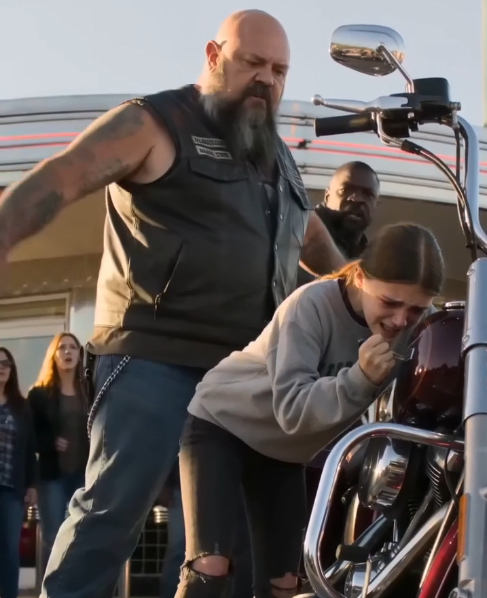
The sound made everyone flinch.
Metal against paint. A thin, ugly scrape. The deliberate destruction of something a man had spent sixteen years rebuilding with his own scarred hands.
Hammer stood six-foot-four and weighed close to 285 pounds, with a shaved head, a thick black-and-gray beard, tattooed forearms and knuckles that looked as though they had been broken more than once. His plain black leather vest had no readable club name across the back, only old stitch holes where patches had been removed. A chain wallet hung against his faded jeans, and his boots were planted so firmly on the pavement that he looked less like a man than part of the parking lot.
Yet he did nothing.
Lily kept walking beside the Harley, dragging the key across the tank and onto the side panel. Her hand trembled, but she did not lift it. Tears had cut two pale tracks through the dust on her cheeks. She wore torn black jeans, a gray high-school sweatshirt despite the heat, and the canvas shoes of somebody who had climbed out of a car before it stopped moving.
“Hey!” a tourist shouted from the patio. “Someone stop her!”
Three bikers rose from their table. The largest, a Black American man we called Moose, reached the doorway before Hammer lifted one hand.
“No.”
That single word stopped him.
Lily scratched another section. The key jumped across a chrome seam, caught, then continued. A retired couple began filming. One of my cooks stepped outside holding his phone. Everyone saw a furious teenager ruining an antique motorcycle while its intimidating owner protected her from anyone trying to intervene.
Nobody understood the ruler.
Lily carried a folding wooden ruler in her left hand. After every ten centimeters, she paused, opened another section and checked the distance. Hammer watched those numbers more closely than he watched the damage.
At forty centimeters, Moose said, “Brother, she’s cutting into bare metal.”
“I can see it.”
“That paint took us eight months.”
“I remember.”
“Then make her stop.”
Hammer’s jaw tightened beneath his beard. “Not your bike.”
By sixty centimeters, Lily was crying too hard to breathe properly. The key had crossed paint Hammer mixed himself, pinstriping done by a club brother who had since died and a small silver star near the rear fender that no one was permitted to polish except Hammer.
She scratched through the star.
Moose cursed under his breath. Hammer closed his eyes, but he still did not move.
I came outside with a glass of water and asked Lily whether she wanted to sit down. She looked straight through me.
“He was seventy-eight miles away,” she said. “That’s all.”
Hammer’s boots shifted.
“Seventy-eight miles,” she repeated. “For seventeen years.”
The people holding phones became quieter, although none of us yet understood. Hammer did. I could see it in the way his shoulders dropped with every centimeter, as if Lily were not cutting paint but removing something he had carried beneath that leather vest for most of her life.
At seventy-seven, the brass key bent.
Lily forced it onward.
At seventy-eight, she stopped near the rear fender and held the ruler against the long pale wound. The parking lot was so still I could hear an idling V-twin at the gas station across the highway.
Then Lily turned toward Hammer.
“That’s every mile between your garage and my house,” she said. “One centimeter for every mile you decided was too far.”
A woman near the patio whispered, “Who is she?”
Hammer reached into his vest.
Moose stepped closer, perhaps expecting money, a phone or the title to the ruined bike. Instead, Hammer removed an old motorcycle key on a cracked leather loop. A tiny plastic hospital bracelet was wrapped around the ring, its faded writing impossible to read from where I stood.
He placed it in Lily’s palm.
She stared at the key, then at him.
Hammer’s voice came out low and rough. “You missed one place.”
He guided her hand toward the only section of the Harley she had left untouched—the small metal plate beneath the seat where an unfinished name had been etched years earlier.
Before Lily could read it, Hammer said the words that explained why he had allowed a stranger to carve seventy-eight centimeters of anger into the only possession he had ever loved.
But the truth was worse than simple abandonment, because Hammer had crossed those seventy-eight miles many times.
He had simply never completed the final turn.
Want to know what was engraved beneath the seat and why Hammer carried that hospital bracelet for seventeen years? Drop FATHER in the comments—I’ll share more soon.
Part 2 — The Man Who Always Turned Around
I had known Hammer for twelve years, which meant I knew almost nothing about him.
Men like Ray Dawson did not tell their histories from the beginning. They gave them away in pieces: the smell of whiskey making them leave a room, a hand tightening when a child called for her father, an old scar they dismissed as nothing and a road they refused to ride after dark.
Hammer owned Dawson Cycle seventy-eight miles east of Flagstaff, in Winslow, inside a former feed store with a corrugated roof and three service bays. He repaired touring bikes, welded cracked frames and restored machines that wealthier men bought after retirement to resemble the riders they imagined they might have been. He charged fairly, spoke little and never allowed alcohol through the door.
The Iron Lanterns met there on Thursday nights. They were not an outlaw club, though their leather, scars and noise encouraged tourists to assume otherwise. Most were mechanics, linemen, truckers or veterans. They escorted military funerals, repaired motorcycles for riders who could not afford shop rates and frightened the life out of anyone who judged them from across a parking lot.
Hammer had joined at twenty-one.
By twenty-six, he had become the man brothers called when a dispute required someone large enough to end it without throwing a punch. By thirty, he had earned his road name because he could rebuild a damaged transmission with basic tools beside the highway.
By thirty-nine, he had also become a drunk.
Moose told me the truth years later. Hammer did not drink socially. He disappeared into it. He kept bourbon beneath the workbench, another bottle in his saddlebag and a third behind the flour bin in the apartment where he lived with a young nursing student named Rebecca Bennett.
Rebecca was twenty-four when they met, eight years younger than Hammer and stubborn enough to believe his silences were wounds she could bandage. She loved the smell of rain, old country songs and roadside postcards. Hammer loved her, too, though he had not yet learned that loving someone and being safe for them were different things.
When Rebecca became pregnant, Hammer promised to quit drinking.
He lasted eleven days.
He missed the first ultrasound because an Iron Lantern had been arrested in Gallup and Hammer rode out to post bail. He missed the second because he had passed out in the shop office. Rebecca left a printed sonogram beside his keys and wrote, “This is the last appointment you miss.”
It was not.
He arrived at the hospital six hours after Lily was born, smelling of fuel, rain and bourbon. Rebecca would later say he stood outside the nursery glass with both palms pressed against it, watching his daughter sleep while a nurse refused to let him enter.
Hammer kept the plastic identification bracelet the nurse handed him. Then he made the worst decision of his life.
He went drinking.
Three weeks later, Rebecca found him unconscious beside his Harley while Lily screamed inside their apartment. She packed a diaper bag, carried her daughter downstairs and told Hammer not to follow until he could remain sober without promises, threats or witnesses.
He did not follow.
At first, he called. Rebecca answered twice, then stopped. He sent fifty dollars when he had it and apologies when he did not. Six months later, Hammer was arrested after driving a van used in a motorcycle-parts burglary. He claimed he had not known what the others had loaded into the back.
Maybe that was true.
The judge did not care.
Hammer served four years in an Arizona prison. Rebecca moved to Flagstaff, completed nursing school and married Daniel Bennett, a soft-spoken high-school counselor who adopted Lily before her fifth birthday. Hammer signed the consent papers from prison.
That signature mattered.
It was not forged. He was not tricked. Nobody stole his daughter from him.
Hammer surrendered his legal place in her life because he believed Daniel could give Lily what he could not: a sober home, food that arrived on time and a father whose phone calls did not come from county jail.
He told himself it was sacrifice.
Later, he called it cowardice.
When Hammer was released, Lily was nearly seven. He got sober, regained the garage and rode to Flagstaff with a birthday gift tied behind his seat. He reached the intersection at Fourth Street, less than two miles from Rebecca’s house, and saw Daniel walking beside Lily as she practiced riding a small red bicycle.
Hammer watched from the gas station.
Daniel ran behind her with one hand near the seat. Lily shouted, “Don’t let go, Dad!”
Hammer turned around.
He returned the following year. Then the year after that.
Seventy-eight miles each way.
He reached Flagstaff, watched from a distance and rode home before Lily could learn his name. He attended one school concert from the back row, stood beyond the fence at two softball games and once followed Rebecca’s car to the emergency room when Lily broke her wrist.
He never entered.
The Iron Lanterns knew about those rides because Hammer always returned before midnight with the same unopened package strapped behind his seat. Moose begged him to speak with Rebecca. Another brother offered to deliver the gifts.
Hammer refused.
“She has a dad,” he would say.
“That doesn’t mean she can’t know the truth,” Moose answered.
“The truth is I left.”
So the birthday gifts accumulated in a locked cabinet above his workbench: a wooden horse for age seven, a beginner’s camera for age ten, a leather-bound sketchbook for thirteen and a small set of motorcycle tools for sixteen.
Hammer did not know whether Lily liked horses, photography, drawing or engines.
He was guessing at a daughter from seventy-eight miles away.
Then Rebecca died.
A sudden aneurysm took her at forty-one, leaving Lily with Daniel and a sealed box Rebecca had kept beneath her bed. Inside were hospital papers, Hammer’s old letters, the signed adoption consent and one photograph of Ray Dawson standing beside a burgundy Harley with his hand resting awkwardly on Rebecca’s pregnant stomach.
Lily found his garage address on the back.
Three weeks later, she walked into Dawson Cycle carrying that photograph and asked Hammer one question.
“Did you know where I lived?”
He could have lied.
He said yes.
Part 3 — The Price of an Honest Answer
Lily did not scratch the motorcycle that first day.
She stood inside the garage while pneumatic tools snapped in the service bays and cooling exhaust pipes ticked behind her. Hammer was under a touring bike when she arrived. He rolled out, saw Rebecca’s photograph in her hand and stopped breathing long enough for Moose to notice.
Lily had her mother’s brown eyes. That was what Hammer told me later. Not her face or hair. Her eyes.
They looked at him without mercy.
“Are you Ray Dawson?”
Hammer wiped his hands on a shop rag. “Yes.”
“My mother said my biological father worked here.”
He nodded.
“She said he was alive.”
Another nod.
Lily looked at the enormous man in front of her, taking in the beard, tattoos and black leather cut. “Is it you?”