Two men were about to take a young woman out of Hollow Creek Diner against her will.
Carol Whitfield saw it from behind the counter.
Corner booth. Table four.
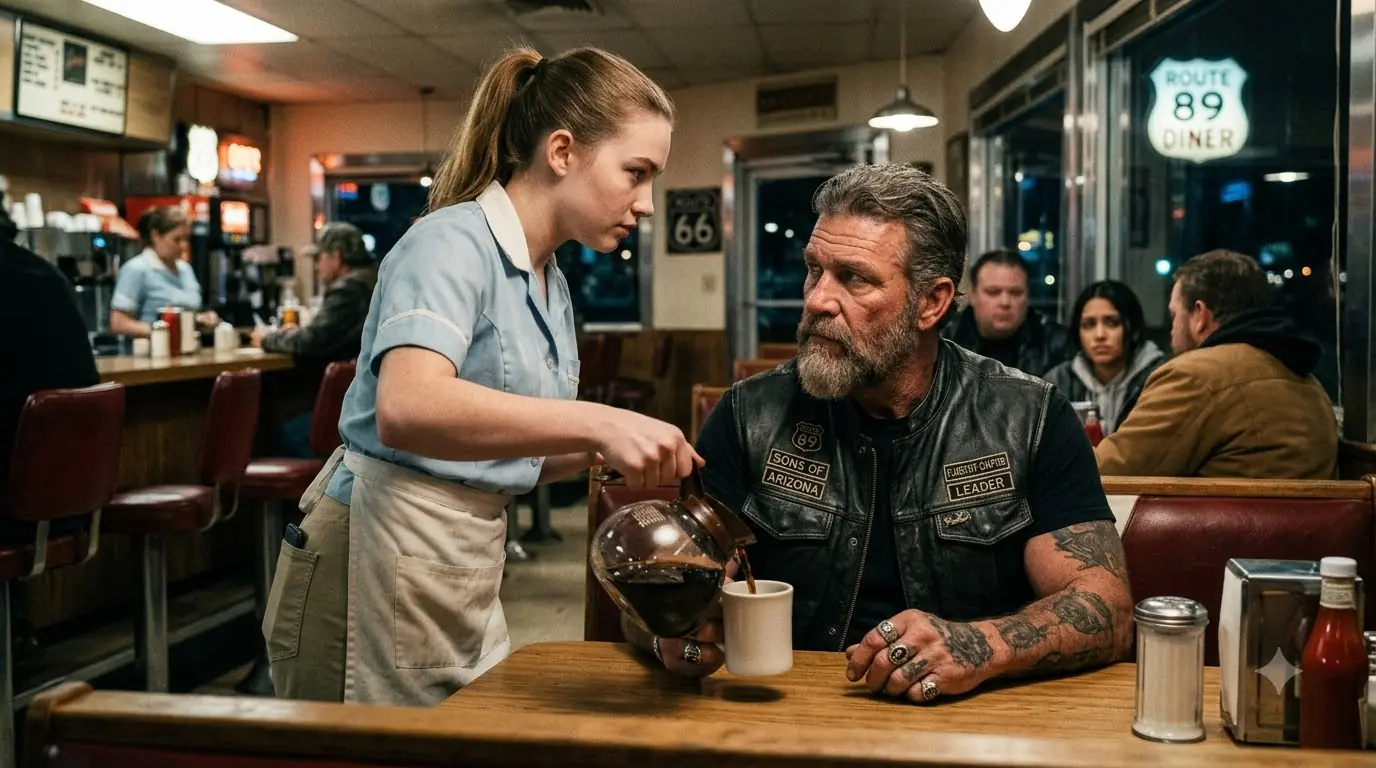
One man, Frank Delinger, kept a hand around Maya Torres’s wrist with the casual confidence of someone who had done it before.
The young woman’s eyes looked emptied out, as though she had run out of tears days ago. An oversized gray hoodie hung from her shoulders, the kind of clothing chosen not because she wanted it, but because somebody needed her to look ordinary.
Carol was only a waitress.
Thirty-six years old. A single mother. Working a Friday night shift outside Flagstaff, Arizona, where help could take time to arrive.
She had no badge.
No authority.
No guarantee that if she intervened openly, she would make the situation better instead of worse.
She had one chance.
So Carol picked up the coffee pot.
Her heart was pounding, but her hands were completely steady.
She walked past the booth without looking directly at Maya, crossed toward the window table near the front of the diner, and placed a folded napkin near the edge.
Triangle.
Fold.
Tuck.
Then she refilled a salt shaker that did not need refilling and walked away as if nothing had happened.
At a table near the entrance, Dale Harker looked at the napkin.
He had been sitting there for more than twenty minutes with black coffee and a plate of pot roast that had gone cold. Carol had stopped bringing him menus years earlier. He came almost every Friday and usually ordered the same thing.
Dale studied the fold for two seconds.
Then he reached for his phone.
“Hollow Creek. Right now.”
That was all he said.
Less than half an hour later, headlights began appearing through the diner windows.
One after another.
And the atmosphere inside Hollow Creek Diner changed.
To understand why a folded napkin mattered so much, you had to go back eleven days.
At 7:41 that Friday evening, Frank Delinger leaned across the table toward Maya.
His voice was low.
“We leave soon. You understand?”
Maya kept her eyes on the laminate tabletop.
A thin crack ran from the salt shaker toward the edge of the booth. She had been staring at it for almost an hour and had memorized its shape without meaning to.
When your world becomes six square feet of vinyl seats and laminate, small details can become the only things your mind has left to hold.
Maya was twenty years old.
She had been missing for eleven days.
Roy Sutter sat beside her on the outside edge of the booth. He was quieter than Frank and constantly aware of the room. He had placed himself between Maya and the aisle the moment they sat down.
That placement had not been accidental.
Very little Frank and Roy did was accidental.
Over eleven days, Maya had learned the way they thought. They liked control. They liked making decisions before she understood there was a decision to make. They tried to make every situation feel closed before Maya could imagine an opening.
But Maya had also learned to watch them.
And Carol had spent nine years learning to watch people too.
She came out of the kitchen holding the coffee pot and began moving along the counter, topping off mugs the way she did every Friday night.
Her left sneaker had a small tear near the toe. Dark circles remained beneath her eyes no matter how carefully she tried to cover them before work.
Her daughter was at home with a trusted neighbor across the hall.
Carol knew almost every regular inside Hollow Creek.
Pete Garland sat at the end of the counter with his usual black coffee. A retired teacher, he had been coming in on Fridays longer than Carol had worked there.
A couple near the window shared pie.
A man in another booth had been reading the newspaper for nearly an hour.
Then there was table four.
The young woman looked twenty, maybe twenty-one.
Dark hair pulled back.
Gray hoodie much too large.
Sleeves pulled over her hands even though the diner was warm.
A backpack sat against the wall, and Maya kept both feet pressed against it, not protectively, but obediently, as if she had been told exactly where everything should remain.
Carol noticed the men had ordered for her.
That was the first thing.
She continued around the counter.
Then she looked again.
Maya’s hands were flat on the table.
Completely flat.
Fingers pressed tightly together.
It looked unnatural.
Or rather, it looked natural only if someone had spent enough time telling you where your hands belonged that the instruction had become part of your posture.
Maya was making herself small.
Carol knew that posture.
She knew it from somewhere she rarely allowed herself to visit.
Fifteen years earlier, Carol had been twenty-one years old and living in Tucson with a man she once believed loved her. Gradually, she realized that the locks on their apartment had stopped being about keeping danger outside.
For months, Carol learned what it felt like to calculate tone, footsteps, silence, and distance.
She eventually left.
The life she built afterward came one piece at a time.
A new town where few people knew her history.
A job.
An apartment.
Her daughter.
Years in which she decided what parts of herself she wanted to carry forward and what she could finally put down.
But she never forgot the hands.
Flat.
Still.
Trying not to attract attention.
That Friday night, she saw those hands again.
Frank looked at his phone.
Roy watched the parking lot.
Maya sat between them like the outcome had already been decided.
Carol had only a few seconds when both men’s attention shifted.
She picked up the coffee pot and walked toward the front window.
A folded napkin went onto an empty table.
Triangle.
Fold.
Tuck.
Frank never looked up.
Dale Harker did.
He was fifty-four years old and had spent much of his adult life around men who believed loyalty meant showing up when somebody needed you.
Years earlier, Dale had returned to Flagstaff after a difficult chapter of his life and eventually became the leader of a local motorcycle club chapter.
The club meant different things to outsiders.
To Dale, its most important meaning was simple.
You showed up.
Especially when someone vulnerable had nobody else.
When he saw the napkin, something inside him became very quiet.
It was a signal he had hoped Carol would never need.
He reached for his phone.
“Hollow Creek. Right now.”
Then he set it down.
Picked up his coffee.
And waited.
Outside, the first distant headlights eventually appeared.
Eleven days earlier, Maya Torres had left her family home in Phoenix expecting a short coffee run.
She never returned.
Maya grew up in Ahwatukee, in a neighborhood where families stayed long enough to know which dogs belonged in which yards and which children had grown up behind which fences.
She was the second of three daughters.
Her father ran a small electrical contracting business.
Her mother worked dispatch for a medical courier service and possessed the kind of organizational energy that made Maya believe almost every problem could be attacked with enough calls, lists, and persistence.
Maya had inherited some of that.
She was studying communications at Northern Arizona University.
Her father jokingly called it her “degree in talking.”
Maya always replied, “That’s exactly what it is.”
He laughed every time, even though he had heard the joke more than once.
She had been home for a long weekend when Frank Delinger and Roy Sutter took advantage of a transportation mix-up and got Maya into a vehicle she believed was legitimate.
Frank had planned carefully.
He preferred places and routes where he thought people would ask fewer questions.
He changed locations repeatedly and tried to keep Maya disoriented.
The exact details mattered less than the pattern.
Nothing about what happened was impulsive.
Frank believed control came from preparation.
He watched people closely, anticipated ordinary reactions, and tried to remove choices before they could become useful.
That was what made him dangerous.
Maya spent the first days trying to stay calm enough to remember.
Vehicle details.
Snatches of conversation.
Places.
Sounds.
Turns.
Anything that might matter if she ever had the opportunity to explain what had happened.
She told herself that information was something Frank could not take from her if she kept it inside her mind.
By the fourth day, that determination became harder.