An Elderly Woman Unzipped a Feared Biker’s Leather Jacket in a Crowded Supermarket—Then a Forty-Year-Old Rescue Returned to Save Him
The elderly woman grabbed the largest biker in our supermarket and pulled his leather jacket open before anyone could stop her; customers thought she was confused, but the sound beneath his shirt made her hands move faster.
I was the evening manager at Mesa Market, an independent grocery store two blocks south of Route 66 in Amarillo, Texas. At 5:37 on a Thursday evening, every register was open, rain tapped against the front windows, and customers moved through the aisles with the impatient rhythm of people trying to get home before the roads froze.
Ray Dawson stood near the pharmacy counter.
Most people called him Hammer.
He was fifty-six, six feet four, and built like somebody had stacked two ordinary men inside one leather cut. His head was shaved. A thick black-and-gray beard covered his throat, old tattoos wrapped both forearms, and his scarred knuckles rested on a shopping cart filled with canned soup, bananas, oatmeal, and three boxes of low-sodium crackers.
Four Harleys waited outside beneath the awning. Their engines had gone silent, but rainwater continued ticking against hot exhaust pipes.
Hammer’s three club brothers were in the next aisle arguing about coffee. He stood alone, reading a nutrition label with the concentration of a man defusing something dangerous.
That was when Evelyn Carter noticed him.
Evelyn was seventy-nine, barely five feet three in orthopedic shoes, with white hair pinned beneath a green rain scarf. She came into our store every Thursday for tea, rye bread, and one lottery ticket she never scratched until Sunday morning. Most employees knew she had once been a cardiac nurse, but to the other customers she was simply an old woman pushing a small cart with a squeaking front wheel.
She stopped six feet from Hammer.
Her head tilted.
Hammer shifted his weight and pressed a fist briefly beneath the left side of his jacket. A faint electronic tone sounded—two notes, a pause, then two more.
Most people mistook it for a phone.
Evelyn did not.
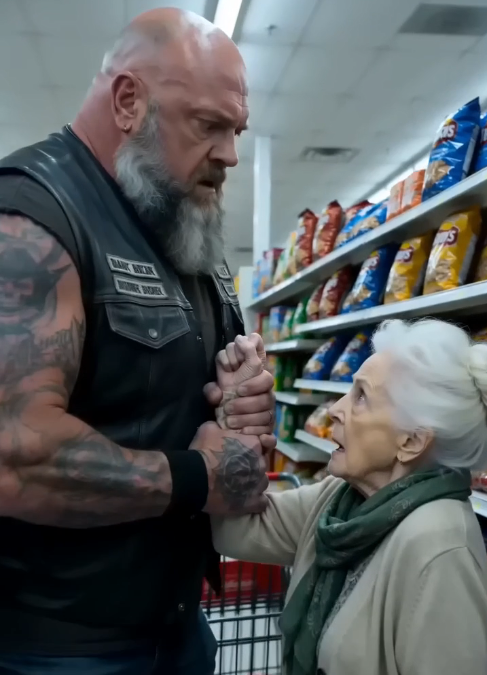
She abandoned her cart, walked straight toward him, and reached for his zipper.
Hammer caught her wrist before she touched it. His hand completely covered hers.
“Ma’am,” he said, his voice low but controlled. “Don’t.”
Evelyn looked into his face. “How long has it been doing that?”
He released her wrist but stepped backward.
A second alert sounded beneath the leather.
Two notes. A pause. Two more.
“What are you doing?” a customer demanded as Evelyn reached again.
This time she pulled the zipper down.
The aisle erupted.
A woman near the pharmacy shouted for security. A man raised his phone and began recording. One of Hammer’s brothers came around the corner, saw an elderly stranger opening his club president’s jacket, and moved toward them with both hands raised.
Evelyn ignored everyone.
Beneath Hammer’s jacket was a faded black T-shirt. The fabric over his left chest shifted with his breathing, revealing a thin surgical scar and the outline of an implanted cardiac device beneath the skin. A small medical transmitter clipped near his belt was flashing amber.
Hammer’s face had gone gray.
Not pale.
Gray.
Sweat stood along his forehead even though cold air blew through the automatic doors. His right hand trembled against the shopping cart. The label he had been reading slipped between his fingers and landed beside Evelyn’s shoe.
She pressed two fingers against his wrist.
“Call 911,” she told me.
Hammer tried to pull his jacket closed. “I’m fine.”
“No,” Evelyn said. “You’re still standing.”
There was something in the way she said it that made those two statements sound completely different.
His club brothers surrounded them. The largest was Leon Brooks, a broad Black man with a trimmed beard and a blue bandanna. He asked Hammer whether he wanted to leave. Hammer nodded once and reached toward him.
Evelyn slapped Leon’s hand away.
“Do not walk him anywhere.”
People gasped as though she had struck a police officer.
Hammer’s knees bent.
Evelyn caught his jacket with both hands, but she could not support his weight. Leon and I lowered him to the floor while groceries rolled beneath the shelves. The electronic warning continued beneath his shirt.
Two notes.
A pause.
Two more.
Evelyn knelt beside the man everyone else was afraid to touch and placed her ear near his mouth. She checked his pulse again, looked toward our customer-service counter, and shouted for the automated defibrillator.
Then Hammer opened his eyes.
He looked at the elderly woman above him, not with recognition, but with the distant fear of someone hearing a voice from another lifetime.
Evelyn leaned close and said, “Stay with me, Ray. Don’t close your eyes.”
Hammer stopped fighting her.
Forty years earlier, beside a flooded drainage canal outside Amarillo, a sixteen-year-old boy in a torn leather jacket had spoken those exact words to Evelyn’s eight-year-old son.
But Evelyn did not yet know the biker on our supermarket floor was that boy.
She would learn his identity only after his heart stopped—and after the paramedic running through our doors called him by the name she had spent four decades trying to find.
Want to know why Evelyn recognized the warning and what Hammer had carried from the 1986 rescue for forty years? Drop HEART in the comments — I’ll share more soon.
Part 2 — The Man Who Bought Low-Sodium Soup
Before that Thursday, Hammer Dawson was a man I recognized without knowing.
He came to Mesa Market two or three times a week, usually late enough that the dinner crowd had thinned. He parked his black Road King at the far end of the building, folded his gloves into his helmet, and walked the aisles with an old paper list. He never blocked carts, never argued about prices, and always returned the loose cart someone had abandoned beside the handicap spaces.
People still watched him.
His leather cut had no words a customer could read from ten feet away, but the worn patches, chain wallet, heavy boots, and dark tattoos supplied whatever story they expected. Mothers drew children closer. Men who had been laughing lowered their voices. New cashiers sometimes called me to stand near their register while he paid.
Hammer noticed.
He never complained.
Six months before the supermarket incident, his purchases changed. He stopped buying bacon, canned chili, and the strong coffee his club favored. He began studying sodium levels and carrying a folded cardiology handout between the pages of his grocery list.
I once teased him about the crackers.
He looked at the box and said, “Cardboard’s got less salt.”
“Does it taste better?”
“No.”
That was the entire conversation.
His brothers knew he had undergone heart surgery, but Hammer had told them it was routine. The implanted device beneath his collarbone was not a simple pacemaker. It was an implantable cardioverter-defibrillator—an ICD—which monitored dangerous rhythms and could deliver a shock if his heart slipped into one.
To most people, it was still a pacemaker.
To Hammer, it was an insult beneath his skin.
He had spent his life being the man who lifted engines, separated fights, pushed broken motorcycles onto trailers, and rode into storms to collect stranded club members. Depending on a device felt like betraying the body that had carried everyone else.
Leon told me later that Hammer had ignored two appointments.
The first time, he said the shop was busy. The second time, a club prospect needed help moving his mother into assisted living. When the cardiology office called about data transmitted from the implant, Hammer turned off his phone and went back to rebuilding a carburetor.
Brotherhood had taught him to show up for others.
It had never taught him how to become the one waiting for help.
Evelyn Carter lived by a different rule. She had retired from cardiac nursing seventeen years earlier, but she still noticed breathing patterns, swollen ankles, blue fingernails, and the tiny pauses people inserted into sentences when they were hiding pain.
She noticed Hammer before she heard the alert.