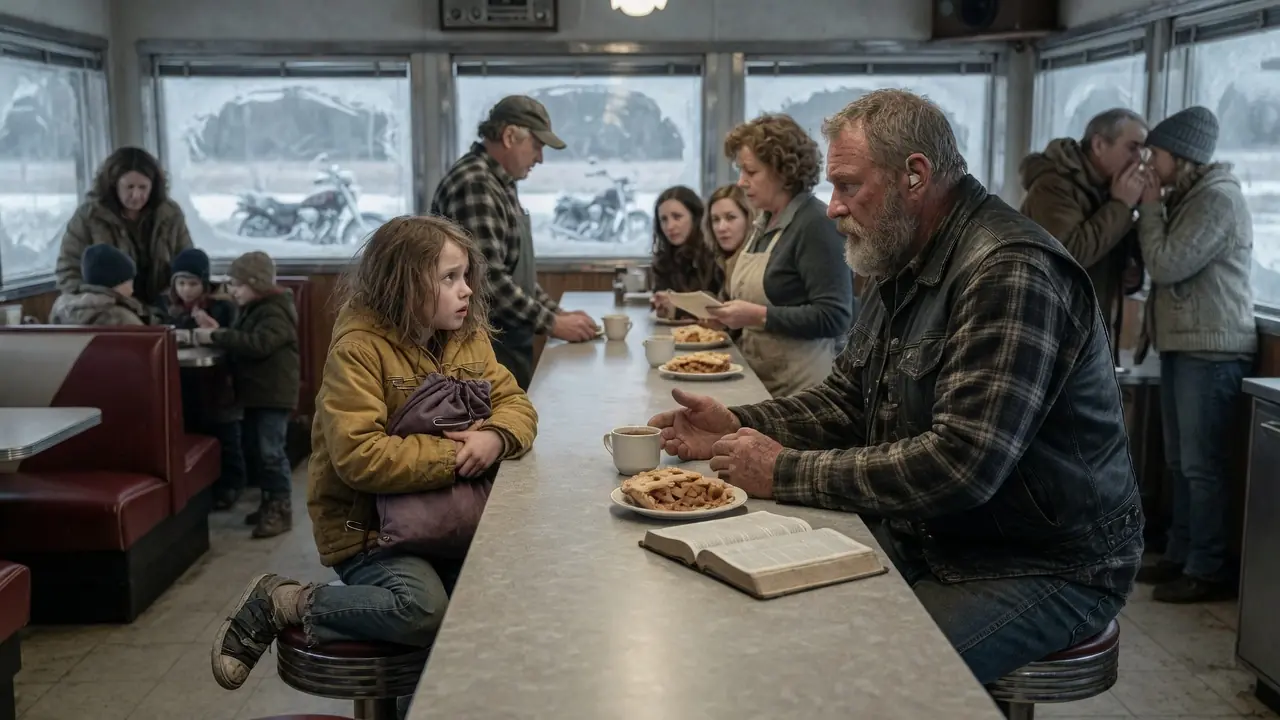
“Can I sit with you?”
“Please.”
Seven words spoken barely above a whisper from a child who weighed forty-seven pounds and had not eaten a real meal in eleven months.
A child who had been turned away by four separate adults in the last twenty-three minutes.
A child who had exactly nineteen days left before the man who controlled every door in her life reached the end of his timeline for her.
She had not walked up to just any table. She had crossed twenty-three feet of linoleum floor, step, drag, step, drag, the soft rubber of her sneaker catching with each step. Her yellow jacket was two sizes too small and held at the zipper with a single safety pin.
She had approached the one person in that diner nobody else had spoken to since he walked in.
For eleven months, Lillian Mercer had been trying to survive inside a system that had looked directly at her and decided she was not its problem.
Until a Saturday afternoon in late January, in a cold truck stop town near the Canadian border, she placed every last chip she had on a man in a black leather cut with a gray beard and a Bible open on the counter in front of him.
What happened in the next four hours would bring hundreds of motorcycles to northern Montana. And the contents of a worn purple drawstring bag would expose a plan so deliberate that the word premeditated would not feel strong enough.
This is Lily’s story, and it does not end the way you think.
“I just needed to be somewhere warm with people.”
That was the first thing Lily said.
Not about the leg. Not about the locked room. Not about the scratched silver MP3 player buried in the bottom of her purple bag.
Just that.
Somewhere warm with people.
She had been walking for a long time before she reached the Huckleberry Flats Truck Stop on Highway 2 East. Outside, the temperature had dropped to twenty-eight degrees and was heading for seventeen by nightfall.
The wind came out of the northwest, the kind of flat, relentless Montana wind that does not howl. It just presses.
Three toes on Lily’s right foot were already showing the early white puffiness that a paramedic would later describe very quietly to Ray as the beginning of something they needed to address that night.
But inside the diner, there was country radio playing low from the kitchen, the smell of black coffee and bacon grease and pine cleaner, and nineteen people who had their own warm booths and their own very good reasons not to notice an eight-year-old girl standing alone by the coat rack near the entrance.
Lily noticed all of them first.
That was something the trauma counselor would later explain as survival behavior. Lily’s eyes swept every room in full before she stepped inside.
She had been doing it for months.
You learn to find the exits before you need them.
She tried four times before she reached Ray Holloway.
The first time, she approached a family of five in the corner booth. A mother, a father, and three children. About the safest-looking configuration in the room.
The mother made eye contact with Lily across the diner floor. Then she quietly pulled her own children closer and gave one small, firm shake of her head.
No words.
Just a wall.
Lily had been rejected before by people who meant nothing to her. Being rejected by a mother figure landed differently.
The second time, she tried a trucker at the counter. Mid-fifties, coffee at his elbow. He looked Lily up and down and said, “Kid, I got nothing for you,” before she had even opened her mouth.
Then he turned back to his mug like she had already left.
She had not even asked yet.
She had been prejudged as a problem before she had spoken a syllable.
The third time, she approached two women sharing pie in the middle booth. One leaned toward Lily with a soft voice.
“Sweetie, where are your parents?”
When Lily hesitated for just a moment, the woman waved the waitress over and asked her to handle it.
Lily was passed off like unclaimed luggage.
The fourth rejection was the one that nearly finished her.
Three women near the window, each wearing a fundraiser pin on her coat that said Serve Others in white letters. One knelt to Lily’s level, studied her face carefully, then stood up and said, loud enough for two nearby tables to hear, “She’s probably just wandering. These children need structure, not handouts. Her parents need to do their job.”
These were precisely the people whose entire identity was built around compassion.
And they had just delivered the final proof to an eight-year-old girl that no adult in the world was going to help her.
Lily had been counting ceiling tiles.
She got to eleven.
Then she turned and saw the man at the far end of the counter.
Big.
Bigger than anyone else in the diner.
Gray beard. Black leather cut with a patch she could not read from that distance. A hearing aid in his right ear. He was reading a Bible, pages worn soft at the corners, open somewhere in the middle.
His coffee was untouched.
A slice of apple pie sat pushed to the side, half eaten.
Everyone else in the diner had moved their eyes away from him when he walked in.
Lily had noticed that, too.
She picked up her purple bag and held it against her chest with both arms crossed over it, the way she always carried it.
Always.
Then she started walking.
Step, drag, step, drag.
Twenty-three feet.
She stopped twice.
Almost turned back twice.
Each time, something pulled her forward.
Maybe it was the Bible. Maybe it was the fact that he was the only one in the room who had not looked at her like a problem to be managed.
She reached the counter.
He did not look up immediately, but she could tell somehow that he already knew she was there.
“Can I sit with you?” she whispered. “Please.”
Ray Holloway closed his Bible.
Not quickly.
Slowly. Deliberately.
He set it aside and rotated his entire body on the stool to face her.
Not a glance. Not a half turn.
A full rotation, giving her everything.
His complete attention before he said a single word.
His eyes moved from her face to the yellow jacket with its safety pin, to her hands crossed over the purple bag, to the sneaker with its electrical-tape sole, to the left leg she was holding slightly off the floor even standing up.
Then back to her face.
He opened his hands, palms up on the counter, empty and visible.
“Sit down, sweetheart,” he said. “I’m not going anywhere.”
He lifted two fingers toward the waitress without breaking eye contact with Lily.
“Whatever she wants. Everything on the menu if she needs it.”
What he did not know yet, what none of them in that diner knew, was that the worn purple bag pressed against Lily’s chest contained the only evidence on earth that a man in Havre, Montana, had already planned her death in careful, deliberate detail.
Ray Holloway was fifty-seven years old.
He had served eighteen years in the Marine Corps, three combat tours, retired as a staff sergeant, and came home with a hearing aid in his right ear from an IED outside Fallujah in 2004 and a slight forward lean in his walk that never quite corrected itself.
On his left forearm was a tattoo in block letters: Psalm 34:18.
He was the road chaplain for the Sons of Thunder Motorcycle Club, Havre chapter, ordained since 2009, and he had not missed a Monday night soup kitchen at the clubhouse in six years.
Inside his cut, in the chest pocket, he carried a photograph.
Her name was Claire.
She had been nine years old when a drunk driver took her in 2019.
Ray had been the one to identify her.
He never talked about it, but the photograph never moved from that pocket.
He knew, the way some people simply know from having lived close to enough grief, that something was different about this child.
Not just the limp. Not just the jacket that had been bought two sizes ago for a girl who had since stopped growing.
It was the way she ate.
He had ordered her a grilled cheese sandwich, tomato soup, and a glass of milk. He watched her carefully unwrap the paper from the straw and set it to the side like it might be needed later.
He watched her take the first sip of soup and go completely still.
Not from the temperature.
From something else entirely.
From the fact that no one was going to take it away.
She ate slowly.
He did not rush her.
He did not fill the silence.
He just let her be warm.
When she had gotten halfway through the sandwich, she set it down and looked at her hands for a moment.
“I just needed to be somewhere warm,” she said again, quieter. “With people.”
“You are,” Ray said. “Take your time.”
He gave her three more minutes before he asked anything.
“Is your leg hurting right now?”
She looked at her left foot.
“Always,” she said.
Flat. Factual. Like it was the most ordinary thing in the world.
“How long?”
“Since I fell. Eleven months ago.”
Ray kept his face calm. He kept his hands open on the counter.
“My stepdad says it’ll heal by itself,” she added, still not looking up. “He says I exaggerate.”
“And what do you think?”
A pause.
The radio played something about a highway and coming home.
“I think it’s crooked now,” Lily said. “I think it healed wrong.”
He let that sit.
What she said next, he would repeat verbatim to five law enforcement officials before the night was over.
“He locks my door at night from the outside. I can’t get out.”
Her voice had the careful flatness of someone who had trained all the feeling out of her words because feeling drew attention.
“I’m in the room off the garage. There’s no heat vent. He gives me food once a day, usually. I ate peanut butter and bread this morning, but not the whole piece because he was watching.”
Ray’s jaw tightened, one small controlled movement, then stillness.
He did not reach for her.
He had understood something in the way she flinched when a man’s voice rose at a table three booths over. Just a laugh, just an ordinary loud laugh, but it told him she needed his hands to stay exactly where they were.
“Lily,” he said, “my name is Ray, and I had a daughter once. She was nine years old, and she died, and I didn’t get to keep her safe.”
He said it evenly, without performing grief.
“So when I sit here with you, I need you to understand something. Whatever you tell me, I’m not going to hand you off to someone else. I’m not going to look at you like a problem. I’m not going anywhere until you are safe. Both of those things are true right now.”
She looked up at him for the first time since she had sat down.
And whatever thin, fragile thread of desperate hope she had been carrying for eleven months, the kind of hope a child does not let go of even when every adult in the world suggests they should, he saw it.
“There’s something else,” she said. “Something I’ve been carrying.”
She reached into the bottom of the purple bag, past what looked like a bundled sock, and pulled something out.
She set it on the counter between them.
A scratched silver rectangle, no bigger than a book of matches.
On the bottom was a piece of pink electrical tape with a name written in careful child’s handwriting.
Lily.
She had put it there when she was six, when the device had still belonged to her mother.
“I recorded him,” Lily said. “Three weeks ago. He was on the phone in the kitchen. He thought I was asleep.”
Ray looked at the MP3 player.
Then he looked at Lily.
“He said Montana winter finishes what he started,” she said.
Her voice stayed flat, controlled, the voice of someone who had rehearsed staying calm in the dark.
“He said I won’t make it to February.”
A pause so small it barely existed.
“And then he said the same thing that happened with my mom.”
The diner kept moving around them.
Radio.
Boots on linoleum.
The cook calling something to the waitress.
A completely ordinary Saturday afternoon in an ordinary town.
Ray did not move for three full seconds.
He sat completely still.
Then he reached into his jacket pocket and checked the date on his phone.
January 26.
Nineteen days.
He stepped outside.
The cold snapped against his face immediately.
Twenty-eight degrees and dropping fast.
He could see his breath.
He dialed Gerald Cobb, and the line picked up on the first ring.
“Ironside, it’s Preacher.”
“Go ahead.”
“I need every brother within two hours of Havre at the Huckleberry Flats lot on Highway 2. Now.”
A pause.
Not hesitation.
Just the weight of understanding settling in.
“What’s going on?”
“Eight-year-old girl recorded proof of a murder plan. Nineteen days on the clock. We’re not waiting for the county to take their time on this one.”
“Say no more. We’re coming.”
The line went dead.
That was it.
No debate about jurisdiction.
No questions about whether the evidence would hold.
No discussion of liability or exposure or what happened if they were wrong.
Just brothers, a direction, and motion.
Because that was what the Sons of Thunder had meant since Bill Schaefer founded the charter in 1987.
You do not argue when a child needs help.
You move.
Ray walked back inside.
Lily had eaten three-quarters of the grilled cheese. She was holding the milk glass with both hands like something precious.
He sat down.
“I made a phone call,” he said. “Some friends of mine are going to come. Good men. They’re going to help make sure you’re safe. Is that okay?”
She thought about it.
Genuinely thought about it.
Then she asked, “Are they like you?”
“Most of them are better,” he said.
Something very faint crossed her face.
Not quite a smile.
But the nearest her face had come to one in a long time.
He had one more question.
He needed the answer before the brothers arrived.
“Your mom. What was her name?”
“Rebecca.”
“And before the accident, did she ever seem scared in the weeks before?”
Lily looked at the counter.
The soup was mostly gone.