Corrupt Cop Demanded $2,000 From a Driver Underground — Then Federal Agents Sealed Every Exit
Officer Ryan Mercer leaned through the open window of the black SUV and rested one hand near the holster on his hip.
“Pay me two grand,” he said, “or I’ll find something in this car.”
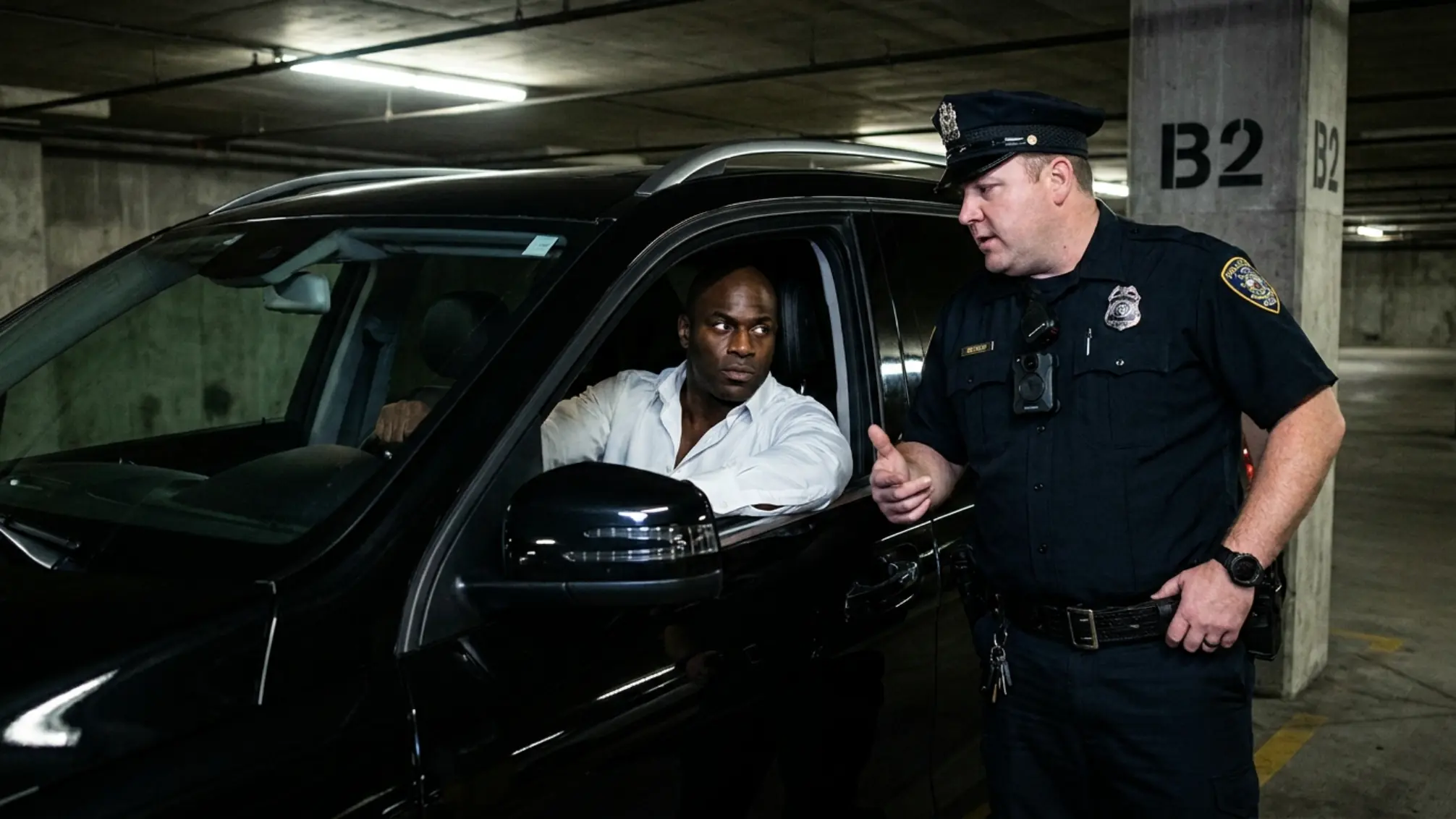
Marcus Kane remained behind the steering wheel, his broad shoulders relaxed beneath a crisp white dress shirt. Fluorescent lights flickered above the empty B2 level of the Atlanta office tower, reflecting in broken lines across the polished hood.
Marcus looked at Mercer’s hand.
“Take it off the holster before this gets worse.”
Mercer stepped closer until his body filled the window.
“You don’t threaten a cop down here. I can bury you before backup arrives.”
Marcus reached slowly inside his shirt and pulled out a leather credential case.
“Then call yours,” he said, opening it. “My federal team just sealed every exit.”
For one second, Mercer did not understand what he was seeing.
The badge was gold, clean, and unmistakable.
FEDERAL BUREAU OF INVESTIGATION
The officer’s expression changed so quickly that Marcus could see each stage separately: confusion, disbelief, calculation, and finally fear.
A heavy metal gate descended across the western exit.
Another slammed into place near the ramp leading to street level.
Red emergency lights began flashing above both lanes.
Mercer stepped away from the SUV.
“What is this?”
Marcus turned off the engine.
“This is the part where you stop pretending.”
Mercer’s eyes moved across the garage. Concrete pillars, parked vehicles, dark corners, and security cameras surrounded him. Until that moment, he had considered the underground level his safest hunting ground.
No pedestrians.
No passing traffic.
No neighborhood witnesses.
No visible patrol cameras beyond the body camera he controlled himself.
Now every shadow looked occupied.
“You set me up,” Mercer said.
Marcus opened the driver’s door and stepped out.
At forty-five, he was six feet three and built like a man who still trained daily despite spending most of his career behind reports, interviews, and surveillance screens. His deep brown skin caught the cold fluorescent light as he straightened beside the SUV.
“No,” he said. “You chose me.”
Mercer’s jaw tightened.
He had selected the vehicle because it looked expensive.
He had selected the driver because Marcus was Black, alone, and dressed well enough to possess money but not visibly powerful enough to make extortion dangerous. Those judgments had been part of Mercer’s method for nearly three years.
The FBI had spent eight months proving it.
The investigation began with a twenty-two-year-old college student named Jamal Bryant.
Jamal worked evenings at an upscale restaurant inside the office tower and parked on level B3. One night, he found Mercer standing beside his car, claiming a security dog had detected narcotics inside the trunk.
There was no dog.
Mercer told Jamal that a full search, arrest, and vehicle impound could be avoided for eight hundred dollars. Jamal had only three hundred in cash. Mercer took it, photographed his driver’s license, and warned him that reporting the incident would turn a “minor misunderstanding” into felony possession.
Jamal remained silent for six weeks.
Then Mercer stopped him again.
This time, the demand was twelve hundred dollars.
Jamal recorded part of the conversation on his phone, but fear caused him to lower it before Mercer stated the amount clearly. The recording contained threats, yet no visible badge number and no proof that money changed hands.
Atlanta police opened an internal inquiry.
Mercer denied everything.
He claimed Jamal had become hostile after receiving a lawful parking citation. His body camera footage began only after the conversation ended and showed Mercer speaking calmly while Jamal looked frightened and angry.
The department classified the complaint as unsubstantiated.
Three months later, a hospital administrator named Dr. Aisha Reynolds reported a nearly identical encounter. Mercer accused her of carrying prescription medication without documentation and demanded fifteen hundred dollars to “resolve the matter privately.”
She refused.
Mercer searched her car and produced a small plastic bag containing white powder.
A laboratory later identified it as crushed aspirin.
The bag carried no usable fingerprints.
Mercer claimed he discovered it beneath the passenger seat.
Aisha spent fourteen hours in custody before prosecutors declined charges.
Her professional reputation survived, but the humiliation did not disappear. Security footage showed Mercer approaching the passenger side of her car before activating his body camera, yet the angle did not reveal what he had done.
Internal Affairs reopened his file.
Five more complaints surfaced.
Every complainant was Black or Latino.
Every encounter occurred late at night inside a parking garage or isolated commercial lot.
Every victim was accused of possessing drugs, stolen property, or invalid identification.
Every incident ended in one of two ways: money disappeared, or suspicious evidence appeared.
Mercer always controlled the beginning of the recording.
The FBI entered the case after one victim was an employee of a federal contractor and reported being threatened with exposure of confidential work information. Investigators suspected Mercer had accessed restricted databases to identify targets unlikely to report him.
Special Agent Marcus Kane led the task force.
At first, the evidence looked frustratingly incomplete.
Victims had inconsistent memories because fear distorted details. Cash transactions left no electronic trail. Mercer’s reports were carefully written and supported by body-camera footage beginning at precisely the moment he wanted official documentation to start.
He had turned procedure into camouflage.
Marcus understood that proving isolated misconduct would not be enough. The task force needed to reveal the entire pattern: selection, pressure, threat, demand, and attempted concealment.
They began watching Mercer.
He worked overnight security details around luxury hotels, medical complexes, and office towers. He volunteered for parking-garage patrols other officers considered boring. He frequently deactivated his body camera, explaining later that battery problems or accidental button presses caused the gaps.
His bank accounts showed no unexplained deposits.
But his younger brother, Kyle, purchased a fishing boat, paid off credit-card debt, and made repeated cash deposits below federal reporting thresholds.
Kyle had no steady employment.
Agents discovered that Mercer met him twice each month behind a storage facility outside Decatur.
The task force still needed direct evidence.
Marcus proposed becoming the target.
His supervisors objected immediately.
“You’re too recognizable,” Assistant Special Agent in Charge Elena Torres told him.
“To Mercer?”
“To local law enforcement. If one officer recognizes you, the operation collapses.”
“Then choose a garage where he works alone.”
“He may search you.”
“He can search the vehicle.”
“He may become violent.”
“That is why the team will be close.”
Elena studied him across the conference table.
“You are personally invested in this.”
Marcus did not deny it.
Twenty-six years earlier, when he was nineteen, a police officer stopped him outside a convenience store in Savannah. The officer accused Marcus of matching the description of a robbery suspect, though the actual suspect was nearly twenty years older and six inches shorter.
Marcus complied.
The officer pushed him against a wall, emptied his pockets, and repeatedly asked where he had hidden the weapon. When Marcus objected, the officer threatened to charge him with resisting arrest.
Nothing was found.
Marcus was released without apology.
The encounter lasted seventeen minutes.
It influenced the rest of his life.
He joined the FBI not because he believed every officer was corrupt, but because he understood how much damage one dishonest person could commit while protected by a legitimate badge.
Elena finally approved the operation.
The task force rented a luxury SUV through a front company. Technicians installed six hidden cameras, three microphones, a remote door-control system, and a concealed transmitter beneath the dashboard.
An evidence technician placed a sealed envelope containing two thousand dollars inside the center console. Every bill was photographed and treated with invisible ultraviolet powder.
Marcus’s background for the operation portrayed him as a private investment consultant visiting the office tower after hours. Parking records, building access logs, and a temporary company profile supported the story.
The team leaked information through a source Mercer trusted.
A wealthy out-of-town businessman.
Alone.
Driving a luxury SUV.
Expected to leave after ten.
Mercer took the bait.
At 10:14 p.m., Marcus entered the garage.
He parked near pillar B2, stepped out briefly, then returned to the driver’s seat and waited. A surveillance van monitored the transmission from across the street. Four agents occupied unmarked vehicles on neighboring levels.