“Don’t Be Afraid, I’ll Save You,” Grandma Told Four Chained Bikers
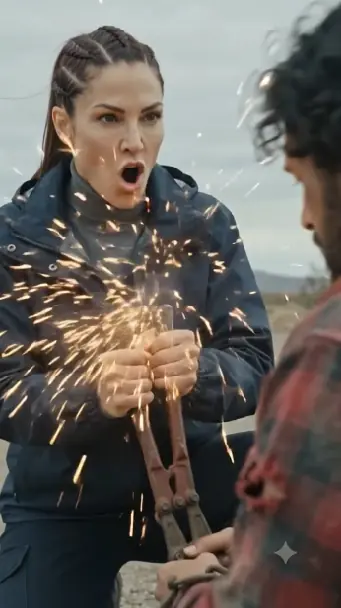
"Don't be afraid," the old woman said, kneeling in the gravel beside four massive chained men who could have snapped her in half with one hand. "I'll save you." She wasn't a cop. She wasn't armed.
She was 74 years old with bad knees and a dead husband's toolbox. The bolt cutters were heavier than she remembered.
Evelyn Harper hadn't opened her late husband's toolbox in almost three years. She told herself she was keeping it for sentimental reasons—the old red Craftsman box that Earl had dragged around every repair job from 1971 to the year he died. But the truth was simpler than that. She couldn't bring herself to touch anything that still smelled like him.
The grease embedded in the metal, the faint ghost of his work gloves, the scratch along the left side where he dropped it the morning their daughter was born because he was so nervous he couldn't hold on to anything straight. She hadn't cried when she lifted it out of the truck bed that afternoon. She was too focused to cry.
The four men chained behind the abandoned repair shop weren't moving much when she got back. The biggest one, the one who had told her to leave, watched her return with something in his eyes she couldn't immediately name.
It wasn't quite disbelief. It was closer to the look a man gets when he's been underwater so long he's stopped expecting the surface, and then suddenly something brushes his hand.
"Ma'am," his voice was a wreck, cracked and low like gravel dragged across dry wood. "What are you doing?"
"What does it look like?" Evelyn set the toolbox down on the packed earth beside him, her knees protesting with the familiar sharp complaint she'd learned to mostly ignore. She unlatched the lid and found the bolt cutters exactly where Earl had always kept them—right side bottom, handle facing up. The man knew how to organize. She'd give him that, even from the grave.
"Those chains are thick," the man said.
"I can see that."
"You won't be able to cut them."
She looked at him over the top of the toolbox. Seventy-four years of life had given Evelyn Harper a particular kind of look—not mean, not sharp, but absolutely, completely unimpressed by people who underestimated her. Her granddaughter called it the grandmother stare. Her late husband had called it terrifying.
"I've been cutting through things people said were impossible my whole life," she said. "You just sit still and let me work."
The man opened his mouth, closed it, and sat still.
The first chain was wrapped around his wrists, thick iron links of the kind used to secure farm equipment. Evelyn had to position the bolt cutter jaws three times before she found the right angle. Her hands were not young hands; they'd done decades of ranch work, shop work, years of kneading bread and ringing out laundry before machines made that obsolete. But they shook now in a way they hadn't ten years ago, and she hated that.
She bore down with everything she had. The chain groaned, but didn't break.
"Try further toward the lock," the man said quietly. "The links are thinner there."
She repositioned and bore down again. The snap of breaking metal was the best sound she'd heard in months.
The man sucked in a breath so deep it was almost a sob. He pressed his freed wrists against his chest, and Evelyn didn't look at his face because she understood intuitively that he needed a moment to have whatever private feeling was moving through him without an audience.
"Thank you," he said once he had himself back together.
"I'm not done yet," she replied and moved to the next man.
His name, she would learn later, was Ryan Whitman. He was 38 years old, had three daughters back in Billings, and a day job managing a logistics warehouse that most of his employees knew nothing about because the leather vest he wore on weekends told a story that complicated the one in his employment file. He had sandy hair matted with sweat and dried blood along his right temple from where someone had hit him during the attack. And when Evelyn got his hands free, he looked at her with an expression so raw it made her chest hurt.
"How long have you been here?" she asked, working on his ankle restraints.
"Two days," he said, "maybe a little more. We lost track of time."
"Two days in this heat." She said it flatly, not as a question, because the math wasn't complicated. Montana summer, no shade worth speaking of, no water. Four men chained to the back wall of an abandoned building on a highway that saw maybe a dozen cars a day. "You should be in a hospital."
"We're okay."
"You're dehydrated and you've got heat exhaustion at minimum." She cut through the ankle chain with considerably less trouble than the wrist restraints. The links were thinner there, just like the big man had suggested. "There's water in the cab of my truck. I want all of you drinking as soon as I get these off."
Ryan Whitman looked at her for a long moment. "Why are you doing this?" he asked. It wasn't an accusatory question. It was genuine, almost childlike in its directness, the way exhausted people sometimes drop all their social armor and just ask the thing they actually mean.
Evelyn sat back on her heels, thought about it honestly the way she always thought about questions people deserved a real answer to. "Because you're here," she said, "and you needed somebody."
She moved to the next man. Nathan Grayson was younger, 26, though she wouldn't know that until later. He had dark hair and a beard that had grown wild during the two days, and he was the quietest of the four, watching everything with careful dark eyes. He didn't speak while she worked on his chains. But when his hands came free, he looked at them for a long moment like he was relearning something basic, and then he looked up at her and said, "My grandmother used to say the Lord sends help in the shapes we least expect."
Evelyn made a sound that wasn't quite a laugh, but was close enough. "Your grandmother sounds like a smart woman."
"She was," Nathan said. "She died two years ago."
"I'm sorry."
"She would have liked you."
Evelyn moved to the last man. Derek Morrison was the largest of the four, wide across the shoulders in a way that suggested his body had been built by work rather than vanity. He'd said nothing since her return, watching with the contained weariness of someone who'd learned that offers of help rarely came without a price. His chains were the heaviest. The locks were older, more rusted, and it took Evelyn four attempts at different angles before she found purchase.
"You can ask," he said finally while she was working.
"Ask what?"
"Whatever you're trying not to ask." He watched her face. "People always have something they want to know. Usually it's whether we're dangerous, or why we live the way we do, or whether the stories they have heard are true."
Evelyn kept cutting. "That's their question, not mine."
He was quiet for a moment. "What's your question, then?"
She looked up at him briefly. "What do you take in your coffee?"
He blinked. "What?"
"I've got a thermos in the truck. It's black, but I've got sugar packets in the glove compartment. I can't do much about the lack of cream out here, but I'm asking so I know what to offer."
Derek Morrison stared at her, and then something happened in his face that she suspected didn't happen often. The hard outer shell of a man who'd spent years making himself unreadable cracked open just slightly, just enough to show something underneath that was younger, less armored, and entirely human.
"Black's fine," he said quietly.
"Good. Me, too." She cut through the last chain. "Earl always said adding milk to good coffee was like adding water to good whiskey. Destroys the point entirely."
"Earl, your husband?"
"Was. He passed four years ago."
"Sorry for your loss."
"Thank you." She helped him find his footing, which he didn't strictly need but seemed to appreciate as a gesture. "He would have liked you boys. He had a thing for people everybody else thought were trouble."
She got them to the shade first. The western wall of the repair shop caught a pocket of shadow in the late afternoon, and she had them sit there while she made three trips to the truck for water bottles, the thermos, and the paper bag of gas station sandwiches she'd bought in town that morning for reasons she couldn't have explained at the time beyond a vague instinct that the day might run long.
Marcus—she'd finally learned his name from one of the others—sat with his back against the wall and drank two full bottles of water without stopping. Then he sat quietly with his eyes closed for a long moment, and Evelyn gave him that time without filling it with words. Around them, the heat sat on the landscape like something solid. The highway beyond the building was empty in both directions. Somewhere distant, a hawk made slow circles over something it had found.
It was Ryan who asked what she was doing out here in the first place.
"This is my shop," she said simply.
"Yours?"
"Mine and my husband's. We ran it for 33 years. Roadside repair mostly. Travelers who broke down, truckers who needed a fast fix to make a deadline. We kept the lights on until Earl got sick, and after he passed, I couldn't quite bring myself to sell it." She looked at the building with the complicated expression of someone who has made peace with something without exactly finishing their argument with it. "I come out here most weeks just to think."
"You come out here alone," Marcus said, "every time. That's not safe."
She almost smiled. "I spent 30 years running a shop on an empty highway. I think I understand the risks."
"Those risks didn't include people being chained to your building."
"No," she agreed. "That's new."
The silence stretched, comfortable enough in the way that silences between people sharing something difficult sometimes become. The men ate the sandwiches without comment, which Evelyn appreciated. She'd never understood people who talked constantly through meals. Earl had been a quiet eater, too. It was one of the first things she'd loved about him.
Marcus finished his sandwich, folded the wrapper carefully—a fastidious habit surprising in a man his size—and turned to look at her directly. "You need to know what you've walked into," he said.
"Tell me, then."
The story came out in pieces, the way true stories always do, not clean and sequential, but layered, with the men adding details from different angles, correcting each other, occasionally circling back to things they'd initially glossed over.
They were returning from Cheyenne, a memorial ride of 500 miles organized across six chapters of the brotherhood to honor a brother named Tommy Briggs who had died in February—not violently, but from a sudden, stupid heart attack the way ordinary death sometimes ambushed people who'd survived a thousand things that should have been worse. Tommy had been with the club for 22 years.
"He had a daughter in college who was studying marine biology because Tommy had taken her to the ocean once when she was nine, and she'd never recovered from it," Marcus explained.
The ride home from Cheyenne had been clean for most of the road.