She stepped toward me.
I raised both hands.
“Do not touch me.”
She stopped.
The pain on her face was unbearable.
Good, I thought.
Let it hurt.
Let it destroy her too.
“Tell me everything,” I said. “And if you lie once, I walk out and you never see me again.”
Celia sank into the chair beside the table.
For a moment, she looked every one of her sixty years.
Then she began.
When she was twenty-three, Elena Salazar had worked in the accounts office of a packing company owned by Rogelio Valdés. She was married to my father, Mateo, and pregnant with me.
Rogelio had built his fortune through smuggling, extortion, and government contracts won with bribes. Elena discovered that his company trucks were transporting more than fruit. Hidden behind crates were weapons, cash, and occasionally people who had no papers and no choice.
She copied documents.
She planned to go to the authorities.
But one of Rogelio’s men saw her.
“They took me from the road outside town,” Celia said. “They told your father I had died of fever. They threatened to kill you if he searched.”
I could barely breathe.
“My father knew?”
“He knew I was alive.”
The room went silent.
“No.”
“He did not know where. But he knew the coffin was empty.”
I remembered his tears at the wedding.
His desperate grip on my arm.
You can still leave.
“Why did he say nothing?”
“Because Rogelio showed him photographs of you leaving school. Sleeping in your bed. Playing football behind the church. He told Mateo that every question would cost you a finger, then a hand, then your life.”
My stomach twisted.
“What happened to you?”
Celia looked toward the open balcony.
For years, Rogelio kept her in a house outside Guadalajara under another name. Not a prison with bars. Something worse. A beautiful house with locked gates, servants who never spoke to her, and guards who watched every window.
He forced her to help clean his accounts because she understood the business better than his own men.
Then he began presenting her as a distant cousin.
Later, as his companion.
By the time Rogelio’s wife died, Elena Salazar had disappeared completely.
Celia Valdés took her place.
“Why did you stay after he died?”
“I had nowhere to return.”
“You had me.”
Her face collapsed.
“I watched you from a distance.”
The sentence chilled me more than anything else.
“What does that mean?”
“I saw your school photographs. I paid your sister’s tuition anonymously. I bought the debt on your father’s store so the bank would not seize it. I arranged the municipal contracts that kept your repair business alive.”
Every small piece of luck I had ever trusted suddenly became contaminated.
“You manipulated my life.”
“I kept you alive.”
“You watched me grow up?”
“Yes.”
“And you never came to me?”
“I tried once.”
She described a Sunday when I was fifteen. She had waited outside the church in a blue car.
I remembered the car.
I remembered a silver-haired woman watching me across the plaza.
My father had dragged me away so quickly that I thought I had done something wrong.
“Mateo came to the hacienda that night,” Celia said. “He begged me to stay away. Rogelio’s organization had not vanished with his death. His partners were still watching me, still watching you. If they learned who you were, they could use you to force me to reveal the accounts and names I had hidden.”
“The men outside tonight.”
“Federal protection.”
I stared at her.
“The security?”
“Investigators. Some of Rogelio’s former associates recently learned that I had contacted prosecutors.”
“Why marry me?”
The question came out as a whisper.
Of all the horrors, that was the one I could not cross.
Celia bowed her head.
“Six months ago, I learned that I am dying.”
I said nothing.
“Cancer. Pancreatic. It has spread.”
The information struck, but there was no room left inside me to feel it.
“I had months, perhaps less. I wanted to tell you. I invited you here with the fountain as an excuse.”
“You could have said, ‘I am your mother.’”
“I was afraid.”
“So instead you let me fall in love with you?”
“At first, I believed your affection was the affection of a son who recognized something he could not name.”
My skin crawled.
“And when I told you I loved you?”
“I should have stopped it.”
“But you didn’t.”
“No.”
“Why?”
Her answer came slowly.
“Because after thirty-seven years of being dead to you, I became selfish.”
I wanted to hate her cleanly.
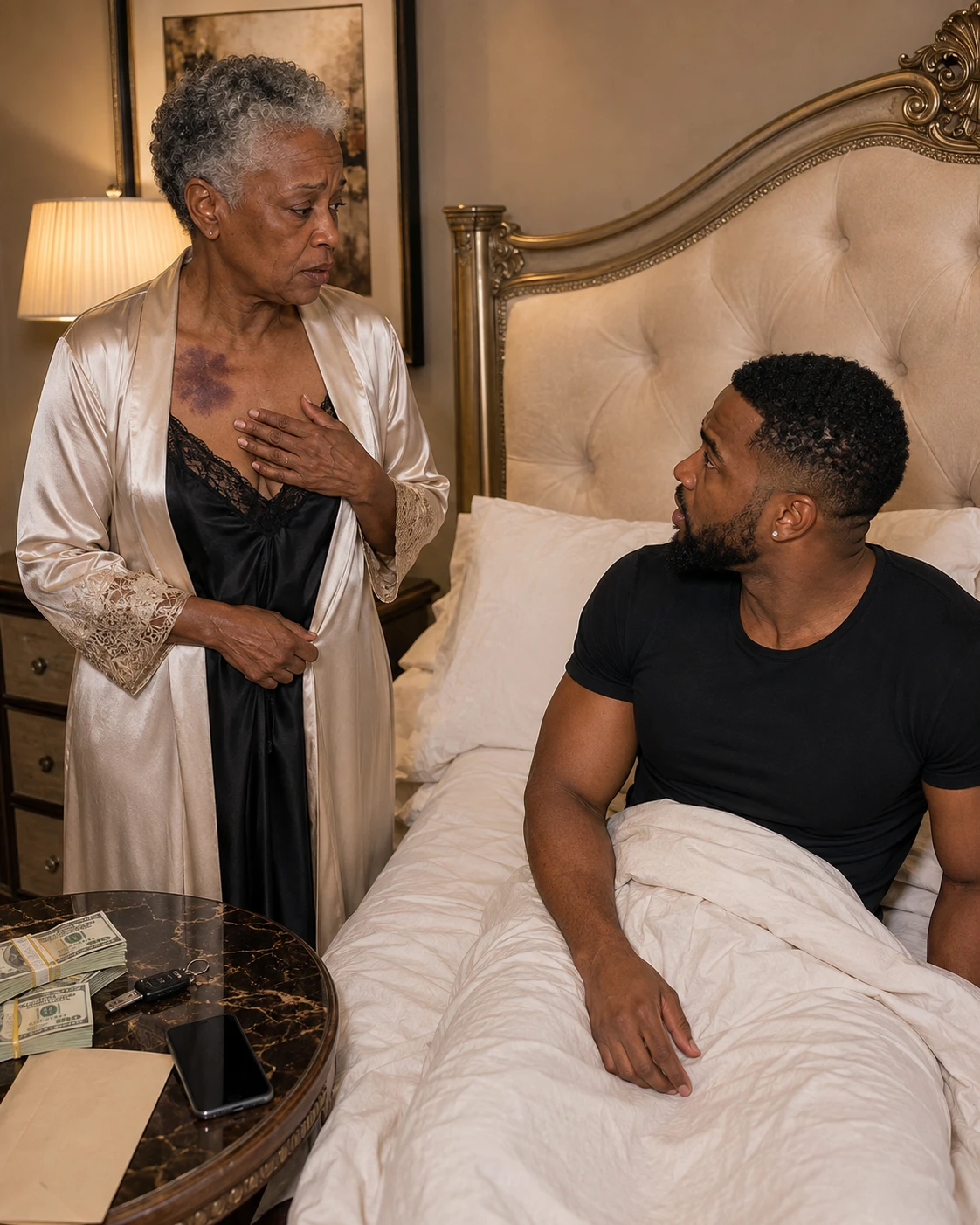
It would have been easier if she had been cold or calculating.
But she sat there with her hands clenched in her lap, looking like a woman who had survived too long and made one unforgivable choice because love and terror had rotted together inside her.
“I never planned to touch you as a wife,” she said. “I never planned for tonight. I believed I could bring you close, transfer everything to you, then tell you before the ceremony. But every day I delayed, the truth became more impossible.”
“You kissed me.”
“Yes.”
“You slept beside me.”
“I never crossed beyond what I could survive.”
“What you could survive?”
My voice rose.
“What about me?”
She wept silently.
I walked to the door.
Her chair scraped behind me.
“Efraín, wait.”
I turned.
“You have no right to ask me for anything.”