He Took a Beating for a Stranger. Twenty Motorcycles Brought Back the Secret His Family Had Buried
He Took a Beating for a Stranger. Twenty Motorcycles Brought Back the Secret His Family Had Buried.
The first time Caleb Mitchell put his life between a stranger and a raised boot, he was more afraid of losing his dishwashing job than of getting hurt.
That was the part people never understood afterward. They wanted courage to look clean and deliberate, like something a person chose after weighing the consequences. Caleb remembered only the greasy floor, the huge man struggling to breathe, and the sickening certainty that somebody had to move.
But that happened at four seventeen on a Thursday afternoon. At four sixteen, he was still counting quarters in his head.
The electricity bill was eighty-three dollars overdue. His mother needed a prescription refill. One of his bicycle tires had developed a slow leak, and he had discovered that if he pumped it before each trip, he could get almost all the way to the community college without stopping.
Almost was a useful word in Caleb’s life. Almost enough money. Almost enough sleep. Almost eighteen years old before he learned that being a good person did not automatically make the world gentler with you.
He had turned eighteen in February. His mother put a candle in a grocery-store muffin and sang in their trailer’s narrow kitchen, smiling so fiercely that he pretended not to see her crying.
Now, in September, the valley heat pressed against Dusty’s Diner like a hand over a mouth. The air conditioner rattled above the register. Arthur Pendleton stood behind the counter, sorting receipts through reading glasses repaired with electrical tape.
“You eat that sandwich I left you?” Arthur asked.
“On my break.”
“Your break was an hour ago.”
Caleb pushed a rag across a table. “Then I’m saving it for the anniversary.”
Arthur snorted. He was sixty-seven, broad through the middle, and had owned the diner long enough that nobody remembered who Dusty had been. He paid Caleb on time, let him take home unsold soup, and never asked why his mother sometimes stared at an envelope for an entire minute before opening it.
The bell over the door rang.
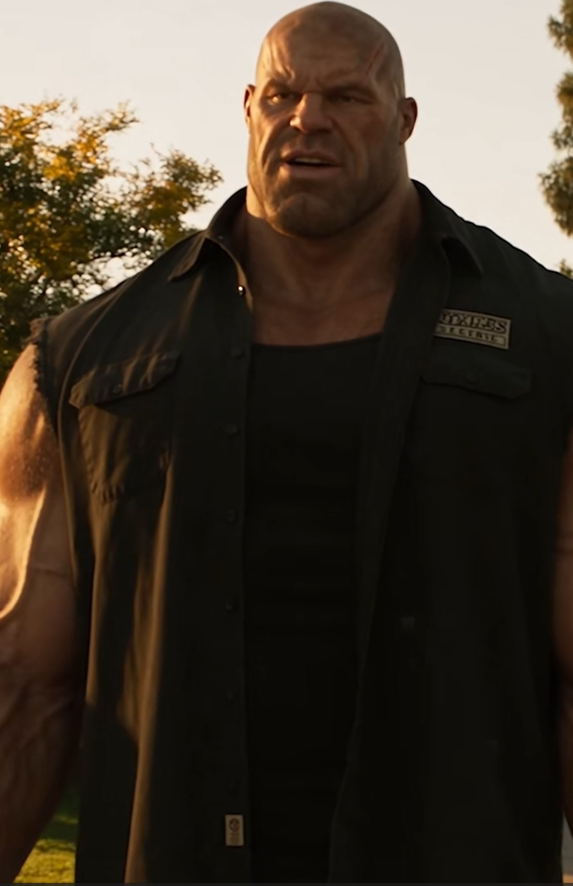
The man who entered was enormous, six-foot-five at least, with silver in his beard and shoulders that nearly filled the doorway. His black leather vest carried a Hells Angels patch. Caleb noticed the patch first because everybody did.
Then he noticed the man’s hands. They were shaking.
The stranger caught the edge of a booth and lowered himself into it with an awkward heaviness. Sweat ran down his temples. His face had the gray-white color Caleb remembered from the time his mother fainted outside a laundromat.
“Sir?” Caleb approached with a menu. “You okay?”
The man moved his lips. At first, nothing came out.
“Sugar,” he managed.
Caleb glanced at the little dispenser on the table, then understood. His mother had worked as a nursing assistant before a back injury reduced her to part-time laundry work. She had taught him that confusion and shaking could mean somebody needed help, not judgment.
“Arthur,” he called. “Can you come here?”
The bell rang again before Arthur could answer.
Troy Dawson entered wearing his red college jacket despite the heat. Greg came behind him, grinning at something on his phone. Liam followed with both hands in his pockets, already looking around to see who was watching.
Caleb’s shoulders tightened automatically.
Troy had been making his life smaller since middle school. A kicked backpack. A lunch dumped into a trash can. A photograph of Caleb’s shoes circulated with the caption EMERGENCY RELIEF FUND.
Teachers called it friction. Troy’s father called it boys being boys. Caleb had learned to call it nothing at all.
Troy spotted him beside the booth, then saw the biker.
“Well, look at that.”
The stranger tried to lift his head. One massive hand fumbled against his vest, searching for something.
Caleb stepped toward the counter. “I’m getting juice.”
Troy moved into his path.
“What’s the hurry?”
“He’s not feeling good.”
“Then he shouldn’t drink before dinner.”
Greg laughed. Liam gave a smaller laugh, the kind that waited for permission.
Troy slapped the table. The silverware jumped.
“What’s wrong, old man? Big tough biker forget how to ride?”
The stranger blinked slowly. Beneath the table, his boot scraped the floor as though he could not remember what feet were for.
Greg flicked the patch on his vest.
“Maybe he can buy us something.”
Arthur was already coming around the counter, but Caleb was closer. He stood with the damp rag hanging from his fist and felt his heartbeat hammering against his throat.
There were sensible things he could do. Move away. Let Arthur handle it. Keep the job his mother needed him to keep.
Then the stranger’s hand closed around empty air.
Caleb had seen that reach before: his mother, on the laundromat pavement, trusting somebody would be there.
“Leave him alone.”
Troy turned his head.
“What?”
Caleb’s voice shook. He hated that it shook, but the words came anyway.
“He’s sick. Leave him alone.”
Something changed in Troy’s face. Amusement drained away, leaving the flat hostility Caleb knew better than he knew most of his classmates.
“You giving orders now, busboy?”
Arthur raised a hand. “That’s enough, Troy. You boys need to go.”
Troy ignored him. He turned and shoved the biker’s shoulder.
The man slid from the booth with a heavy, helpless sound. His head struck the edge of the seat before he crumpled onto the floor. For one terrible second, nobody moved.
Then Troy drew his foot back.
Caleb lunged.
He hit Troy around the waist, all one hundred and forty pounds of him, and they crashed against the next table. A coffee cup shattered. Troy landed hard, surprised more than hurt, then rolled on top of him.
The first punch filled Caleb’s mouth with blood.
“You stupid little punk!”
Caleb tried to turn. A hand caught his shirt. Another blow flashed white across his sight.
Somewhere above him, Arthur shouted. A chair scraped. Greg’s sneaker came down near Caleb’s hand, and he pulled his fingers away just in time.
He could have curled into himself. He knew how; he had practiced that particular shape for years.
Instead, he dragged himself toward the fallen man.
The biker’s cheek rested against broken porcelain. Caleb slid his forearm beneath the man’s head and bent over him, both arms forming a clumsy shelter.
Something struck his ribs. Breath left him in a ragged grunt.
He stayed.
Behind the counter, Arthur had reached the telephone.
“Police are coming! Get away from him!”
Troy grabbed Caleb’s shoulder, trying to turn him. Caleb held on. He could smell leather and coffee.
“Stay here,” he whispered, though he did not know whether he meant the man or himself. “Just stay here.”
Sirens rose in the distance.
Troy released him. His scholarship, his father’s expectations, and the witnesses around him appeared to return to his mind all at once.
He backed toward the door.
“You’re dead, Mitchell. Watch your back.”
Then they were gone, leaving the bell swinging above an empty doorway.
Arthur knelt so quickly that his bad knee cracked.
“Caleb. Son. Can you hear me?”
“Juice,” Caleb said.
“The ambulance is coming.”
“For him. He said sugar.”
Arthur looked at the biker, whose eyes had closed, and stayed on the line with the dispatcher until the paramedics arrived.
Later, Caleb sat against a police cruiser with frozen peas pressed to his face. A paramedic had checked him, recommended further evaluation, and listened without approval when Caleb asked whether that would cost money.
Arthur finally said, “Get in the second ambulance or I’ll carry you.”
Before Caleb could answer, the doors of the first ambulance started closing. The biker, more alert now, turned his head.
Their eyes met. One enormous hand lifted from the stretcher.
It wasn’t quite a wave. It looked like a promise made by someone who did not yet have enough strength to speak.
At the hospital, Caleb learned the man’s name was Joseph Callan, though everyone called him Bear. He learned that Bear’s blood sugar had fallen dangerously low and that the interruption in the diner could have had a very different ending.
He also learned that bruised ribs could hurt more than anything he had imagined without being broken.
His mother arrived wearing her laundry uniform, her hair coming loose from its clip. She stopped in the doorway when she saw his face.
“Mom,” he said quickly. “I’m okay.”
Rachel Mitchell crossed the room and touched the uninjured side of his cheek with two fingers.
“Don’t do that,” she whispered.
“Do what?”
“Tell me you’re okay because you’re afraid I can’t bear it.”
He looked down at the blanket.
She sat beside him, still wearing the plastic badge from work. Her hands smelled of detergent. There were pale scars across two knuckles, old injuries Caleb had never asked much about.
Arthur stood near the door while an officer took another statement. When Troy’s name came up, Rachel’s fingers tightened around Caleb’s.
The officer noticed. “You know the family?”
“Everybody knows the Dawsons,” she said.
That wasn’t an answer, but it was the only one she gave.