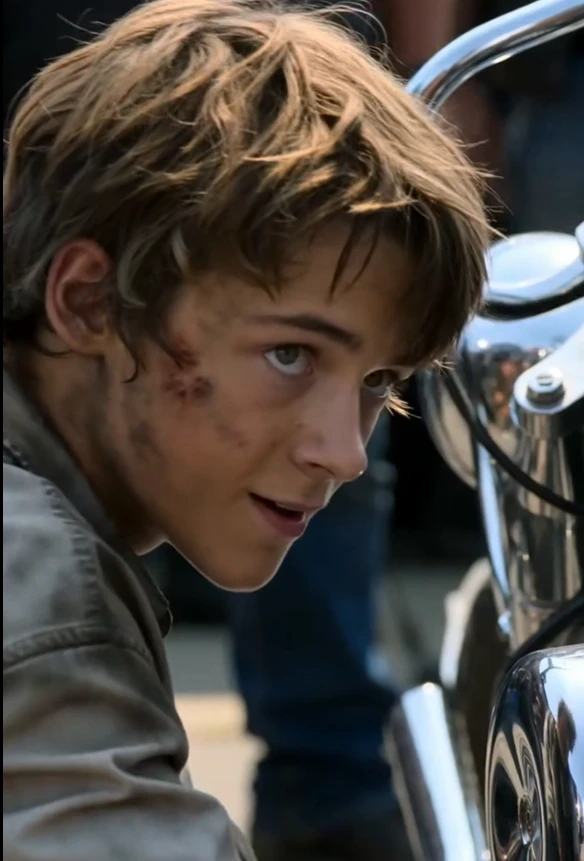
He did not make a sound.
“Clock’s ticking, boy. Crawl position is waiting.”
Vince cracked his knuckles behind Owen. Two other bikers moved closer, flanking him on both sides, arms crossed, shadows falling over the engine.
Not helping.
Hovering.
Waiting for the moment they would get to drag this kid across the parking lot on his hands and knees.
The crowd pressed in tighter.
Phones everywhere.
Sixty screens glowing in the evening heat.
Livestream viewers climbing.
Two hundred.
Five hundred.
A thousand.
Comments flooded in.
This kid is toast.
Hells Angels are going to eat him alive.
No way he fixes that in five minutes.
Somebody call this boy’s mama.
Owen blocked it all out.
Every voice.
Every laugh.
Every camera flash.
He picked up the half-inch Craftsman, his father’s wrench, the one with the chip on the jaw, and positioned it on the first bolt of the cam cover.
His hands were not shaking.
His breathing was even.
His eyes were locked on that engine like nothing else in the universe existed.
Eleanor Graves uncrossed her arms.
She recognized something in the way Owen held that wrench, the angle of his wrist, the pressure of his fingers, the way he braced his elbow against the cylinder for leverage.
Textbook form.
No.
Better than textbook.
Instinct.
She took out her phone, not to record, but to time him herself.
Three minutes and thirty seconds remained.
Owen took one breath.
Then he began.
The first bolt came off in three seconds.
Owen’s fingers moved with a precision that did not belong to an eighteen-year-old. The cam cover lifted clean. No fumbling. No hesitation.
Like he had opened this exact engine a thousand times.
Underneath, the timing chain sat exposed.
A long loop of roller chain wrapped around the cam sprocket and the crankshaft sprocket, connecting the top and bottom halves of the engine’s breathing system.
On a healthy Shovelhead, the chain would be taut, aligned, every link seated perfectly on every tooth.
This one was not.
Owen pointed his flashlight at the cam sprocket.
Two teeth off.
The chain had slipped forward by exactly two positions.
Subtle.
Almost invisible.
On a modern engine, a sensor would catch it. But on a 1972 Shovelhead with mechanical points, there was no sensor, no warning light, no error code.
Just an engine that refused to fire because the valves were opening and closing milliseconds off.
Enough to kill compression entirely.
“Timing chain slipped two teeth,” Owen said.
Not to Garrett.
Not to the crowd.
To himself, the way his father used to talk through a diagnosis out loud.
He loosened the cam sprocket bolt, rotated the sprocket backward by hand two clicks, felt the chain seat into position, tightened the bolt, and checked the tension with his thumb.
He pressed the chain midway between sprockets and measured the deflection by feel.
Twelve seconds.
The whole repair took twelve seconds.
Dale Prescott stood at the edge of the crowd.
His face went white.
Thirty minutes with a four-thousand-dollar scanner, and he had missed it completely.
Because scanners do not read mechanical timing on points-ignition engines. They search for electronic signals that do not exist on a 1972 Shovelhead.
Owen found it with his ear and confirmed it with a two-dollar flashlight.
“That’s one,” Owen said.
Garrett glanced at Vince, then back at Owen.
“Lucky guess. Even a blind squirrel finds a nut.”
Then he barked louder, making sure every phone in the lot picked it up.
“Hey, rat. One lucky poke doesn’t make you a mechanic. My dead grandmother could have knocked that chain back if she tripped over it. You want a cookie? You want me to clap for you?”
He slow-clapped, loud and mocking.
The crowd joined in.
Sixty pairs of hands beating a rhythm designed to humiliate.
“Clap louder, boys. The car wash kid fixed one thing. Somebody call the news. Alert the president.”
Vince grabbed Owen’s shoulder and spun him around.
“You got lucky once, Roach. Touch that engine again, and I’ll snap that wrench in half and feed it to you.”
Owen turned back to the bike without a word.
He pulled the carburetor bowl off with four quick turns of a Phillips screwdriver.
Inside, the float, a small brass pontoon controlling fuel level, was supposed to ride freely, opening and closing a needle valve to regulate gasoline entering the carburetor throat.
This float was stuck, jammed fully open by a microscopic piece of debris.
A flake of old gasket material wedged between the float arm and the bowl wall.
With the needle valve permanently open, fuel poured in nonstop. The cylinders flooded. Raw gasoline pooled on top of the pistons.
A flooded cylinder cannot compress.
It hydraulic locks.
Even if the timing had been perfect, the engine would never have fired.
This was Nolan Briggs’s mistake.
He had pulled the carburetor apart, cleaned every jet, checked every gasket, but he never tested the float under load.
On a Keihin butterfly carburetor from that era, the float does not look stuck unless you press exactly the right spot, exactly the right way.
Owen pressed.
Index finger on the pivot point.
Gentle push at fifteen degrees off axis.
The debris flake popped free.
The float dropped to neutral.
The needle valve clicked shut.
Owen held up the flake between his thumb and finger.
Smaller than a grain of rice.
“This is why she flooded. Float stuck open. Fuel pouring straight through.”
Nolan Briggs shoved through the crowd, face twisted.
Not anger.
The specific shame of a specialist watching his reputation dissolve in public.
“I checked that float. I checked it twice.”
“You checked it assembled,” Owen said, without malice. “The debris only shows at fifteen degrees off axis. Known defect on pre-1974 Keihin units. Harley issued a technical service bulletin in 1978. Bulletin number HD-78-041.”
The crowd murmured.
A bulletin number from memory.
From a kid who could not afford new shoes.
Garrett stepped in fast and jabbed his finger into Owen’s chest so hard Owen rocked backward.
“So you memorized a number. My grandmother memorizes bingo numbers. Doesn’t make her an engineer.”
“Two down,” Owen said, like he had not felt a thing.
Garrett’s face flushed dark red.
“Two lucky finds don’t make you special, boy. They make you a freak who got lucky twice.”