HOA Karen Sold Access to a Homeowner’s Private Pool — Then He Locked Every Code She Had Sold
The first access code failed at 11:03 on a Saturday morning.
A mother carrying two striped beach towels punched six digits into the keypad beside the tall white pool gate, waited for the familiar green flash, and received a red light instead.
She frowned.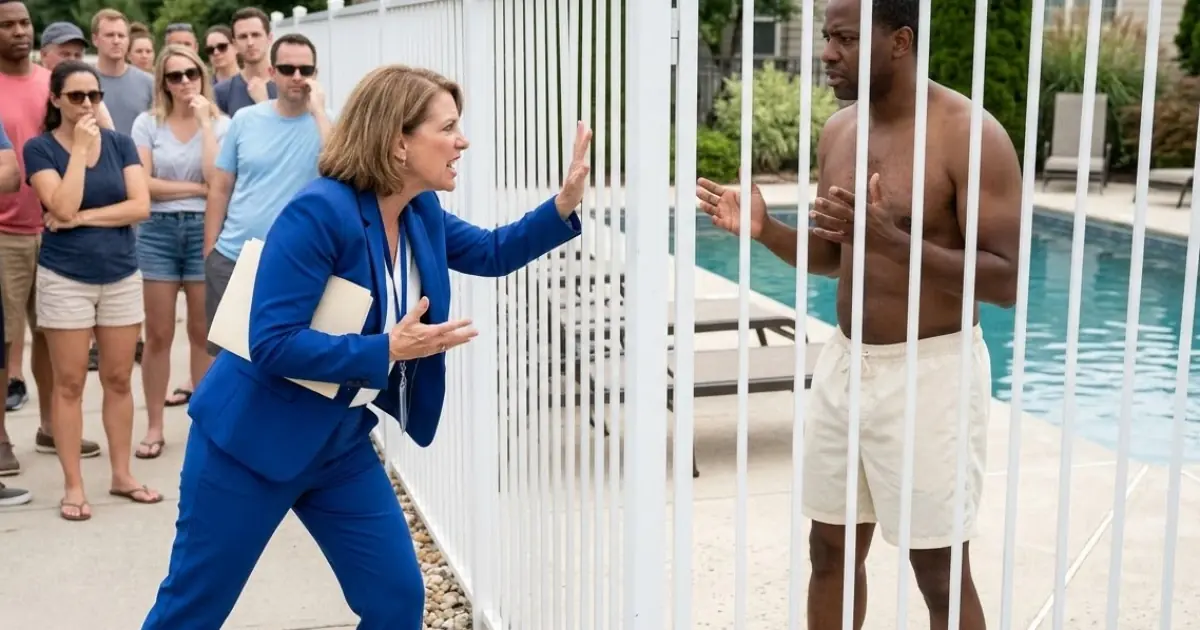
Tried again.
Red.
Her two children stood behind her in flip-flops, one hugging a lime-green inflatable ring almost as large as his body.
“Mom?”
“Hold on.”
She entered the number a third time.
Nothing.
By 11:06, four more families had joined her.
By 11:12, there were fifteen people gathered along the walkway.
By 11:20, there were nearly thirty.
Coolers.
Towels.
Foam noodles.
Inflatable loungers.
Sunscreen bags.
A portable speaker.
Several laminated cards printed with the words Summer Recreation Access.
Everyone had paid.
Everyone had been told the same thing.
The pool behind the fence belonged to the neighborhood for the summer.
And everyone had been given a code that had worked before.
Inside the gate, standing barefoot beside the turquoise water in plain cream swim trunks, the Black homeowner watched the crowd grow.
He was forty-two, tall and athletic, with deep-brown skin, close-cropped black hair, and the calm expression of a man who had already spent three days being told that protecting his own property somehow made him unreasonable.
His phone rested in one hand.
The smart-lock administration screen remained open.
At 10:47 that morning he had pressed one button.
Deactivate all third-party credentials.
Eighty-three access codes had vanished at once.
The only active credentials now belonged to him, his family, his pool-service company, and the emergency code stored with the fire department.
Nobody else.
Especially not the HOA President.
The crowd did not know that yet.
They only knew the codes they had purchased were dead.
Then she arrived.
The HOA President came down the walkway wearing a cobalt-blue pantsuit over a white blouse despite the Florida heat, sunglasses pushed on top of her short blonde bob, a brown leather folder tucked beneath one arm.
She moved quickly.
People parted for her.
Relief moved through the group.
“There she is.”
“Thank God.”
“Something’s wrong with the gate.”
“My code worked Thursday.”
“We paid for the whole summer.”
The HOA President did not answer them immediately.
She went straight to the gate.
Saw the Black homeowner inside.
Stopped.
The two stared at each other through the white metal bars.
He said nothing.
She pointed toward the keypad.
“What did you do?”
The homeowner glanced at the families behind her.
Then back.
“I secured my property.”
The HOA President’s mouth tightened.
“Open the gate.”
“No.”
A murmur moved through the crowd.
The President stepped closer.
“These residents paid for lawful summer access.”
“Not to me.”
“They paid through the association program.”
“Then the association can provide the pool it owns.”
Her cheeks flushed.
“You know perfectly well the community pool is closed.”
“I do.”
“And the board approved temporary recreation access here until repairs are complete.”
“No, it didn’t.”
The Board Treasurer, standing several people back with a towel around his neck, frowned.
The President ignored him.
She pushed her sunglasses higher.
“This is not the place to replay our disagreement.”
The homeowner almost smiled.
“You brought forty people to my backyard.”
“You made it the place.”
A woman beside the Treasurer whispered:
“Wait, this is actually his pool?”
The HOA President heard.
She turned.
“It is part of a temporary shared-use agreement.”
The homeowner lifted his phone.
“No agreement exists.”
The President turned sharply toward him.
“I have the document.”
“You have a forgery.”
The crowd went quiet.
That word changed everything.
The President recovered quickly.
“You need to be very careful.”
“So do you.”
She stepped toward the gate and pressed the call button.
Nothing happened.
She pressed again.
Then tried a six-digit code.
Red.
Her face changed.
The homeowner watched.
“You killed my administrative code.”
“I killed every code you generated.”
“You had no authority to do that.”
He stared at her.
“It’s my gate.”
The absurdity of the exchange reached the crowd before it reached her.
Someone laughed once.
Nervously.
The President slapped one palm against the metal bars.
“Open this immediately.”
“No.”
She shoved the gate.
It did not move.
“Open it.”
“No.”
Her voice rose.
“These people paid hundreds of dollars because this neighborhood needed a solution after the main pool failed.”
The homeowner’s expression remained calm.
“You sold access to something you didn’t own.”
“I acted on behalf of the community.”
“You acted without permission.”
“You were barely using it.”
There it was.
Several people shifted uncomfortably.
The homeowner looked at her.
“My use is not the measure of my ownership.”
The President pulled one laminated card from her folder and threw it through the bars.
It landed on the pale stone pool deck near his feet.
“There.”
“That card represents a paid summer membership.”
The homeowner looked down.
Then back.
“To my backyard.”
“To temporary recreational access.”
“To my backyard.”
She opened her mouth.
A middle-aged man behind her—the Board Treasurer—was already looking at his phone.
He had been quiet for most of the confrontation.
Now his expression changed.
He scrolled.
Then again.
The woman beside him asked:
“What?”
The Treasurer ignored her.
He stepped toward the President.
“Where did the money go?”
She turned.
“What?”
“The pool passes.”
She looked irritated.
“Into the recreation program.”
“I’m looking at the HOA accounts.”
“This is not the time.”
“Where did the money go?”
The crowd quieted again.
The President stared at him.
The Treasurer lifted the phone.
“There isn’t one deposit.”
Her eyes flicked toward the screen.
He continued.
“No summer recreation income.”
“No temporary pool-access income.”
“No new escrow account.”
“Nothing.”
The homeowner stood motionless behind the gate.
He already knew.
The Treasurer did not.
Not completely.
The President said:
“The payments were processed separately.”
“Through what?”
“A temporary merchant account.”
“Authorized by whom?”
“The executive committee.”
“I am the Treasurer.”
Her voice hardened.
“You do not oversee every operational detail.”
“I oversee money.”
Someone in the crowd lowered a cooler.
The Treasurer stepped closer.
“How much did you collect?”
The President looked around.
“This discussion is inappropriate.”
The Treasurer asked again.
“How much?”
A man holding a blue inflatable raft said:
“My family paid four hundred fifty.”
A woman near the back raised her phone.
“Same.”
“Three hundred for me.”
“Five hundred fifty, family plus guests.”
“My parents paid three hundred.”
Voices started overlapping.
The Treasurer looked at the President.
She looked toward the locked gate.
For the first time that morning, she no longer appeared angry at the homeowner.
She looked afraid of the crowd behind her.
The homeowner bent, picked up the laminated card she had thrown, and held it between two fingers.
On the bottom was a QR code.
He had scanned one the previous evening.
It did not lead to the HOA website.
It led to a payment page registered to a private company.
A company nobody on the board had approved.
He looked at the Treasurer.
“You should probably ask who owns Bluewater Community Services.”
The President’s face went white.
The Treasurer stopped.
“What?”
The homeowner held his gaze.
“Bluewater Community Services.”
“That’s where the payments went.”
The Treasurer looked at the President.
She said nothing.
He searched on his phone.
Thirty seconds later, his mouth opened.
The business registration was public.
Manager:
The HOA President.
The crowd turned.
Not all at once.
But fast enough.
And for the first time since she had begun selling access to a Black man’s private pool, the HOA President had nowhere to hide behind the word community.
Three weeks earlier, none of them had known there was anything to hide.
The homeowner had purchased the house five years before.
It sat at the end of a curved street inside one of the newer sections of Palmetto Preserve, a master-planned neighborhood a few miles inland from Florida’s Gulf Coast.
The property was unusual.
Most houses in Palmetto Preserve had modest screened patios.
His had a full private courtyard.
Large pool.
Small spa.
Covered outdoor kitchen.
Tall white privacy fencing concealed by palms.
The house had been built as a developer’s model before the neighborhood HOA formally took control.
The private pool appeared clearly on the original deed documents.
So did a recorded declaration stating that the pool, deck, pump house, gate, and associated structures were part of the residential parcel and were not common elements.
The homeowner had read that language before buying.
Twice.
Then paid a real-estate attorney to read it again.
He had learned young that expensive paperwork only protects people who understand what it says.
His parents had never owned much.
His father drove city buses for thirty-one years.
His mother worked payroll for a medical supply company.
They raised three children in a small house where the backyard was mostly clay, weeds, and one stubborn pecan tree.
There had been no pool.
Swimming happened at the municipal recreation center.
When he was nine, his father tried to take him to a private swim club as the guest of a coworker.
They were stopped at the front desk because the guest policy had mysteriously changed that morning.
His father never called it racism in front of him.
He simply said:
“They don’t want us here.”
They went home.