HOA President Forged A Bill Of Sale To Take His Classic Camaro For Her Son — Then The Officers Stepped Out And Saluted Him
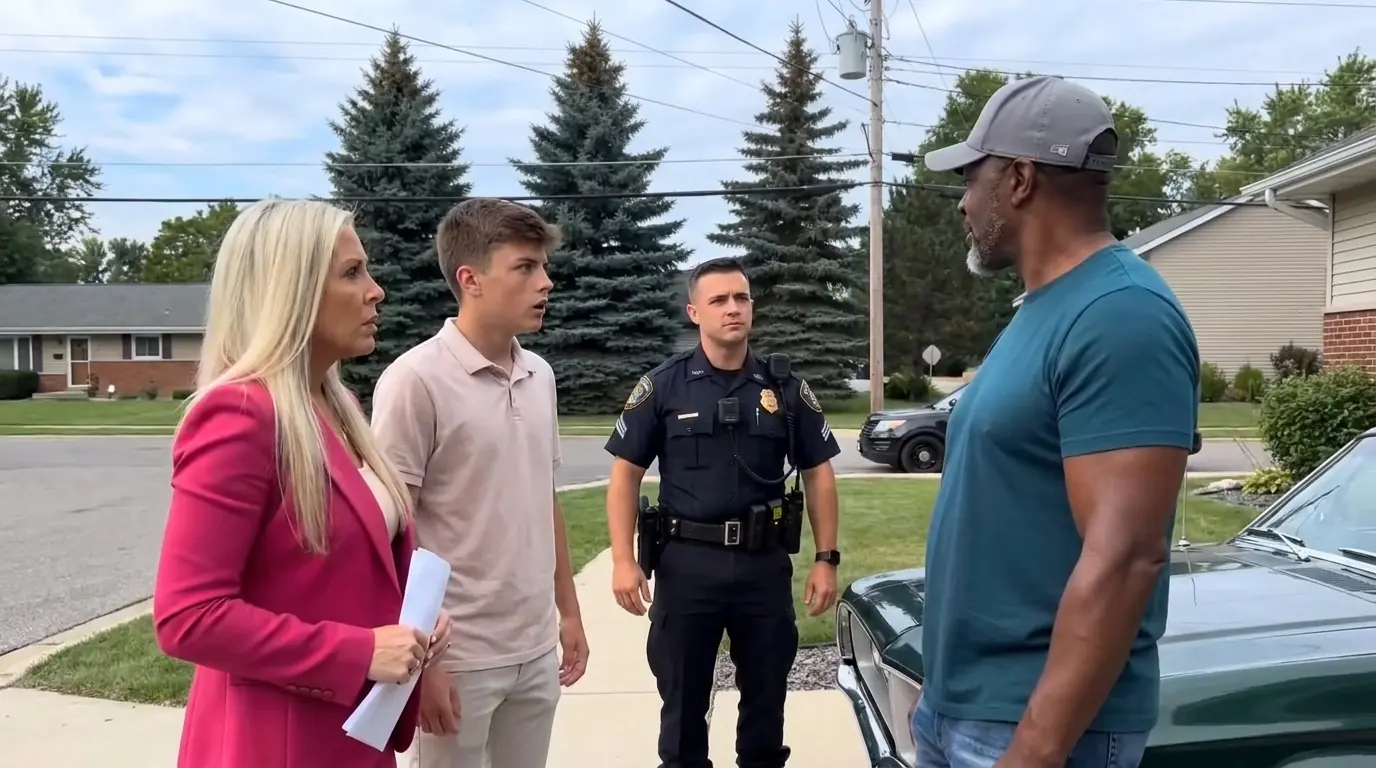
Evelyn Mercer crossed the cul-de-sac holding a sheet of paper over her head like she had just won a court case. Behind her walked her twenty-year-old son, Tyler, wearing mirrored sunglasses and the satisfied grin of someone who had already decided where he was driving that night. Fifty-nine-year-old Walter Hayes watched them approach while slowly polishing the chrome trim on his black 1969 Chevrolet Camaro SS. When Evelyn stopped beside the car and said, “Step away from Tyler’s vehicle,” Walter lowered the microfiber cloth and looked at her for several seconds before asking whether she had finally lost her mind.
Evelyn smiled and pushed the paper against his chest. It was titled MOTOR VEHICLE BILL OF SALE, and beneath the heading were Walter’s full name, the Camaro’s VIN, a purchase price of $32,000, and Tyler Mercer listed as buyer. At the bottom sat a signature that looked enough like Walter’s to fool someone who had only seen it once or twice. Walter studied the page, then looked at Evelyn and said quietly, “You forged my name.”
“You signed an agreement,” Evelyn answered. “Whether you remember doing it isn’t my problem.”
Tyler walked around to the driver’s side and placed one hand on the roof. “Mom said you changed your mind after we talked,” he said, as though explaining something to an elderly relative. Walter’s eyes moved to Tyler’s hand, and his voice became noticeably colder when he told the young man to remove it. Tyler laughed and asked what Walter planned to do if he refused.
Walter did not answer immediately. He folded the paper once, then again, and slipped it into the pocket of his work shirt. “Take your hand off my car,” he repeated. Something in his tone finally reached Tyler, because the young man removed his palm even though his expression remained smug.
Evelyn glanced toward the entrance to Ridgecrest Meadows. “Fine,” she said. “We’ll let the police explain it to you.”
Walter followed her eyes. Two marked patrol vehicles were already turning onto the main street, moving slowly between landscaped medians and stone pillars carrying the neighborhood name. Evelyn’s smile widened as if the arriving officers were personal witnesses she had arranged for an audience.
“There,” she said. “Now maybe you’ll stop pretending.”
Walter removed his baseball cap and wiped his forehead with the back of one hand. “Evelyn,” he said, “I don’t think the police are going to help this go the way you think.”
She crossed her arms. “That’s because you still think being stubborn makes you right.”
Walter almost smiled.
The first cruiser stopped near his driveway. Sergeant Daniel Price stepped out, followed by Officer Marissa Cole from the second vehicle. Both officers looked toward Evelyn, Tyler, the Camaro, and finally Walter.
Then everything changed.
Price straightened instantly.
Cole did the same.
Both raised their right hands.
“Chief Hayes, sir.”
Evelyn’s smile disappeared.
Tyler’s mouth opened.
Walter returned the salute.
“Sergeant. Officer.”
For nearly two years, Evelyn Mercer had lived four houses from Walter Hayes and decided she knew everything worth knowing about him. She knew he was widowed, quiet, owned two older cars, spent most mornings walking before sunrise, and rarely attended HOA social events. What she had never bothered to learn was that Walter had spent thirty-three years in law enforcement and currently served as chief of police in neighboring Greenhaven, a city of nearly ninety thousand people.
That did not make the forged document more fraudulent.
It simply made Evelyn’s mistake much harder to bury.
Sergeant Price lowered his hand and looked between them. “What’s going on, Chief?”
Walter removed the folded document from his pocket and handed it over. “Mrs. Mercer says I sold my Camaro to her son.”
Price opened the paper.
His eyebrows rose.
Officer Cole leaned closer.
“Thirty-two thousand?”
Walter nodded. “Apparently I’ve become generous in my old age.”
Tyler frowned. “Mom said that was the deal.”
Walter looked at him. “There was no deal.”
Evelyn stepped forward. “That’s not true.”
Price turned toward her. “Ma’am, did you call us?”
“Yes.”
“What did you report?”
“That Mr. Hayes was refusing to release a vehicle he legally sold.”
Price looked again at the document.
“Do you have proof of payment?”
Evelyn’s expression barely shifted. “The agreement states the purchase price.”
“That wasn’t my question.”
She looked toward Tyler.
Tyler looked at her.
Walter noticed.
“There was no payment,” he said.
Evelyn’s face hardened. “He offered the car as part of a private arrangement.”
Walter stared at her. “Which arrangement?”
“You know.”
“No, I don’t.”
“Walter, don’t embarrass yourself.”
The chief’s expression changed at that sentence, not because it offended him but because he had heard the same tactic countless times during interviews. A person with a weak story often tried to make the other party feel unreasonable for requiring details. Confidence became a substitute for evidence.
Price held up the paper. “Chief, is this your signature?”
“No.”
“Could anyone have had access to a document containing your signature?”
Walter thought about it.
The answer came quickly.
“Yes.”
Evelyn’s eyes shifted.
Walter saw it.
Three weeks earlier, the Ridgecrest HOA had circulated a petition authorizing contractors to repair the private road near the south entrance. Every homeowner signed a one-page consent form that included legal names, addresses, parcel numbers, and signatures.
Evelyn was HOA president.
She collected the forms personally.
Walter looked directly at her.
“You copied my signature from the road authorization.”
Evelyn gave a small laugh.
“That’s ridiculous.”
Walter said nothing.
Price asked, “Do you still have those originals?”
The laugh disappeared.
“The HOA secretary handles records.”
Walter knew that was false too. Secretary Martin Hale had been in Florida for six weeks caring for his sister after surgery. Evelyn had taken over document storage during his absence.
Tyler finally spoke.
“Mom?”
She turned sharply.
“Don’t.”
He looked confused.
“You said he signed it.”
“He did.”
Walter watched the young man’s confidence begin to crack.
Price folded the document carefully.
“Until ownership is verified, nobody touches the vehicle.”
Evelyn stepped toward him.
“You’re just taking his side because he’s a chief.”
“No, ma’am.”
Price’s expression tightened.
“I’m taking the position that a bill of sale disputed as fraudulent does not allow me to seize a vehicle from someone’s driveway.”
“He’s abusing his position.”
Walter almost laughed.
“I haven’t asked them to do anything.”
“You didn’t need to.”
She pointed toward the officers.
“They saluted you.”
Walter’s voice remained calm.
“They recognized me. That doesn’t transfer title to Tyler.”
Evelyn turned toward Officer Cole. “Run the VIN.”
Cole nodded and used her radio.
The Camaro was registered to Walter Hayes.
Same address.
Title clean.
No lien.
No transfer pending in the police-accessible record.
Evelyn crossed her arms again.
“That system hasn’t updated.”
Walter looked at her.
“What do you mean?”
Silence.
Price noticed too.
“Updated from what?”
Evelyn hesitated.
Then said, “The paperwork was submitted.”
Walter’s face went still.
“What paperwork?”
Tyler looked at his mother.
She should have stopped talking.
Instead, she doubled down.
“The title-transfer application.”
Price lowered his radio.
“Who submitted it?”
“I did.”
Walter stared.
“You submitted a title transfer for my car.”
“As Tyler’s representative.”
“With a forged bill of sale.”
“It isn’t forged.”
Walter put his cap back on slowly.
“All right.”
Evelyn interpreted his calm as retreat.
She smiled slightly.
“Good. Now maybe we can handle this like adults.”
Walter looked toward Price.
“Sergeant, I need an incident number.”
Her smile vanished again.
“For what?”
Walter answered without looking at her.
“Suspected forgery, attempted vehicle-title fraud, and whatever else your investigators determine applies.”
Tyler stepped backward.
“Mom.”
Evelyn’s face turned red.
“This is an HOA dispute.”
“No.”
Walter looked toward the Camaro.
“This is a sixty-thousand-dollar piece of property someone tried to transfer without permission.”
“The agreement says thirty-two.”
“That makes it worse, Evelyn.”
She stared.
Walter continued.
“You undervalued the car enough to benefit your son and still created a taxable transaction under my name.”
Price nodded slowly.
“We’re going to need statements.”
Evelyn looked at him.
“You cannot possibly be serious.”
“I am.”
“Over a misunderstanding?”
Walter finally smiled.
“Now it’s a misunderstanding.”
She ignored him.
“This entire thing started because Walter promised Tyler first right of refusal.”
Walter shook his head.
“I said if I ever decided to sell, I’d let Tyler know.”
Tyler’s head snapped toward him.
“You did say that.”
“Yes.”
“So that meant—”
“It meant I’d tell you if I wanted to sell.”
Walter rested one hand on the Camaro’s roof.
“I never said I wanted to.”
Tyler looked toward his mother again.
She had apparently converted a neighborly sentence into a transaction.
That was not the first time Evelyn had treated another person’s courtesy as permission.
Ridgecrest Meadows had learned that slowly.
When Walter moved into the subdivision eighteen months earlier, Evelyn was one of the first people to greet him. She arrived carrying a basket containing muffins, community rules, trash schedules, pool-access instructions, and a packet labeled OWNER RESPONSIBILITIES. Walter thanked her, offered coffee, and spent half an hour listening while she explained which families were “easy” and which ones “needed reminders.”
He disliked that description immediately.
Still, he assumed she was simply enthusiastic.
Evelyn had served as HOA president for four years and treated the position as though voters had granted her municipal authority. She drove around twice a week photographing weeds, boats visible behind fences, basketball hoops left near curbs, and vehicles she considered inappropriate for front driveways.
Walter’s Camaro bothered her from the beginning.
Not because it was damaged.
The opposite.
The car was beautiful.
Black paint.
Red interior.
396 V8.
Four-speed manual.
Chrome polished enough to mirror the driveway.
Walter had restored it with his late wife, Elaine.
They bought the car twelve years before she died.
At the time it was little more than a rolling shell with rust in the quarter panels and mice living beneath the rear seat. Walter handled mechanical work while Elaine researched original trim, upholstery, and factory colors.
Restoring the Camaro became their weekend ritual.
After Elaine died from pancreatic cancer, Walter nearly sold it.
His daughter stopped him.
“Mom would haunt you.”
Walter asked whether she believed in ghosts.
“No.”
“Then why are you threatening me with one?”
“Because Mom would make an exception.”
He kept the car.
Years later, when he accepted the Greenhaven chief position and moved to Ridgecrest, the Camaro came with him.
Tyler Mercer noticed immediately.
He was nineteen then, taking classes at a nearby community college and spending most evenings working at an auto-parts store. Unlike his mother, Tyler’s interest in the Camaro was genuine.
He asked Walter questions.
Engine code.
Gear ratio.
Restoration process.
Original parts.
Walter did not mind.
He even let Tyler help replace a leaking power-steering hose one Saturday.
That was when Tyler asked whether Walter would ever sell.
“Probably not.”
“If you do, call me first.”
Walter smiled.
“You’ll need more money.”
“I’m serious.”
“So am I.”
Tyler laughed.
Walter finally said, “If the day comes, you can have first conversation.”
Apparently Tyler repeated that sentence to his mother.
Evelyn turned it into something else.
Months later, she came by while Walter was washing the Camaro.
“How much is it worth?”
Walter shrugged.
“Depends who’s buying.”
“Tyler says you promised it to him.”
“No.”
“He said you’d sell it to him.”
“I said I’d talk to him first if I ever sell.”
“What would you take?”
Walter laughed.
“I’m not selling.”