HOA Woman Tried to Smash a Homeowner’s Emergency Water Tank — Then the Fire Chief Arrived
The first strike sounded like somebody had dropped a steel pipe onto an empty shipping container.
A flat, violent clang exploded through the quiet suburban afternoon.
The Black homeowner looked up from his kitchen counter.
For half a second, he did not understand what he had heard.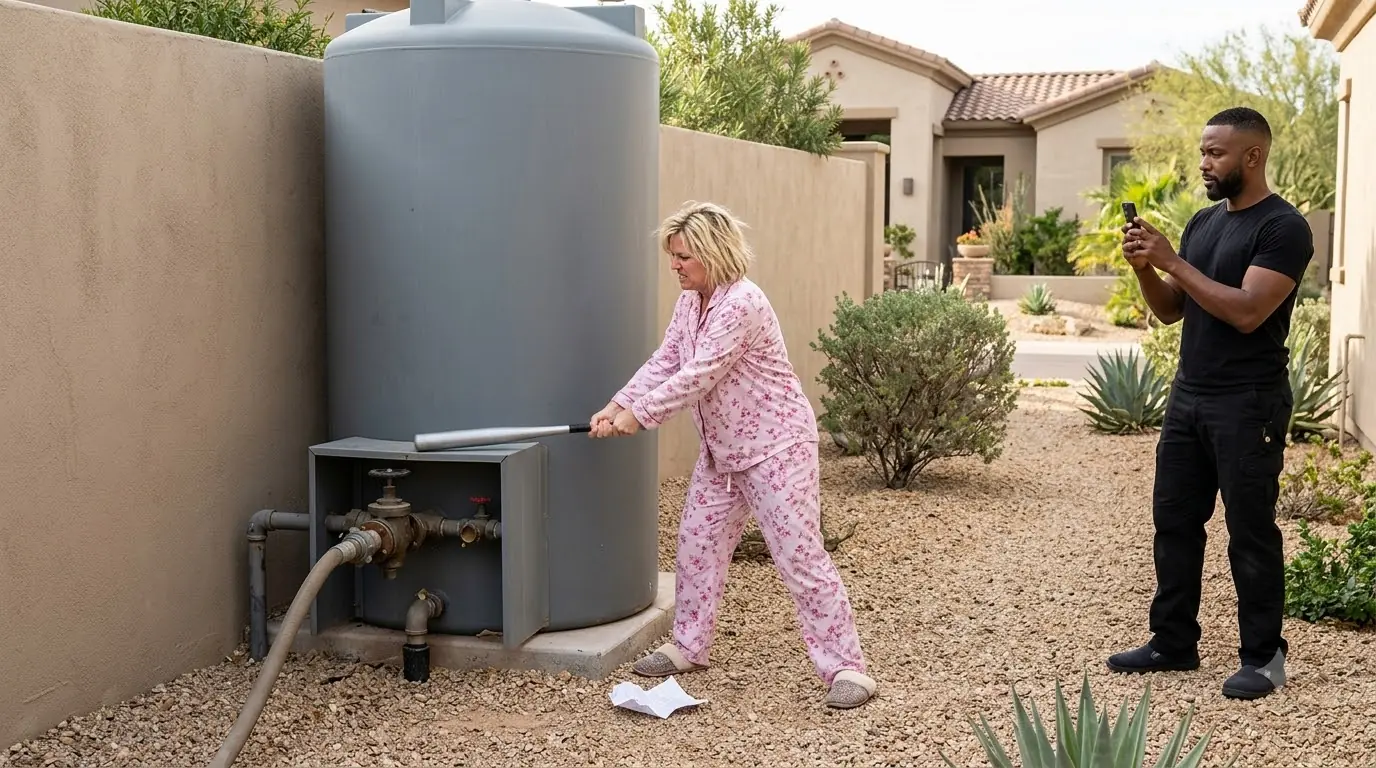
Then came the second strike.
CLANG.
This one was followed by a woman’s voice.
“Ugly piece of junk.”
He was moving before the third blow landed.
He crossed the kitchen, pushed through the mudroom door, and stepped into the narrow side yard beside his house.
What he saw stopped him cold.
The HOA president was standing beside his emergency water tank in pink floral pajamas.
Not a suit.
Not the expensive orange blazer she wore to community meetings.
Not the pearl earrings and immaculate makeup she used whenever she wanted to appear authoritative in front of neighbors.
Pink pajamas.
Little white flowers.
Soft house slippers already coated with desert dust.
Her blonde bob looked like she had brushed it once after getting out of bed and then changed her mind halfway through.
And in both hands she held a metal baseball bat.
The homeowner stared.
“What are you doing?”
She swung again.
The bat struck the protective steel housing around the tank’s lower outlet valve.
The impact rang across the property.
“Removing a violation.”
He walked forward two steps.
“Put the bat down.”
The HOA president turned.
Her face was bright red.
“You were warned.”
“I said put it down.”
She pointed the bat at the massive cylindrical tank beside her.
It stood nearly twelve feet high, matte gray, positioned behind a masonry privacy wall and screened from the street by desert landscaping.
Ten thousand gallons.
Reinforced polyethylene inside a protective exterior shell.
Fire-service connection.
Isolation valve.
Pressure gauge.
Backflow protection.
Dedicated underground line to the driveway.
The homeowner had spent almost eleven months planning it.
Permits.
Engineering.
Excavation.
Inspection.
A county fire review.
A plumbing contractor.
An electrical contractor for the pump control.
He had spent far more money than he intended.
The HOA president had spent exactly zero minutes trying to understand why it existed.
She said:
“You had thirty days.”
“I have permits.”
“HOA rules come before your excuses.”
“No, they don’t.”
Her eyes narrowed.
“What did you say?”
He took out his phone.
Opened the camera.
Started recording.
She noticed.
“Oh, really?”
“Yes.”
“You’re recording me now?”
“You’re standing on my property with a bat.”
“This is HOA enforcement.”
“No.”
“It’s trespassing.”
She laughed.
“I am president of the association.”
“That does not give you permission to enter my yard.”
“You refused inspection.”
“I refused to let you enter without notice.”
“Same thing.”
“No.”
The homeowner kept his voice low.
That took effort.
He was forty-two years old, broad shouldered, wearing a black T-shirt, black work pants, and house shoes because he had been repairing a cabinet hinge when the banging started.
He had spent most of his adult life learning how expensive anger could become for a Black man when another person already expected aggression.
So he did something he had taught himself years earlier.
He made his hands visible.
He stayed several feet away.
And he documented.
The HOA president hated that more than shouting would have bothered her.
“Stop filming.”
“No.”
“You do not have my permission.”
“You’re on my property.”
She lifted the bat again.
“Then maybe you’ll finally understand.”
She swung.
The homeowner stepped forward instinctively.
“Stop!”
The bat struck the protective valve cover.
A sharp metallic snap followed.
Not the tank.
Something smaller.
The plastic face of the pressure gauge cracked.
The needle jumped.
The homeowner felt his stomach drop.
He moved closer.
“That’s enough.”
She kicked at the heavy hose connection near the base.
Her slipper connected with the rubber protective cap and sent it swinging on its chain.
“You should’ve thought about that before putting an industrial tank in a residential community.”
He stared at her.
“Do you understand what that connection is?”
“An eyesore.”
“It’s a fire-service connection.”
Her mouth twisted.
“This neighborhood has hydrants.”
He almost laughed.
That was the entire reason the tank existed.
Before he could answer, tires rolled over the driveway outside the side gate.
Heavy.
Large.
A diesel engine.
Then an air brake sighed.
The HOA president glanced over.
The homeowner did too.
A red fire engine had stopped outside his house.
Three firefighters were climbing down.
The Fire Chief came through the open side gate first.
He was in his mid-fifties, gray-haired, wearing a navy department uniform beneath a light protective jacket.
He took in the scene in less than two seconds.
The woman in pink pajamas.
The metal bat.
The cracked pressure gauge.
The homeowner filming.
The gray tank.
His expression changed.
“Ma’am.”
The HOA president brightened instantly.
“Chief, thank goodness.”
The homeowner almost admired the speed.
She lowered the bat but did not release it.
“I have been trying to deal with this illegal structure for weeks.”
The Fire Chief looked at the homeowner.
“You okay?”
“Yes.”
Then he looked at the bat.
“What happened to the gauge?”
The HOA president answered:
“He refuses to remove this thing.”
The Fire Chief stared at her.
“That wasn’t my question.”
She blinked.
“I was demonstrating that it’s unsafe.”
The homeowner closed his eyes briefly.
The Chief walked toward the tank.
He crouched.
Examined the protective outlet housing.
Touched the cracked gauge.
Checked the valve stem.
Then stood.
“Who hit this?”
Silence.
The homeowner held up his phone slightly.
“I’ve been recording since I came outside.”
The HOA president pointed.
“He’s been harassing me with that camera.”
The Fire Chief looked at her.
“You hit the tank?”
“I struck the external hardware.”
“Why?”
“Because it violates HOA architectural guidelines.”
The Fire Chief stared at her for several seconds.
Then:
“Drop the bat.”
Her mouth opened.
“Excuse me?”
“Put it on the ground.”
“I am not threatening anyone.”
“I didn’t say you were.”
He pointed toward the gravel.
“You’re standing beside ten thousand gallons of emergency water with a metal bat after damaging a pressure gauge.”
“Put it down.”
She slowly lowered it.
Then let go.
The bat landed in the gravel.
The homeowner kept recording.
The Fire Chief looked toward one of his firefighters.
“Check outlet integrity.”
The firefighter moved immediately.
The HOA president folded her arms.
“I’m glad you’re here, actually.”
The Chief looked at her.
“So am I.”
“You can explain to him that private industrial tanks are inappropriate in a residential development.”
The Chief’s expression did not change.
“No.”
She smiled as if she had misunderstood.
“No?”
“No.”
“This tank is not illegal.”
Her smile disappeared.
The homeowner said nothing.
The Chief continued:
“It was inspected.”
“Approved.”
“And registered with us.”
The HOA president stared.
“As what?”
The Chief pointed toward the large connection she had just kicked.
“An auxiliary emergency water supply.”
“For this property?”
“For this block.”
Nobody moved.
The woman looked at the homeowner.
Then at the tank.
Then back at the Fire Chief.
“That’s impossible.”
“No.”
“The HOA never approved a community water facility.”
“The HOA does not approve fire-department emergency access agreements.”
Her face tightened.
“You cannot just designate private property for public use.”
The homeowner finally spoke.
“I signed the access agreement.”
She turned.
“You what?”
“I authorized fire-service use during an emergency.”
“You cannot do that without us.”
“It’s my property.”
“The tank is screened.”
“Permitted.”
“And the fire department approved the connection.”
The Fire Chief said:
“We were scheduled to conduct another flow test this afternoon.”
The HOA president looked at the engine outside.
“That’s why you’re here?”
“Yes.”
She appeared to relax slightly.
As if this were merely an inconvenient coincidence.
Then the Fire Chief added:
“Especially after what happened this morning.”
The homeowner looked at him.
“What happened?”
The Chief’s face hardened.
“The hydrant at the west entrance failed pressure testing.”
The homeowner stopped recording for half a second without meaning to.
Then started again.
“What?”
“We tested at eight forty.”
“Pressure dropped below the minimum we need under full draw.”
The homeowner looked toward the street.
That hydrant was the nearest high-volume municipal source to seventeen homes.
Including his.
Including the HOA president’s.
He asked:
“Water main?”
“Probably.”
“We’ve notified the utility.”
“Could take days to isolate exactly where.”
The HOA president shook her head.
“But there are other hydrants.”
“Yes.”
“Farther away.”
The Chief pointed toward the tank.
“That is why supplemental supply matters.”
She stared.
He continued:
“If we get a structure fire on this block before the water utility resolves the pressure problem, this tank may be the fastest reliable local source we have while additional engines establish a longer relay.”
Her expression changed.
The Chief added quietly:
“Your house is inside that response area.”
That did it.
For the first time since the homeowner walked outside, the HOA president looked at the gray tank instead of through it.