“No, it doesn’t,” Dwight agreed.
Hank looked toward the back of the diner.
Ruth had set up a small space for Shelby near the kitchen. A blanket spread on the floor, a pillow, another glass of milk, and a plate of food.
Shelby stood beside it.
She had eaten some of the crackers and a few bites of a sandwich, but she would not lie down, and she would not sit.
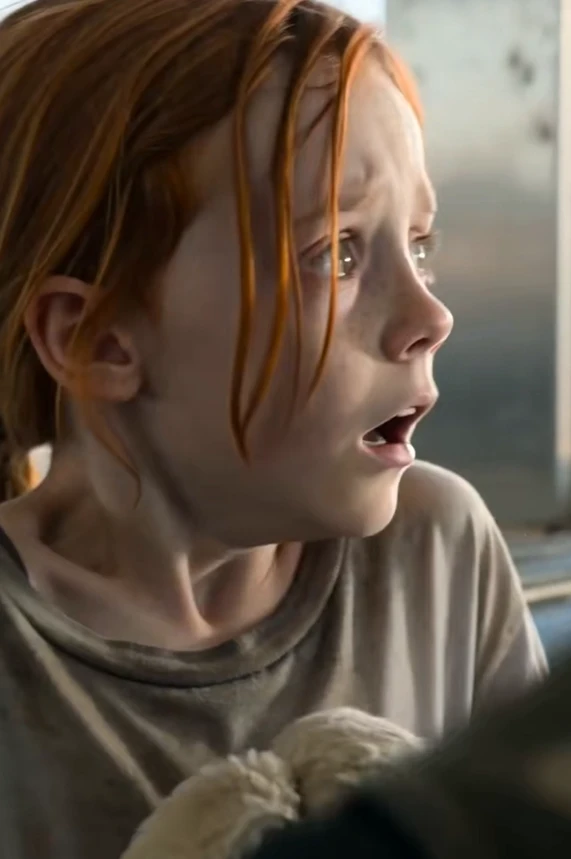
She stood with Captain in her arms, swaying slightly the way exhausted children do when their bodies beg for rest, but something stronger than tiredness keeps them upright.
Hank excused himself and walked over to her. He knelt down again, keeping his distance.
“Shelby, you must be real tired. You could lie down on your stomach on that blanket there. You don’t have to sit. Just lie on your tummy and rest. Captain could rest, too.”
Shelby looked at the blanket.
Then she looked at Hank.
Something in her face shifted, not trust, not yet, but the absence of active fear.
Just enough.
She lowered herself carefully to her knees, then eased onto her stomach on the blanket, wincing as she moved.
She laid Captain beside her head and rested her cheek on the pillow.
The wince.
Hank saw it.
Ruth saw it from behind the counter.
Boyd saw it from across the room.
As Shelby settled onto her stomach, the oversized T-shirt rode up along her lower back.
What Hank saw there made him stand up and turn away so the girl would not see his face.
He walked to the counter and gripped the edge of it with both hands, his knuckles white against the laminate.
Ruth appeared beside him.
Her voice was barely a whisper.
“I saw.”
Hank could not speak for a moment.
When he did, his voice was thick and strange in his own ears.
“Call the sheriff’s department. Ask for someone who handles these cases. Someone who knows what they’re doing.”
“Already did. Deputy Walsh is on her way. Twenty minutes.”
Hank nodded.
He looked down at his hands on the counter.
These hands had rebuilt engines, thrown punches, gripped handlebars through rainstorms and desert winds.
They had never felt as useless as they did right now.
He turned back to the room.
Every man was looking at him. They had seen him turn away. They had read his face.
Now the diner was filled with a silence that was different from the quiet of an empty room.
This was the silence of twelve men confronting something that made the hardest parts of their own lives seem small.
“The woman who dropped her off,” Hank said, his voice steady now, “Ruth said she headed south. I think she was trying to leave the girl somewhere safe. Somewhere she’d be found.”
“You think the mother dropped her?” Dwight said.
“I think a mother who couldn’t protect her daughter did the only thing she could think of. She put her in a room full of strangers and prayed that someone would look close enough to see what she couldn’t say out loud.”
The silence held.
Boyd spoke first.
“What do we do?”
“We wait for the deputy. We let the law do what the law does. And we make sure that little girl knows that every man in this room sees her.”
“And if the law isn’t enough?” Boyd asked.
It was not a threat.
It was a genuine question from a man who had seen the system fail often enough to know that good intentions did not always survive contact with procedure.
“Then we figure out what is,” Hank said. “But we do it right. We do it so that girl has a future, not just a rescue.”
Deputy Karen Walsh arrived eighteen minutes later.
She was a steady-eyed woman in her mid-thirties with brown hair pulled back in a practical bun and a manner that was professional without being cold.
She spoke to Shelby alone, with Ruth present in the small office behind the kitchen.
She was in there for forty-five minutes.
When she came out, her expression was controlled, but Hank could see the tension in her jaw, the way her hand rested on her duty belt, not out of habit, but out of a need to hold on to something solid.
“I’ve called Child Protective Services,” she told Hank and Dwight. “A caseworker is coming from Bakersfield. I’m going to need to talk to the stepfather.”
“Glenn Tate,” Dwight said.
Walsh looked at him.
“You know him?”
“We know the name. That’s all.”
“Keep it that way,” Walsh said.
It was not a request.
Hank nodded, but as Walsh walked back to her patrol car to radio dispatch, he watched her go and felt the cold weight behind his ribs grow heavier.
Because he knew how this worked.
He knew about the paperwork, the investigations, the home visits, and the assessments that could take weeks while a child waited in a system that was overworked, understaffed, and heartbreakingly slow.
He looked back through the diner window.
Shelby was still lying on her stomach on the blanket, Captain tucked under her chin.
Her eyes were open.
She was watching the door.
The Desert Kings MC annual gathering had been planned for months.
Every July, chapters from across California, Nevada, and Arizona converged on Ridgecrest for a weekend of riding, brotherhood, and the kind of organized chaos that only a motorcycle club could pull off with any grace.
This year, three hundred riders were expected.
They would fill the parking lots of the Desert Rose Motel, line their bikes along China Lake Boulevard, and turn the Dust Bowl Diner into a temporary headquarters that smelled like leather, engine oil, and black coffee.
The gathering was scheduled for Saturday.
It was now Thursday.
In the two days since Shelby had been found at the Dust Bowl, a series of events had unfolded with the grinding, methodical pace of institutional machinery.
Deputy Walsh had interviewed Glenn Tate at his home.
He had been cooperative, polished, and convincing. A concerned stepfather who claimed his wife, Lorraine, had been struggling with erratic behavior and had taken the girl without telling him.
He expressed worry.
He asked when his stepdaughter would be returned.
The CPS caseworker, a young man named Dennis Pratt, who looked like he had not slept since his first week on the job, placed Shelby in emergency foster care with a family in Ridgecrest.
The Overtons.
A retired couple who had fostered eleven children over the past decade and ran their home with the warmth and structure that a child like Shelby desperately needed.