Mechanics Gave Up On A 40-Year-Old Hells Angels Bike — An 8-Year-Old Poor Boy Said, “I’ll Fix It.”
Mechanics Gave Up On A 40-Year-Old Hells Angels Bike — An 8-Year-Old Poor Boy Said, “I’ll Fix It.”
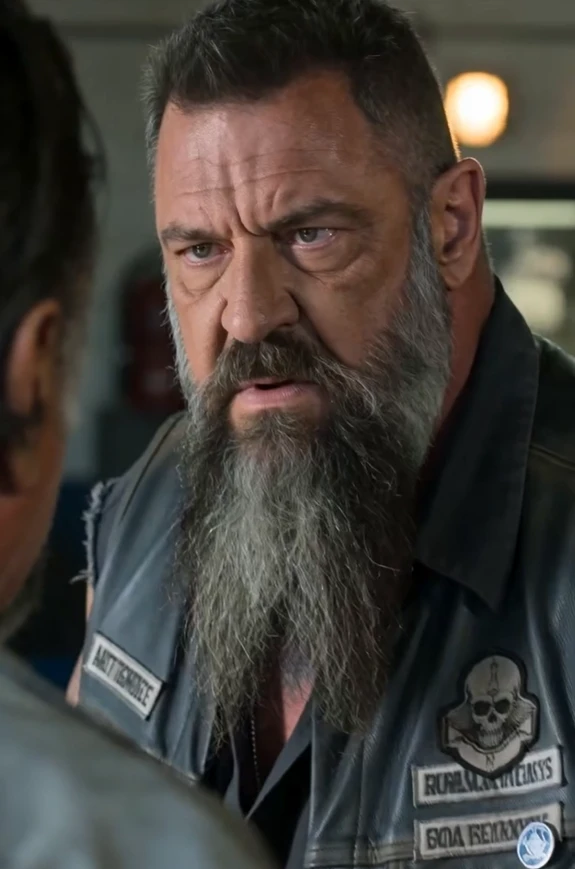
After defeating some of California’s most experienced mechanics, the forty-year-old Harley-Davidson FXR seemed completely beyond saving.
Grown men became uneasy when Jim Mercer, a feared motorcycle-club enforcer, arrived demanding that the machine be repaired.
Then, breaking the tense silence, a scrawny eight-year-old boy emerged from the shadows of the garage.
“I will fix it,” he said.
The midday sun beat mercilessly against the cracked asphalt of Oakland, California.
Heat waves rising from the pavement made the approaching motorcycles resemble phantoms emerging from the earth, but the deep rumble of their unbaffled V-twin engines confirmed that they were very real.
It was Tuesday afternoon, and the local chapter of the Hells Angels Motorcycle Club was descending upon Apex Iron Works, the most respected custom-motorcycle garage in the Bay Area.
At the front of the procession rode Jim Mercer, a mountain of a man with a beard the color of steel wool.
Jim was a veteran enforcer for the club.
His weathered leather vest carried the club’s familiar winged-skull patch and an insignia representing decades of unwavering loyalty and a life lived entirely on his own terms.
That day, however, Jim was not looking for a confrontation.
He was looking for a miracle.
Behind him, secured to the bed of a heavy-duty flatbed truck, was the reason for the intimidating procession.
It was a 1986 Harley-Davidson FXR.
To the untrained eye, it appeared to be nothing more than an old, damaged motorcycle with chipped black paint and rusted chrome.
To the men wearing the winged skull, the machine was a sacred relic.
It had belonged to Dutch Sullivan, the club’s legendary former chapter president, who had died three months earlier.
The club was organizing a massive memorial run, a procession of nearly one thousand motorcycles traveling down the California coast to honor Dutch.
Tradition required Dutch’s motorcycle to lead the pack.
There was only one problem.
The FXR was dead.
It was not merely mechanically broken.
The motorcycle appeared almost cursed.
The caravan rolled into the parking lot of Apex Iron Works.
The heavy bay doors had already been raised, and the shop’s owner and head mechanic, a man everyone called Rusty, stood near the entrance wiping his greasy hands on a rag.
Rusty was a master of his profession.
He had built custom motorcycles for celebrities, wealthy collectors, and men who lived far outside ordinary society.
If an engine required air, fuel, and spark, Rusty could normally make it roar.
As Jim Mercer shut down his engine and stepped from his motorcycle, Rusty’s face turned pale.
“Tell me she is breathing, Rusty,” Jim said.
His voice was a low, gravelly rumble that barely carried above the ticking sounds of cooling exhaust pipes.
Rusty swallowed and tossed the dirty red rag onto a nearby workbench.
He looked toward the flatbed and then back at Jim.
“Jim, I am going to speak honestly because I respect you and your club.”
He drew a breath.
“I have had three of my best mechanics working on that FXR for two weeks.”
“We rebuilt the carburetor, replaced the ignition system, removed the old wiring harness, and changed the stator, rotor, and coil.”
Rusty pointed toward the motorcycle.
“We even opened the top end and checked the compression. Everything is perfect.”
He shook his head helplessly.
“Mathematically and mechanically, that engine should start.”
“I do not want a science lesson,” Jim interrupted, taking a step forward.
The half-dozen bikers behind him mirrored the movement and folded their heavily tattooed arms.
“I want to hear Dutch’s motorcycle turn over.”
“It will not,” Rusty admitted.
His voice cracked slightly.
“Every time we press the starter, the engine cranks, but it refuses to ignite.”
“When we try to kick-start it, it kicks back so violently that it nearly injured one of my apprentices.”
Rusty rubbed one hand across his forehead.
“Then there is the electrical drain. It makes no sense.”
“You install a brand-new battery, and within ten minutes, something pulls every bit of power from it.”
“There must be a fault hidden somewhere inside the machine, but we cannot find it.”
Rusty looked toward the floor.
“I am sorry. We gave up.”
He forced a nervous smile.
“You need something beyond an ordinary mechanic.”
A heavy silence settled over the garage.
The air felt thick with gasoline, sweat, and growing tension.
Jim stepped into the shop, his heavy boots echoing against the concrete floor.
He approached the FXR and rested one scarred hand on the leather seat that still carried the shape of his deceased friend.
“Dutch built this chapter,” Jim said quietly.
In the silence of the garage, every man heard him.
“He pulled me out of the gutter in 1994.”
Jim’s fingers tightened against the seat.
“This motorcycle leads the memorial run on Saturday. If it does not, people will see it as disrespect toward his legacy.”
Jim slowly turned toward Rusty.
The sorrow in his eyes hardened into something cold.
“I paid you five thousand dollars in advance because I trusted you.”
He looked around the shop.
“If the great Apex Iron Works is surrendering to a forty-year-old piece of American steel, perhaps people have overestimated this garage.”
Rusty stepped backward and raised his hands.
“Jim, please. We tried everything.”
“It is a dead machine.”
“I will give you until Friday,” Jim said.
His voice contained no emotion.
“If I return and that engine does not start, I am taking the motorcycle and recovering the money I paid.”
The warning hung heavily in the air.
Rusty understood that the failure could destroy his reputation and possibly his business.
He had a wife, a mortgage, and a garage he had spent years building.
He stared at the motorcycle, a black monument to iron and frustration, and felt completely helpless.
“You are checking the wrong timing marks.”
The voice was small, barely louder than a whisper.
Still, it cut through the tension like a razor.
Jim snapped his head toward the sound.
Rusty blinked in shock.
The bikers turned almost in unison.
Standing inside a shadowy corner of the garage was a boy holding a push broom nearly twice his height.
He could not have been more than eight years old.
The child was painfully thin and wore a faded, oversized T-shirt hanging from his narrow shoulders.
His jeans were patched at both knees.
Engine grease covered parts of his face, but his bright blue eyes stared directly at the massive biker.
The boy’s name was Leo.
“Leo, close your mouth and return to sweeping,” Rusty barked.
His panic increased.
The last thing he needed was a child provoking a group of already frustrated bikers.
Leo did not move.
He tightened his grip on the wooden broom handle and stepped out of the shadows.