My daughter sold my house while I was in Europe, used the money to cover her husband’s $200,000 debt, then opened her apartment door and smiled like she had finally won.*999
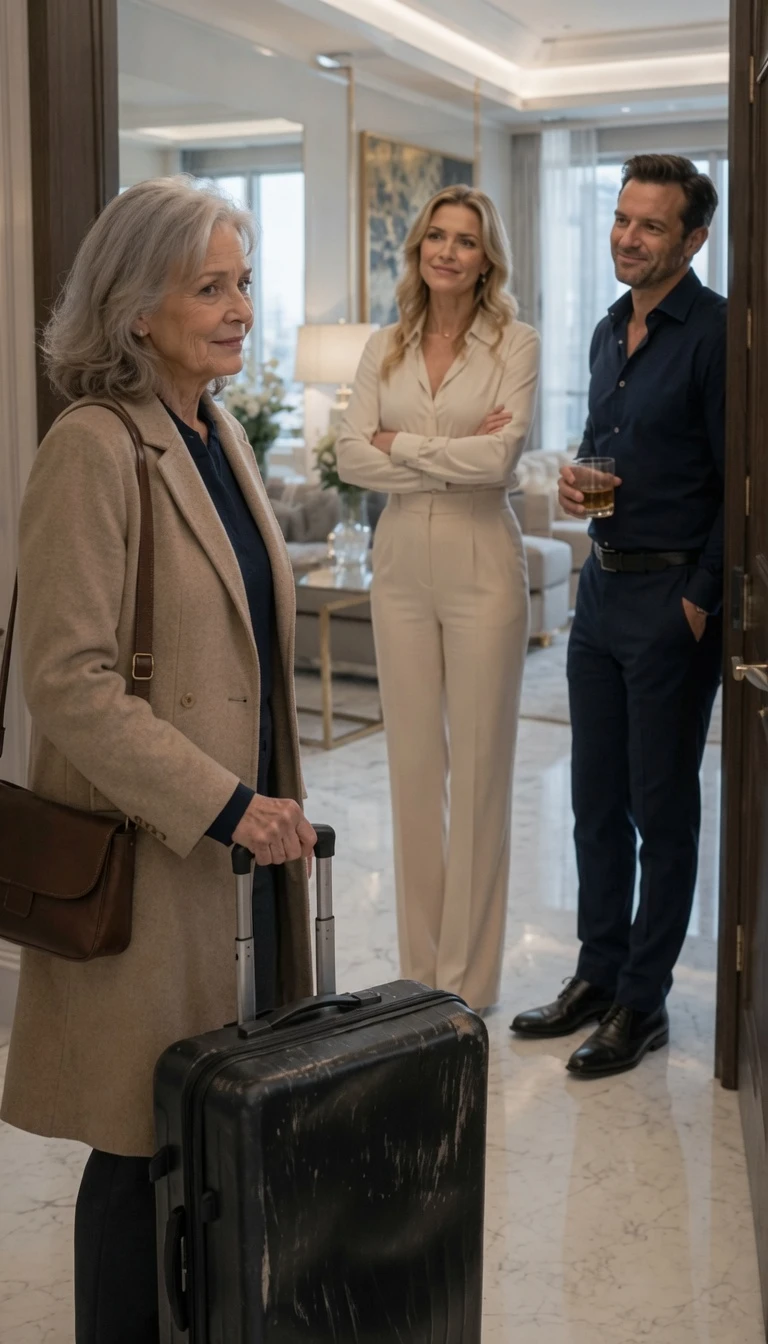
The wheels of my suitcase scraped against the polished hallway floor like a dying animal’s last breath. Jet lag pressed behind my eyes, a dull hammer of exhaustion mixed with the sharp scent of airport coffee still clinging to my coat. Rain from London had soaked into the wool during my layover, and now it mixed with the sterile smell of this sleek building—bleach, lemon polish, and money. I was seventy years old, standing outside my daughter’s door with everything I owned tilted awkwardly beside me. The broken wheel caught on the threshold.
Jessica opened the door.
Her smile hit first—wide, triumphant, the kind that doesn’t reach the eyes. **“Now you’re homeless, Mom.”**
The words landed like cold stones in still water. Behind her, Vincent leaned against the wall in a crisp navy shirt, whiskey glass catching the light at ten in the morning. He didn’t even try to hide his smirk.
I didn’t cry. I didn’t scream. I simply smiled back.
Jessica’s perfect eyebrows drew together. “Why are you smiling?”
I let the silence stretch, savoring the shift in their faces. The hallway felt smaller, the air thicker. My heart, which should have shattered into a thousand jagged pieces, beat steady and sure.
**Because the house on Maple Street had one detail they never bothered to check.**
But that moment was still hours away in the telling. To understand, we must go back.
---
The house on Maple Street had blue shutters and stubborn rosebushes that Arthur planted the summer Jessica turned six. We bought it with sweat and sacrifice when she was five. He worked construction until his knees swelled like overripe fruit and his back screamed every night. I cleaned other people’s houses—women with marble counters and voices like ice—who left notes about dust on baseboards and expected perfection for minimum wage.
Every extra shift, every packed lunch instead of diner specials, every birthday check folded into a coffee can in the pantry went into that house. **It wasn’t just walls and a roof. It was our life pressed into wood and plaster.**
Jessica’s first lost tooth under her pillow. The Christmas when wrapping paper turned the living room into a snowstorm and Arthur wore the silly Santa hat until she fell asleep laughing. Pencil marks on the pantry door tracking her growth—tiny notches climbing higher each year. The kitchen table where Arthur took his last breath, his hand cold in mine as I whispered promises I couldn’t keep.
After he died, the house became my anchor. The scent of his aftershave still lingered in the closet for years. I kept his muddy boots by the back door until the leather cracked. On quiet evenings, I sat at that kitchen table with his old mug, listening to the creak of floorboards that knew every secret.
Jessica used to understand. Or I convinced myself she did.
Then Vincent arrived.
He was charming at first—too charming. Tall, polished, with a laugh that filled rooms. Jessica glowed around him. “Mom, he’s the one,” she said, eyes bright over Sunday dinner. Arthur met him once before the cancer took him fully. **“Watch that one, Ellie,”** he’d whispered that night, voice weak but eyes sharp. “**He smiles without warmth.**”
I should have listened harder.
After Arthur passed, Vincent lost his job. Suddenly they visited more. Jessica brought lemon pastries from the fancy bakery. Vincent fixed cabinet doors I didn’t need fixing, changed bulbs that worked fine. They hovered, concerned.
But Jessica’s eyes wandered the rooms differently. She ran fingers along windowsills Arthur built by hand. Vincent’s questions slipped in like needles.
“How much do you think this place is worth now, Eleanor?”
“Mortgage paid off, right? Smart lady.”
“Ever think about downsizing? This big old house for one person…”
I laughed it off. “I’m fine right here. This is home.”
But doubt crept in like evening fog.
The Europe trip came wrapped in love.
“Mom, you deserve this,” Jessica said one afternoon, squeezing my hand across the kitchen table. Sunlight poured through the window, catching dust motes in the air like tiny stars. The rosebushes outside bobbed in the breeze. “London, Paris, Rome. You and Dad talked about it forever. Let us give you this.”
Vincent nodded beside her, smile wide and warm. “We’ll cover everything. Finally do something big for you, Eleanor.”
It sounded like redemption. Like the daughter who once raced across the school sidewalk, backpack bouncing, shoelaces flying, calling “Mom, wait for me!” had returned.
Before I left, Jessica brought a neat folder. “Just for emergencies. Bills, repairs. Nothing important.”
**Nothing important.** Three words that tasted like ash later.
I signed. She was my daughter. Blood. The little girl I carried through thunderstorms, the teenager who cried on my shoulder when her father missed the school play because overtime paid the mortgage.
That night before the flight, I stood alone in the kitchen. Arthur’s mug warm in my hands from tea. The school bus hissed at the corner. Mrs. Donnelly dragged her trash out. Everything ordinary. But my stomach twisted.
I called my old friend Margaret, a retired lawyer two streets over. “Just in case,” I told her. “Make sure those papers are what they seem.”
She reviewed them quietly the next morning. Her face tightened. “Power of attorney, but limited. I added safeguards. They can’t sell without proper verification and my countersign on major actions. I’ll watch it.”
I hugged her. “Thank you, old friend.”
Then I flew.
Europe was a dream laced with unease.
London’s rain-slicked streets smelled of history and wet stone. I walked where Arthur and I once planned to go, touching cobblestones, breathing in the chill. Paris at dusk, lights on the Seine like scattered diamonds. Rome’s ancient ruins whispering of empires that fell. I sent Jessica photos. She replied with hearts and “Love you, Mom!”
But the neighbor’s message came on day twelve.
*Eleanor, call me. Urgent. It’s about the house.*
My hands shook in the hotel lobby. The concierge asked if I needed water. I waved him off.
The call confirmed it. The house listed suddenly. Sale rushed through a contact of Vincent’s. Money wired. Keys changed.
I booked the first flight home, heart pounding through every delay and layover. The cracked suitcase—Arthur’s old one—became my companion, its weight a reminder of everything I carried.
When I landed, my key slid uselessly into the front door of the Maple Street house. A new lock gleamed mockingly. The rosebushes looked wilted, neglected. I stood on the porch for a long minute, fingers tracing the blue shutters. **The home that held my entire life, gone in weeks.**
Jessica had texted: *Come to our apartment, Mom. We’ll talk.*
So I went.
Now, in that sleek hallway, her smile faltered under my steady gaze.
“Why are you smiling?” she repeated, voice sharper.
Vincent set his whiskey down with a soft clink. “Eleanor, look, these things happen. Market’s hot. We can help you find a nice senior place. With the proceeds—”
**“Did you check the paperwork carefully before you sold it?”** I asked, voice calm, looking straight at him.
The silence was deafening.
Jessica crossed her arms. “What paperwork? I handled it. You signed. It was all legal.”
Vincent’s face drained of color. A small muscle twitched near his eye. **That was the moment they began to understand something was wrong.**
I stepped closer, suitcase wheel scraping. The scent of his whiskey mixed with Jessica’s expensive perfume—sharp, floral, suffocating.
“You had me sign for emergencies,” I said softly. “Bills. Repairs. I trusted you. My daughter. The girl who used to fall asleep on my lap during thunderstorms, who promised she’d always take care of me.”
Tears welled in Jessica’s eyes, but they weren’t the soft ones from childhood. These were angry, cornered. “We did take care of you! Vincent needed help. His debt—creditors were calling. The house was too much for you alone. We sold it fair. The money went to pay what we owed so we could start fresh. For all of us.”
**Vincent laughed nervously.** “Come on, Eleanor. Family helps family. You’ll get a cut. Enough for a condo.”
I reached into my coat pocket—the one that still smelled of rain and airports—and pulled out a folded envelope. Margaret had messaged me the details during my frantic return flight.
**“The detail you missed,”** I said, unfolding it slowly, “is that the power of attorney was limited. Margaret added clauses. Any sale required her verification as co-trustee on the living trust Arthur and I set up years ago—after his diagnosis. The house was never fully mine to sign away alone in that way. It was protected. For me. And for the granddaughter you never told me about.”
Jessica’s mouth opened, closed. Vincent froze.
**“What granddaughter?”** Jessica whispered.
I smiled, this time with genuine warmth mixed with sorrow. “The one growing in you right now. I saw the prenatal vitamins in your bathroom cabinet last visit, hidden under the sink. The way you touched your stomach when you thought I wasn’t looking. You’re pregnant, Jessica. And you tried to steal your child’s future home to cover his mistakes.”
The air crackled. Vincent’s glass slipped, spilling whiskey across the floor like spilled blood.
**“You forged the rest,”** I continued, voice steady. “Pushed the sale through shady contacts. But the buyer’s title company called Margaret yesterday when red flags appeared. The sale is void. The house is still mine. Protected. And you two… you’re facing fraud charges if the buyer pursues it. Margaret already documented everything.”
Jessica staggered back a step. “Mom… I… we were desperate. Vincent’s debts—he said they’d hurt the baby if—”
**“Desperate?”** My voice cracked for the first time, raw with decades of love and betrayal. “I would have given you anything. Sold it myself if you asked honestly. But you chose this. You chose to make me homeless in my own story.”
Tears streamed down Jessica’s face now. Real ones. The little girl peeked through the stranger for a flicker—racing across the sidewalk, calling for me. But the cold woman returned, shattered.
Vincent tried bluster. “This is ridiculous. We’ll fight it. The money’s already—”
**“Gone to a trust for my granddaughter,”** I interrupted. “The buyer’s deposit is frozen. Your ‘sale’ transferred nothing real. The house returns to me. Clean.”
The weight of forty years settled in the hallway. The jet lag, the cracked suitcase, the smell of coffee and rain—it all faded into clarity.
I turned toward the elevator, suitcase wheel finally steady as I righted it. Jessica reached out, fingers brushing my sleeve. “Mom, please. We can fix this. I’m sorry. The baby—”
I paused, looking back over my shoulder one last time. **Her face held the wreckage of choices, the ruin of trust, and the faint spark of a future she nearly destroyed.**
“You have a child coming,” I said gently, yet firmly. “Raise her better than this. Teach her that family isn’t something you sell for whiskey and smiles without warmth.”
The elevator doors closed on their stunned silence.
---
Weeks later, the house on Maple Street welcomed me back. The rosebushes perked up with water and care. New locks, but the same blue shutters. Margaret helped navigate the legal mess; charges hovered but Vincent’s creditors scattered when the money trail dried up.
Jessica tried calling. Once. I answered but kept it brief. The conversation was tears and half-apologies. She was keeping the baby. Vincent moved out shortly after—debts too heavy, consequences too real.
I sat at the kitchen table that evening, Arthur’s mug warm again. The pencil marks on the pantry door caught the light. I traced them with a finger, imagining a new notch someday—if forgiveness found a path.
**Outside, the school bus hissed at the corner. Life continued, scarred but standing.**
In the end, the house wasn’t just wood and plaster. It was proof that some roots run deeper than betrayal, and a mother’s quiet foresight could rewrite even the cruelest ending.
The smile I gave Jessica that day in the hallway wasn’t victory. It was survival. And the echo of a little girl’s voice, still calling “Mom, wait for me,” somewhere in the distance of what might still be saved.