Officer Drew His Gun on a Black Man Reading on His Own Porch — Then Three Black SUVs Turned Onto the Street
Officer Drew His Gun on a Black Man Reading on His Own Porch — Then Three Black SUVs Turned Onto the StreetOfficer Derek Mason’s pistol came out before Marcus Williams had even finished folding the newspaper.
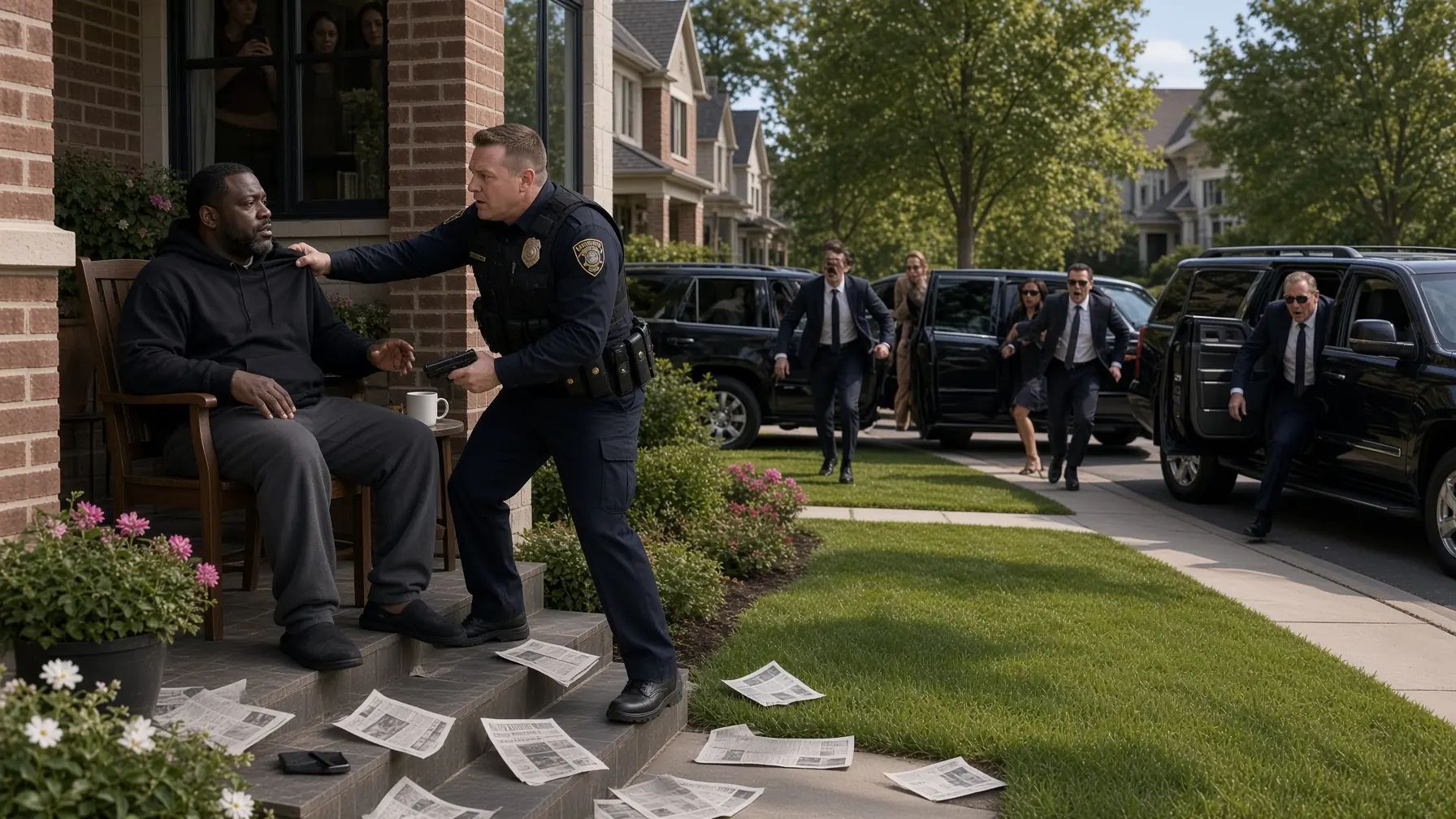
One second, Marcus was sitting beneath the morning sun with a cup of coffee cooling beside him and the Sunday paper open across his knees. The next, the patrol officer standing at the bottom of his porch steps had both hands wrapped around a service pistol pointed directly at Marcus’s chest. Birds still moved through the maple trees along Briarwood Lane, a sprinkler continued ticking three houses away, and somewhere behind a neighboring fence a lawn mower kept running as if nothing important had changed. Marcus did not move. He simply looked at the weapon, then at the officer holding it, and placed the folded newspaper slowly beside his coffee.
“Hands where I can see them,” Mason ordered.
Marcus raised both hands.
“They’re visible.”
“Don't reach for anything.”
“I won't.”
Mason took another step toward the porch. “What are you doing here?”
Marcus glanced briefly at the white-columned house behind him, then back at the officer. “Drinking coffee and reading the newspaper.”
“I asked what you’re doing at this residence.”
Marcus’s expression changed slightly.
“I live here.”
Mason did not lower the gun.
At 8:46 on that Sunday morning, that should have been the beginning of verification. It was not proof Marcus owned the house, but it was a simple explanation that could be checked in less than a minute. The county property database existed. Vehicle registration existed. Dispatch could check the address. The key resting on the table beside Marcus’s coffee could be tested. A framed photograph visible through the front window showed Marcus standing beside the woman whose name appeared with his on the property record.
Derek Mason checked none of it.
Instead he looked at Marcus’s black sweatshirt, gray sweatpants, bare feet inside house slippers, and the expensive homes surrounding them as though the combination itself contained an inconsistency.
“You have ID?”
“Inside.”
“Where inside?”
“My wallet is on the kitchen counter.”
“Don't go for it.”
“I wasn't planning to.”
Mason’s weapon remained level.
Marcus studied him carefully now. Not aggressively. Not with the challenging stare Mason would later describe in his report. It was closer to observation—the kind of steady attention that made the officer suddenly conscious of everything he was doing.
“Is somebody else inside?” Mason asked.
“My wife is at church. My daughter is with her.”
“You alone?”
“Yes.”
“Whose house is this?”
“Mine.”
“Name?”
“Marcus Williams.”
Mason hesitated.
Something about the name seemed to bother him, though he did not recognize why.
Marcus noticed that too.
“What was the call?” he asked.
“You don't need to worry about the call.”
“If someone reported a crime at my house, I’d like to know what crime.”
“I’m asking the questions.”
Marcus nodded once.
That small gesture irritated Mason more than open hostility probably would have.
There was no fear in Marcus’s voice.
No frantic explanation.
No pleading.
That was not because he felt no fear. He was a Black man sitting twenty feet from an armed officer who had already skipped several opportunities to lower his weapon. Marcus understood exactly how little his calm guaranteed. One misread movement could change the morning faster than any credential could fix afterward.
So he kept his hands open.
His feet still.
His voice ordinary.
“Then ask.”
Mason narrowed his eyes.
Across Briarwood Lane, Elaine Porter stood behind the curtains of number 1187 with one hand covering her mouth.
She had made the call.
Thirty-eight minutes earlier, Elaine had been standing in her upstairs bedroom when she noticed Marcus sitting on the porch of the house across from hers. Elaine had moved into Briarwood Estates only three weeks before. She knew almost nobody. She knew the Williams house even less. The real-estate agent had mentioned that an older couple once lived there, and Elaine had seen a white-haired man collecting mail during a property viewing months before.
She did not know he had been the previous owner.
She did not know Marcus and his wife, Renee, had purchased the house fourteen months earlier.
What Elaine knew was that a Black man in a dark hoodie was sitting on a porch in a wealthy subdivision early on Sunday morning.
She watched him drink coffee.
Watched him open a newspaper.
Watched him stand once, retrieve another section from the front step, then sit back down.
Nothing criminal occurred.
That did not prevent Elaine’s discomfort from growing.
At 8:22, she called the police non-emergency line.
The dispatcher asked, “What exactly is he doing?”
“Sitting on the porch.”
“Trying to enter the house?”
“No.”
“Checking doors or windows?”
“No.”
“Taking property?”
“No.”
“Threatening anyone?”
“No.”
“Do you know who lives there?”
Elaine hesitated.
“I thought an older couple owned it.”
“Have you confirmed that?”
“No.”
“Does the man have a weapon?”
“I can't see one.”
“What makes him suspicious?”
That question should have ended the call.
Instead Elaine looked through the curtain again.
“He just doesn't look like he belongs there.”
The dispatcher did not convert that sentence into burglary.
The call was entered as a suspicious-person check with an explicit note:
MALE SEATED ON PORCH. NO CRIMINAL ACTIVITY OBSERVED. CURRENT HOMEOWNER UNKNOWN.
Officer Derek Mason received those exact words.
He would later claim he believed the call involved a possible burglary suspect.
His body camera would prove the dispatch information had been read aloud inside his patrol car before he arrived.
Marcus did not know what Elaine had said yet.
He did know Derek Mason.
Not personally.
That distinction was about to matter.
Mason moved one step closer.
“Stand up.”
Marcus looked at him.
“Why?”
“Because I’m telling you to.”
“That isn't a reason.”
Mason’s jaw tightened.
“You want to make this difficult?”
“No.”
“Then stand.”
Marcus rose slowly.
He was forty-seven, tall, broad through the shoulders, with close-cropped hair beginning to gray at the temples. He stood almost two inches taller than Mason, which seemed to increase the officer’s tension.
“Hands up.”
“They’re already up.”
“Higher.”
Marcus raised them slightly.
“Turn around.”
“What crime am I suspected of committing?”
“Turn around.”
Marcus did not resist. He turned toward the front door.
Mason came up the stairs.
The weapon remained in his right hand.
With his left, he reached toward Marcus’s waistband.
“I'm going to pat you down.”
Marcus looked over one shoulder.
“I do not consent to a search.”
“It’s for officer safety.”
“What fact makes you believe I’m armed?”
Mason stopped.
There were many answers he could have given if he had possessed one.
A visible bulge.
A threatening gesture.
A report of a weapon.
A hand repeatedly moving toward a concealed area.
He had none.
“You keep questioning everything I tell you.”
Marcus’s voice remained quiet.
“That isn't a weapon.”
“Face forward.”
Marcus did.
Mason conducted the frisk anyway.
Nothing.
No weapon.
No object.
No bulge.
Only the soft fabric of sweatpants and the outline of a house key in one pocket.
Mason removed the key.
Marcus turned his head slightly.
“Why are you taking that?”
“Evidence.”
“Of what?”
Mason looked toward the front door.
“This could have come from inside.”
Marcus almost smiled.
“Yes.”
The officer heard sarcasm where there was mostly disbelief.
“You think this is funny?”
“No.”
“You have a key to a house you claim is yours but no ID showing this address.”
“My ID is six yards away.”
“Convenient.”
Marcus looked at him.
That word landed.
“Check the property record.”
“I'll decide what I check.”
“Then call dispatch.”
“Stop directing the investigation.”
Marcus became quiet again.
That was when Mason began feeling something he could not identify.
Not danger.
Recognition without memory.
The man’s face.
The name.
Marcus Williams.
He had seen it somewhere.
Then Marcus said:
“Derek Mason.”
The officer froze.
His nameplate displayed only MASON.
His first name had never been spoken.
“Who told you my first name?”
Marcus turned his head slightly.
“No one today.”
Mason’s grip tightened around the pistol.
“How do you know me?”
Marcus did not answer.
That silence shifted the entire encounter.
Mason stepped backward.
“Turn around and look at me.”
Marcus turned.
For the first time, the officer looked less confident than angry.
“You know me?”
“I know your name.”
“From where?”
Marcus glanced toward Mason’s body camera.
The recording light was active.
Good.
Then he looked back.
“You should lower your weapon.”
“Don't tell me what to do.”
“You have searched me. I’m unarmed. I’ve told you I own the house. No crime has been identified. You have several ways to verify my address.”
“You're avoiding my question.”
“No.”
Marcus’s voice became even softer.
“I’m waiting to see what you do next.”
That unsettled Mason more than anything else.
Because it sounded less like something a detained homeowner would say and more like something an evaluator would write down.
Mason took another step toward him.
“You're going to tell me how you know my name.”
Marcus looked beyond him.
At the street.
Something had appeared at the far end of Briarwood Lane.
Three dark SUVs.
No sirens.
No flashing lights.
Just three black Chevrolet Suburbans turning into the neighborhood one after another.
Mason followed Marcus’s gaze.
The vehicles slowed.
Then came directly toward the house.
Neighbors who had already begun watching from windows moved closer to the glass.
Elaine Porter stepped onto her porch.
The first SUV stopped behind Mason’s patrol car.
Then the second.
Then the third.
Doors opened.
Four men and three women stepped out.
Plain clothes.
Dark jackets.
One carried a hard-sided evidence case.
Another wore a radio clipped beneath his blazer.
A tall woman with silver-framed glasses walked fastest toward the porch.
Mason turned fully.
“Stay back.”
She stopped twenty feet away.
Her hands remained visible.
“Officer Mason?”
His face changed.
“Yes?”
She opened a credential wallet.
“Lisa Grant. Ohio Bureau of Criminal Investigation.”
Two others displayed credentials.
One was from the Ohio Attorney General’s Office.
Another was an investigator assigned to a joint public-integrity task force.
Nobody drew a weapon.
Nobody rushed Mason.
Grant looked first at his pistol.
Then at Marcus.
“Is anyone under arrest?”
Mason hesitated.
“I'm conducting an investigation.”
“What offense?”
“Possible burglary.”
Marcus said nothing.
Grant looked toward the front door.
Then toward the coffee.
Newspaper.
House slippers.
Finally Marcus.
“Mr. Williams, are you injured?”
“No.”
Mason looked between them.
“You know him.”
Grant did not answer immediately.
“Officer, would you holster your weapon while we sort this out?”
Mason’s face tightened.
“This is my scene.”
“You have an unarmed man frisked on his own porch and you haven't articulated a weapon threat.”
“You don't know what I have.”
Grant nodded.
“Then articulate it.”
Silence.
Marcus watched Mason.
The gun finally lowered.
Then returned to the holster.
Only after it clicked into place did the atmosphere on Briarwood Lane begin to change.
Not relax.
Change.
Mason pointed at Marcus.
“He knows who I am.”
Grant said nothing.
“He knew my first name.”
Still nothing.
Mason looked around at the investigators.
Then back at Marcus.
“What is this?”
Marcus lowered his hands slowly.
Grant did not stop him.
Mason noticed that too.
Marcus walked to the small table.
Picked up his coffee.
It had gone cold.
He set it back down.
Then he looked at Mason.
“You thought you were investigating me.”
Mason stared.
Marcus continued.
“You were sent here because a woman across the street saw a Black man sitting on a porch she did not know belonged to him.”
Elaine heard it.
Her face flushed.
Marcus went on.
“The dispatcher recorded no crime.”
Mason said, “I had reasonable concern.”
“Maybe when you arrived.”
That answer surprised him.
Marcus was not claiming the initial contact should never have occurred.
He was doing something worse for Mason.
He was being precise.
“You could have approached,” Marcus continued. “Asked questions. Checked the address. Verified the call.”
“I did ask questions.”
“You also drew your weapon before you knew who I was.”
Mason’s jaw tightened.
“You reached.”
“For the newspaper.”
“I didn't know that.”
“Then when you did know?”
No answer.
Marcus glanced toward the body camera.
“You kept the gun out.”
Mason looked at Grant.
“Who is he?”
Marcus answered himself.
“My name is Marcus Williams.”
“I know your name.”
“I’m the supervisory investigator assigned to the Attorney General’s joint civil-rights and public-integrity review involving your department.”
The words landed slowly.
Mason’s face changed one layer at a time.
Confusion.
Recognition.
Then fear.
Marcus continued.
“Your name has been in my case files for eleven weeks.”
Mason said nothing.
“Earlier this morning, before you arrived, I was reviewing three of your incident reports and body-camera timelines.”
The neighborhood seemed to become silent.
Even the mower had stopped.
Mason looked toward the black SUVs.
“You're investigating me?”
Marcus did not smile.
“Yes.”
“For what?”
“You already know there is an outside review.”
“Not of me.”
“You were not notified as an individual target because the review is broader than one officer.”
Mason’s breathing changed.
Grant stepped closer.
“Marcus.”
He looked at her.
She gave him a small glance toward the street.
A reminder.
This was still an active encounter.
Marcus nodded.
He looked at Mason again.
“My job is not why your weapon matters.”
Mason frowned.
Marcus pointed toward the body camera.
“That recording is.”
Then toward the patrol car.
“The dispatch tape is.”
Then toward his front door.
“The property record is.”
He stepped closer, stopping a safe distance away.
“If I worked nights at a warehouse, every fact on this porch would be exactly the same.”
Mason said nothing.
“If your explanation depends on discovering I investigate police misconduct, then you have already missed the point.”
One of the investigators quietly requested a patrol supervisor through dispatch.
Mason heard.
“What are these vehicles doing here?”
Grant answered.
“We were scheduled to pick Marcus up at nine.”
“For what?”
Nobody answered immediately.
Marcus looked at his watch.
8:57.
Three minutes early.
The SUVs had not been summoned because a powerful man needed rescuing.
They had already been coming.
That coincidence would later produce every dramatic headline in Columbus.
The actual reason was less cinematic.
At 9:15 that morning, the task force planned to serve preservation orders and administrative demands at Mason’s department for body-camera audit logs, report revision histories, and internal complaint records. The team had agreed to pick Marcus up because his house sat on the direct route between two staging locations.
Mason had unknowingly drawn a weapon on the investigator scheduled to spend the morning examining the very system that recorded what he was doing.
His supervisor arrived seven minutes later.
Lieutenant Karen Avery stepped from a marked cruiser, looked at the line of black SUVs, and visibly wished she had been assigned almost anywhere else.
She separated Mason from everyone.
Asked whether Marcus had been detained.
Asked what the suspected crime was.
Asked whether a weapon had been reported.
Asked why Mason had frisked him.
Then she requested dispatch read the original call notes aloud.
The radio answered:
“Caller reports unknown Black male seated on porch, possibly not resident. No criminal activity observed. No weapon observed. Current homeowner unknown.”
Avery looked at Mason.
“Where did burglary come from?”
Mason answered, “Totality.”
“What totality?”
“He was at a house caller believed belonged to someone else.”
“Caller said she didn't know the current owner.”
“She believed—”
“I asked what you knew.”
Mason stopped.
Avery turned toward Marcus.
“Do you have proof of residency?”
“My driver’s license is inside.”
“May I have permission to retrieve it if you direct me where it is?”
“Yes.”
That tiny exchange mattered.
Permission.
Avery did not walk inside simply because she wore a uniform.
Marcus directed Grant to the kitchen counter instead because he preferred not to have local personnel enter the house while the incident was being documented. Grant retrieved the wallet with his consent.
Marcus’s license listed 1184 Briarwood Lane.
The address beneath their feet.
Avery handed it back.
“Mr. Williams, you're not detained.”
“I assumed.”
She looked uncomfortable.
“I apologize for how this developed.”
Marcus nodded.
“Preserve the recordings.”
“We will.”
“Both cameras?”
Avery looked toward Mason.
“Yes.”
“Dispatch and CAD?”
“Yes.”
“Any report he writes?”
Avery understood the significance.
“Yes.”
Then Marcus added, “And keep me out of the administrative investigation.”
Avery looked confused.
“You're the complainant.”
“I can give a statement.”
“You’re also investigating our department.”
“Which is exactly why I cannot touch discipline arising from this incident.”
Grant nodded.
“The Attorney General’s office will wall Marcus off from that portion.”
Mason stared.
The reversal was not what he had imagined.
Marcus was not taking control.
He was removing himself from it.
That disturbed Mason more.
He had expected anger to be the danger.
Process was worse.
By 9:24, Mason had been ordered to return to his vehicle pending supervisory review.
Nobody arrested him.
Nobody confiscated his badge.
Nobody dragged him away while neighbors applauded.
Marcus watched him walk toward the cruiser.
Then Grant came beside him.
“You okay?”
“Yes.”
“You sure?”
Marcus looked toward the patrol car.
“No.”
Grant followed his gaze.
“You want ten minutes?”
“We have a job.”
She gave him a look.
“What?”
“You just had a gun pointed at you on your porch.”
“I know.”
“Your blood pressure doesn't care about the schedule.”
Marcus almost smiled.
“Five minutes.”
Grant nodded.
Marcus went inside.
He closed the door.
Then leaned both hands against the kitchen counter.
Only then did they start shaking.
That was the part nobody outside saw.
Calm during danger was not absence of fear.
Sometimes it was merely delayed fear.
Marcus looked at the secure tablet still open beside his breakfast plate.
The screen displayed an incident summary he had been reading before deciding to sit outside with the newspaper.
Officer Derek Mason.
Traffic stop.
March 14.
Vehicle search.
Driver: Jerome Ellis.
Black male, thirty-two.
Mason’s written report stated Ellis repeatedly reached beneath his seat despite commands to stop.
Body camera showed no clear reaching motion.
Another officer’s report described Ellis’s hands as visible on the steering wheel for most of the contact.
Marijuana had supposedly been recovered from beneath the driver’s seat.
Laboratory analysis confirmed marijuana.
The question was not whether the drugs existed.
The question was how the search had begun and whether Mason’s report accurately described the facts that justified it.
Two similar complaints had surfaced.
Then a fourth.
The Attorney General’s office had authorized a broader review with county prosecutors and state investigators.
Nobody had concluded Mason was guilty of a crime.
Not yet.
Marcus had spent weeks reminding younger investigators of that.
Allegation was not proof.
Suspicion had to shrink as easily as it grew.
Now he stood in his own kitchen realizing Derek Mason had just demonstrated the exact problem they had been trying to define.
Marcus had given him an innocent explanation.
Mason had not tested it.
He had looked for another reason to preserve suspicion.
That was not proof of every allegation.
It was data.
Marcus splashed water on his face.
Then went back outside.
The SUVs left at 9:31.
Marcus went with them.
Briarwood Lane remained filled with neighbors.
Elaine Porter stayed on her porch.
Marcus did not look at her.
The task-force operation continued.
That decision mattered later.
Marcus could have canceled the morning.
Nobody would have blamed him.
Instead Grant took operational lead so Marcus could avoid decisions involving Mason’s department that might now appear retaliatory.
The team served preservation orders.
They secured body-camera audit data.
Report modification histories.
Supervisor reviews.
Dispatch notes.
Complaint files.
Nothing dramatic happened.
Computers were copied.
Forms signed.
Lawyers argued about scope.
By lunchtime, the most important work looked like people sitting at folding tables labeling evidence drives.
That was usually what accountability looked like before television edited it.
Meanwhile, Mason wrote his report.
That was his first serious mistake after the porch.
He described receiving a report of “a suspicious male believed to be attempting unauthorized access to an occupied residence.”
The call did not say that.
He wrote that Marcus “made repeated movements toward objects positioned beside his chair despite commands.”
Body camera showed Marcus folding the newspaper once and placing it down after Mason drew his weapon.
He wrote that Marcus “displayed escalating verbal hostility and refused to provide proof of residency.”
The recording captured Marcus offering several verification methods.
He wrote that the frisk occurred because Marcus’s “bulky clothing could conceal a weapon.”
It was seventy-three degrees.
Marcus wore a lightweight sweatshirt.
Then there was the sentence Lieutenant Avery circled twice:
Weapon was lowered once subject compliance and scene conditions permitted.
The body camera showed Mason keeping the weapon trained on Marcus after the frisk found nothing and after Marcus repeatedly identified himself as the homeowner.
He lowered it only when state investigators arrived.
Internal affairs requested an interview.
Mason brought union representation.
He defended the initial approach.
That part was not difficult.
A citizen call, even a weak one, could justify consensual contact.
He defended increased caution because he did not know who Marcus was.
Again, officers did not need certainty before approaching uncertain situations.
Then investigators reached the weapon.
“What specific fact caused you to draw?”
“He reached toward the table.”
“For what?”
“I couldn't know.”
“Once you saw it was a newspaper?”
“I still had not verified him.”
“Does lack of verified identity mean armed threat?”
“No.”
“Then what maintained the threat?”
Mason hesitated.
“His demeanor.”
“What about it?”
“Unusually calm.”
The investigator looked up.
“Calm was suspicious?”
“In context.”
“What context?”
“He seemed like he knew more than he was saying.”
The room became quiet.
The investigator looked toward Mason’s representative.
Then back.
“You are describing his behavior after you pointed a firearm at him.”
Mason folded his arms.
“Yes.”
“So he was suspicious because he remained calm while you held him at gunpoint?”
“I’m saying something felt off.”
The investigator nodded.
“Feelings can inform attention. They don't replace articulable facts.”
Mason said nothing.
Then they discussed Marcus using his first name.
Mason admitted that had increased his concern.
The investigator asked:
“Did that happen before or after you drew the gun?”
Mason knew where the question was going.
“After.”
“Before or after the frisk?”
“After.”
“So it cannot justify either.”
Silence.
The porch incident became a separate administrative review from the task-force investigation.
Marcus gave one recorded statement and nothing more.
He did not sit in meetings about Mason’s suspension.
Did not recommend discipline.
Did not read the internal interviews until they later entered the broader criminal file through proper channels.
That separation frustrated the public after the story leaked.
People wanted Marcus to be the man in control.
He refused the role.
His wife, Renee, understood why.
She was less interested in procedure.
When she returned from church and learned what happened, she stood in the kitchen staring at him.
“He pointed a gun at you?”
“Yes.”
“On our porch?”
“Yes.”
“You were drinking coffee.”
“Yes.”
“Marcus.”
“I know.”
“Why are you saying everything like a deposition?”
“Because you're getting angry enough for both of us.”
“I am angry.”
“I know.”
Their fifteen-year-old daughter, Zoe, stood near the doorway.
“Did you tell him who you were?”
Marcus looked at her.
“No.”
“Why not?”
“I told him my name.”
“You know what I mean.”
Marcus understood.
“Because my job wasn't relevant to whether I lived here.”
Zoe frowned.
“But if you had told him, maybe he would've stopped.”
“Maybe.”
“Then why not?”
Marcus looked at his daughter for a long moment.
That question was harder than the internal-affairs questions.
“Because I was trying to stay safe first. Not prove a point.”
She waited.
“And when I realized the body camera was recording and I could see he wasn't immediately escalating beyond the weapon and frisk, I wanted him to check the facts.”
“Why?”
“Because that's his job.”
Zoe looked toward the porch.
“He didn't.”
“No.”
“What if the SUVs hadn't come?”
Marcus did not lie.
“I don't know.”
That answer frightened her.
It frightened him too.
The broader investigation lasted seven more months.
Derek Mason was not the only officer under review.
Two complaints against other officers proved unsupported after complete video review.
Another involved poor communication but no constitutional violation.
One allegation against Mason also collapsed when store surveillance showed his account had been substantially correct.
Marcus insisted those results remain in the final analysis.
Bad evidence did not become good because investigators disliked the target.
But three Mason incidents remained troubling.
Jerome Ellis’s traffic stop was one.
A second involved twenty-six-year-old Andre Cooper, stopped while entering his employer’s construction site at night. Mason claimed Cooper attempted to flee. Security video showed Cooper walking approximately eight steps toward the site trailer before recognizing Mason was addressing him, then stopping.
A third involved a Black nurse named Tamara Wells, questioned outside a home where she provided overnight care for an elderly patient. The homeowner’s daughter verified her employment by phone within four minutes. Mason detained her for sixteen additional minutes while attempting to connect her to unrelated vehicle break-ins.
In each report, certain words appeared repeatedly.
Evasive.
Furtive.
Uncooperative.
Failed to provide satisfactory explanation.
The language itself was not unlawful.
The recordings increasingly failed to support it.
Investigators then examined body-camera activation metadata.
Mason had several unusual late activations immediately before searches.
Not enough to prove deliberate concealment alone.
Then report revision logs appeared.
In the Ellis case, Mason had added the phrase repeated reaching below seat forty-three minutes after reviewing another officer’s supplemental report that raised questions about search justification.
That timing mattered.
Investigators obtained station messages.
One text from Mason to another officer read:
Need report tight on PC. Defense will pick at it. Make sure movements are clear.
“PC” meant probable cause.
The other officer replied:
My cam doesn't show much movement.
Mason answered:
Then describe what you saw before cam angle changed.
The other officer never did.
He later cooperated.
That still did not prove drugs had been planted.
Investigators found no sufficient evidence for that more serious allegation.
They said so.
What they did find was evidence that Mason had sometimes written reports to strengthen justification after the fact rather than accurately record what he had observed at the time.
The porch incident became especially important because there was no underlying crime to distract from the process.
No drugs.
No burglary.
No fleeing suspect.
No damaged property.
Just a man.
A chair.
A newspaper.
A house.
And a body camera recording suspicion being preserved after facts should have weakened it.
Mason was placed on administrative leave during the later stages of the investigation.
Three months afterward, prosecutors charged him with state offenses related to falsification of official records in two prior cases and misconduct connected to knowingly inaccurate reports.
Not the porch encounter alone.
Marcus testified before a grand jury only about the task-force evidence he had personally handled before becoming a complainant.
Another investigator presented the porch incident.
Again, separation.
The criminal case took more than a year.
Mason fought the charges.
His attorney argued that police reports were necessarily interpretive and that prosecutors were criminalizing imperfect wording.
That argument had force.
Officers describe fast-moving events from memory. Minor discrepancies do not automatically become crimes.
The prosecution therefore narrowed its case to statements it believed could be shown knowingly false.
One count was dismissed before trial.
Mason was acquitted on another.
He was convicted on two falsification-related counts tied to report changes contradicted by body-camera evidence and contemporaneous communications.
The sentence was not twenty years.
He received a comparatively modest custodial sentence followed by supervision and lost his police certification after separate administrative proceedings.
Some people considered that anticlimactic.
Marcus did not.
He had never wanted a revenge ending.
He wanted records that could survive cross-examination.
Elaine Porter contacted him before the criminal trial.
He declined the first request.
Then accepted the second.
They spoke on opposite sides of the low hedge between their properties one autumn afternoon.
Elaine looked nervous.
“I owe you an apology.”
Marcus waited.
“I called the police.”
“I know.”
“I didn't tell them you had a gun.”
“I know.”
“I didn't say you were breaking in.”
“I know.”
She looked at him.
“Then you know I didn't mean for that to happen.”
Marcus considered.
“Yes.”
Elaine seemed relieved.
Then he continued.
“But that isn't the only question.”
Her relief faded.
“What is?”
“Why did you call?”
She looked toward his porch.
“I thought someone else lived here.”
“You didn't know who lived here.”
“No.”
“You saw me sitting.”
“Yes.”
“Reading.”
“Yes.”
“Drinking coffee.”
“Yes.”
Marcus waited.
Elaine's eyes dropped.
“I saw a Black man in a hoodie at a house I associated with an older white couple.”
There it was.
Marcus did not humiliate her.
He did not need to.
Elaine said, “I told myself I was being careful.”
“Maybe you were.”
She looked surprised.
Marcus continued.
“Being careful isn't the same as being correct.”
“No.”
“The call gave police information.”
“Yes.”
“It did not force Mason to draw his gun.”
She nodded.
“I know.”
“Your responsibility and his are not identical.”
Elaine’s eyes filled.
“That makes it worse somehow.”
“Why?”
“Because I kept telling myself what happened was his fault.”
“Some of it was.”
“But I put him there.”
Marcus looked toward the street.
“You made a call.”
Then back at her.
“You need to decide what you learn from why.”
That was all.
They never became friends.
They became neighbors.
Which was probably healthier.
Months later, Elaine brought Renee a package accidentally delivered to her house.
Marcus waved.
Elaine waved back.
No speeches.
No reconciliation ceremony.
Just ordinary life.
The Attorney General’s task-force report came out nearly two years after the porch incident.
It did not declare the department systematically racist based on one officer.
It did identify weaknesses in suspicious-person response, supervisory review, report auditing, and failure to reassess detention once innocent explanations were verified.
One recommendation became department policy.
Supervisors called it the “reassessment rule,” though Marcus disliked that name because the principle was older than any policy.
During investigatory encounters, officers were explicitly trained to ask:
What fact justified the contact?
What fact justifies continuing it?
What information has reduced suspicion?
The third question mattered most.
Before the reforms, training spent enormous energy teaching officers how suspicion grows.
Matching description.
Inconsistent story.
Visible evidence.
Furtive movement.
Flight.
Contraband.
Witness identification.
Less time was spent teaching that suspicion could move in the opposite direction.
Wrong description.
Verified address.
Confirmed employment.
Independent witness.
Valid explanation.
Video contradiction.
No evidence of reported offense.
Facts were not supposed to become irrelevant merely because they were inconvenient to the first theory.
Years later, Marcus taught that idea to a room full of state investigators.
He did not begin with Mason.
He drew a line across a whiteboard.
On the left:
MORE SUSPICIOUS.
On the right:
LESS SUSPICIOUS.
“Most investigators are comfortable moving left.”
People smiled.
Marcus continued.
“Some of your best work will be moving right.”
A younger agent asked, “You mean clearing somebody?”
“Yes.”
“That doesn't feel like progress.”
Marcus looked at her.
“That’s the problem.”
The room became quiet.
“If your investigation can only produce guilt, you aren't testing a hypothesis.”
He tapped the board.
“You're decorating one.”
Then he told them about the porch.
Not his title first.
A homeowner.
Sunday morning.
Newspaper.
Coffee.
Suspicious-person call.
Officer arrives.
Weapon drawn.
Homeowner provides address.
Offers verification.
No weapon found.
Suspicion persists.
Marcus asked:
“Where does the case move?”
Someone said, “Right.”
“Exactly.”
Another agent recognized the story.
“Was that you?”
Marcus smiled slightly.
“Eventually.”
The room laughed.
He shook his head.
“That's the least important fact.”
Years passed.
Briarwood Lane changed.
The maple tree in front of Marcus’s house grew large enough to shade most of the porch by noon.
Zoe left for college.
Renee replaced the porch chairs because the originals began splitting along the arms.
Marcus retired from state service at sixty-one.
On his first Sunday without a government phone, he carried coffee outside and opened an actual printed newspaper mostly because Renee had bought him a subscription as a joke.
She came through the front door.
“You look eighty.”
“Retirement ages people.”
“You've been retired six days.”
“Brutal six days.”
She laughed and went inside.
A patrol cruiser rolled slowly down Briarwood.
Marcus noticed.
His shoulders tightened before he could stop them.
The body remembers things the mind has categorized.
The cruiser approached.
A young officer drove.
She glanced toward Marcus.
Then lifted two fingers from the steering wheel in a small wave.
Marcus raised his hand.
The cruiser continued.
No stop.
No questions.
No gun.
Nothing happened.
Marcus looked back at the newspaper.
That ordinary nothing meant more than he expected.
People continued telling the Mason story incorrectly.
The internet version became cleaner every year.
Racist officer points gun at helpless Black homeowner.
Black SUVs arrive.
Homeowner turns out to be powerful investigator secretly building a case against him.
Officer arrested on the spot.
Career destroyed.
Justice.
Reality had been slower.
Messier.
More demanding.
Marcus had not been helpless.
He had also not been protected by his title until other people recognized it.
The SUVs had not been summoned as personal cavalry.
They had arrived because of a preexisting operation.
Mason had not been arrested because he embarrassed the wrong man.
His career ended only after months of evidence, hearings, records, testimony, appeals, and findings tied to conduct broader than one porch.
And Marcus had never considered that a weakness in the story.
It was the point.
Powerful people did not deserve a faster version of justice simply because they could demand one.
The porch incident mattered because it stripped the problem down to its simplest form.
Derek Mason had been given uncertainty.
He converted it into suspicion.
Then facts arrived that should have reduced suspicion.
He treated those facts as obstacles instead.
Marcus’s calm became suspicious.
His questions became suspicious.
His correct address became insufficient.
His house key became possible stolen property.
Knowing Mason’s first name became another reason to escalate.
Every answer produced a new test.
That was what Marcus had already seen in the reports on his secure tablet that morning.
Different people.
Different streets.
Same structure.
Suspicion that could grow but never shrink.
The black SUVs did not reveal that pattern.
They merely arrived in time to make Derek Mason realize the quiet man on the porch had already been reading it.
Years later, someone asked Marcus what he remembered most clearly about the morning.
The weapon?
“No.”
The SUVs?
“No.”
Mason’s face when he learned who Marcus was?
Marcus shook his head.
“The coffee.”
The interviewer laughed.
“Why?”
“Because it got cold.”
“That’s what you remember?”
“Yes.”
Marcus smiled.
“I had been sitting there doing something completely ordinary.”
He looked toward the porch.
“That matters.”
The interviewer asked why.
“Because people like dramatic explanations for why something went wrong.”
Marcus folded his hands.
“Sometimes there isn't one.”
A Black man was sitting on his own porch.
A neighbor did not recognize him.
An officer arrived.
The officer had several opportunities to check the facts.
He did not.
Everything else came later.
Marcus’s job.
The investigation.
The vehicles.
The prosecution.
The reforms.
None of those things changed what had been true at 8:46 that Sunday morning.
He belonged on the porch.
Derek Mason’s badge did not make the accusation stronger than the evidence.
And Marcus Williams’s position did not make his innocence more important.
The morning only became extraordinary because one officer refused to let an ordinary explanation be enough.
By the time the black SUVs appeared, the truth had already been sitting in plain sight for nearly twenty minutes.
Bare feet.
A house key.
A newspaper.
A cup of coffee.
And a man who knew Derek Mason’s name because, long before the patrol car turned onto Briarwood Lane, someone had finally started checking the officer’s story too.