Poor Elderly Woman Fixed Bikers' Bikes for Free — Then They Saw the Foreclosure Notice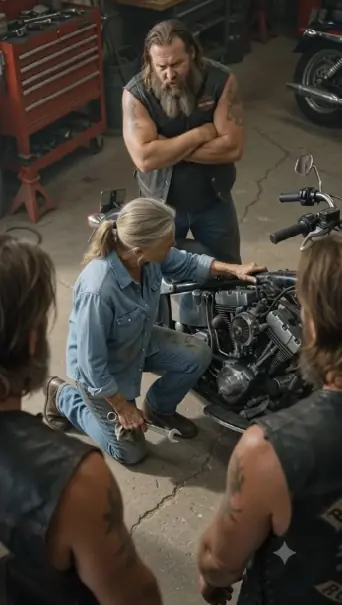
Chapter 1
"You fixing my bike or writing your will?"
The biggest man Maggie Carter had ever seen was standing in her garage doorway, blocking the sun, arms crossed, watching her work.
She didn't look up. "Both, possibly. Hand me that wrench."
He handed her the wrench. "Sorry."
"Oh." She kept working.
That was the moment everything changed. Not with a bang, not with a threat, not with a miracle. It changed with a 72-year-old woman on her knees in the dirt refusing to stop, refusing to fail, and refusing to be anything less than exactly who she had always been.
The foreclosure notice had been on the kitchen table for eleven days. Maggie hadn't moved it, hadn't thrown it away, hadn't called the bank back, and hadn't cried over it—at least not where anyone could see. She had simply set her coffee mug on top of it every morning, drunk her coffee standing up because the chair nearest the window had a broken leg, and then walked out to the garage and started working.
There wasn't much work to start. Hadn't been for a long time. But the garage was hers. The tools were hers. The smell of oil, metal, and dry Nevada heat that baked into the concrete floor every summer—that was hers, too. As long as she was standing in it, wrench in hand, she was still the woman her late husband, Roy, had called the finest mechanic in three counties.
Roy had been gone ten years. The interstate had moved eight years ago. It was just a quiet bureaucratic decision made in Carson City—a new route that shaved eleven minutes off the drive to Reno, taking every traveler, trucker, and lost tourist with it.
Maggie had tried to adapt. She put a new sign on the highway, ran ads in the Ely newspaper, and called every rancher within forty miles to remind them she was still capable. Some of them came. Some months, it was enough to keep the lights on. Other months, the power company got a phone call instead.
She was three payments behind on the mortgage when Roy died. She was eleven behind now. The number on the foreclosure notice was like the sun; she couldn't look directly at it. She knew what it meant, but she couldn't afford to let it become real. If it did, she might sit down in that broken chair and never get back up.
On a Tuesday in the dead center of August, the temperature outside was 104°F. The single standing fan in the garage did nothing but move hot air from one side to the other. Maggie heard them coming before she saw them.
You always heard motorcycles first. It was a sound that started as a distant rumble, low and rolling like thunder that had lost its storm. Then it separated into four distinct machines, each carrying its own particular complaint.