# Racist Woman Calls Cops on Man Reading in Park — Then the Officers Suddenly Stiffened
# Racist Woman Calls Cops on Man Reading in Park — Then the Officers Suddenly Stiffened
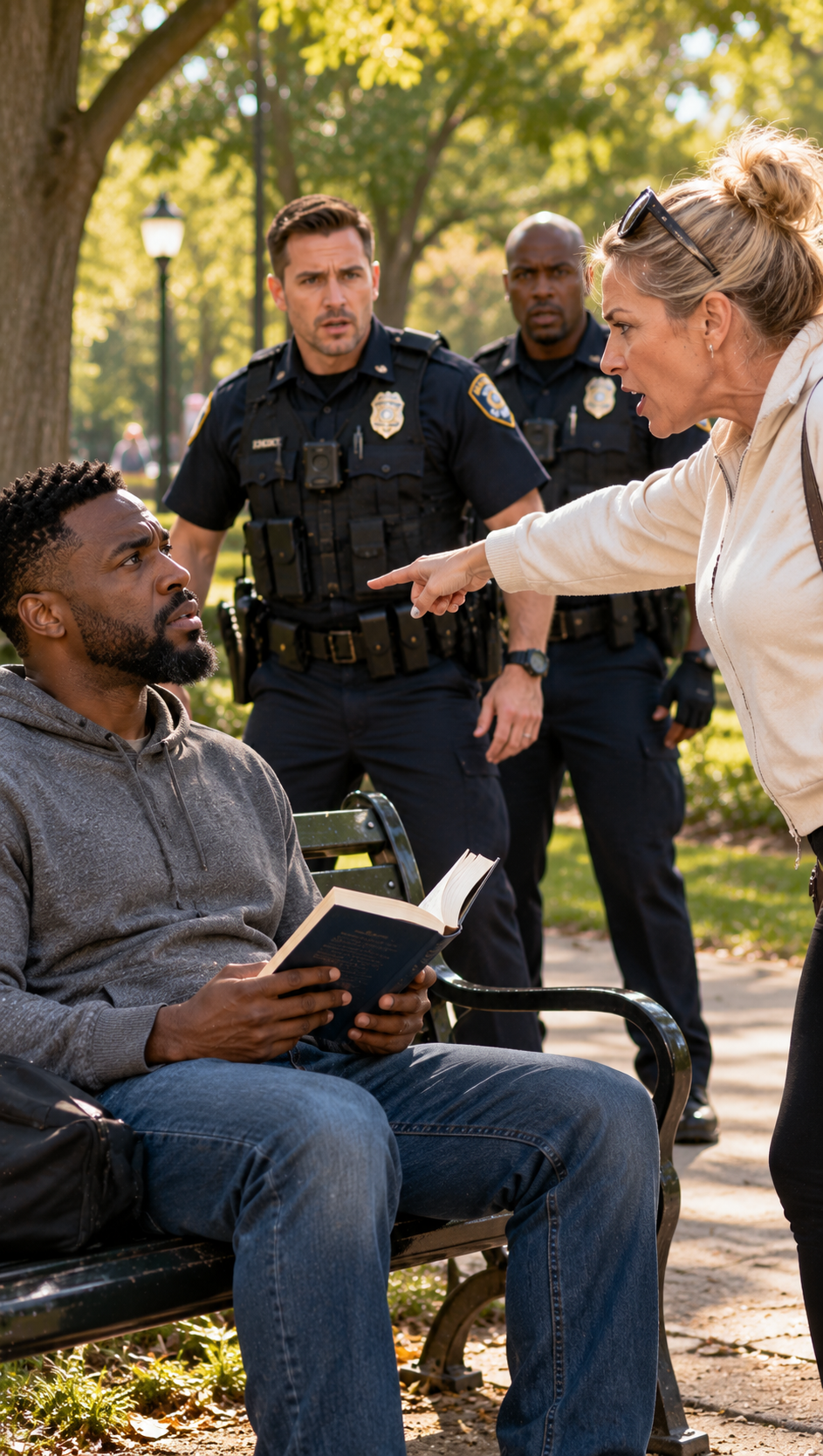
“He’s been sitting here forever.”
The woman pointed at the man on the bench.
He looked up from his book.
“I’m reading.”
Officer Daniel Brooks took the hardcover from his hands and placed it beside him.
“Sir, answer her complaint.”
The man stared at the book.
Then at the officer.
“What exactly did I do?”
The woman folded her arms.
“He’s making people uncomfortable.”
The man looked around.
Joggers.
A father pushing a stroller.
Two teenagers walking a dog.
Nobody seemed uncomfortable.
Except the woman standing three feet from him.
Officer Brooks held out one hand.
“Just give me your name.”
The man’s jaw tightened.
“Why?”
“Because we’re investigating.”
“Investigating what?”
The woman cut in again.
“This is a family park.”
The man looked at her.
“So?”
“You’ve been watching people.”
“I’ve been reading.”
Brooks glanced toward the open book.
Then back at him.
“You’re disturbing people in this park.”
The man blinked.
“By reading on a bench?”
A second officer, Marcus Hill, stood slightly behind Brooks.
Hill had been quiet since arriving.
Now he looked toward the woman.
Then at the empty space around the bench.
The man took a slow breath.
“Check my name, officer.”
Brooks frowned.
“What?”
“My name.”
The woman scoffed.
“Oh, please.”
The man looked at Hill.
“Check it.”
Brooks started to ask another question.
But Hill had already glanced at the name written on Brooks’s notepad.
His posture changed.
His shoulders went rigid.
His eyes lifted immediately.
“Wait.”
Brooks turned.
Hill stared at the man.
“I know that name.”
And suddenly nobody was looking at the book anymore.
---
Twenty minutes earlier, Dr. Malcolm Hayes had walked into Franklin Park with a paperback tucked under his arm and a coffee in his hand.
He had done the same thing dozens of times.
The park was halfway between his apartment and the university where he worked.
On good days, he sat for thirty minutes before heading home.
That afternoon, he chose a bench under an oak tree.
He opened his book.
And disappeared into it.
At least until Linda Mercer noticed him.
Linda had been sitting near the playground with two friends.
She saw Malcolm alone.
Saw his black shoulder bag.
Saw him look up occasionally.
And decided that meant something.
At first, she just stared.
Then she moved closer.
Malcolm noticed but ignored her.
A few minutes later, she asked:
“Are you waiting for someone?”
Malcolm looked up.
“No.”
She didn’t leave.
“Why are you sitting here?”
He held up the book.
“Reading.”
Linda frowned.
“For this long?”
Malcolm almost laughed.
“Yes.”
She walked away.
He thought that was the end of it.
It wasn’t.
Ten minutes later, police arrived.
Brooks approached first.
Hill followed.
Linda rushed over before either officer could speak.
“That’s him.”
Brooks looked at Malcolm.
“Him who?”
“The suspicious man.”
Malcolm closed his book.
“What?”
Linda pointed toward the playground.
“He’s been sitting here watching families.”
Malcolm’s expression hardened.
“No. I haven’t.”
Brooks asked:
“How long have you been here?”
“Maybe forty minutes.”
“Why?”
Malcolm lifted the book again.
“To read.”
Linda shook her head.
“That doesn’t make sense.”
Malcolm looked at her.
“Reading doesn’t make sense?”
That was the first moment Hill looked uncomfortable.
---
Brooks asked Malcolm for identification.
Malcolm asked whether he was being detained.
Brooks said:
“We’re just asking questions.”
“Then am I free to leave?”
Brooks didn’t answer.
Instead, he asked for Malcolm’s name.
Malcolm remained seated.
“Before I give you anything, tell me what law I broke.”
Linda muttered:
“See? He’s being difficult.”
Malcolm turned toward her.
“No. I’m asking why police are questioning me for reading.”
Brooks stepped closer.
“Keep your voice down.”
“My voice is down.”
“You’re becoming confrontational.”
Malcolm stared at him.
“Because I disagree with you?”
Hill finally spoke.
“Sir, nobody said you committed a crime.”
Malcolm looked at him.
“Then why are two officers standing over me?”
Nobody answered.
Linda did.
“Because people like you make others nervous.”
The words sat there.
Brooks glanced at her.
Hill’s face changed.
Malcolm did not raise his voice.
He didn’t need to.
“People like me?”
Linda realized what she had said.
“That’s not what I meant.”
“It’s exactly what you meant.”
Brooks interrupted.
“Let’s keep this calm.”
Malcolm looked at him.
“I was calm before she called you.”
That landed.
Hill looked away.
Brooks reached for the book.
Malcolm instinctively tightened his grip.
“Don’t.”
Brooks took it anyway and placed it on the bench.
“Sir, cooperate.”
Malcolm stared at the officer’s hand.
That simple act changed the entire tone.
The book had become evidence.
Not because it mattered.
Because Brooks had decided the encounter needed control.
Malcolm sat back.
Then said:
“Fine.”
He gave his full name.
Hill heard it.
And froze.
---
“Malcolm Hayes?” Hill asked.
“Yes.”
Hill looked at Brooks.
“Daniel.”
“What?”
Hill lowered his voice.
“That’s Dr. Hayes.”
Brooks frowned.
Malcolm said nothing.
Linda looked between them.
“So?”
Hill ignored her.
He looked back at Malcolm.
“Professor Hayes?”
Malcolm nodded once.
Brooks looked confused.
Hill continued.
“He runs the constitutional policing program at State University.”
Silence.
Linda’s mouth opened.
Brooks stared.
Malcolm’s expression did not change.
He taught law.
More specifically, constitutional criminal procedure.
He also ran a city-funded training partnership for police supervisors, prosecutors, and public defenders.
Hill had attended one of his courses the previous year.
That was where he knew the name.
Brooks looked at Malcolm.
“You’re a law professor?”
Malcolm shook his head.
“That changes nothing.”
Hill nodded slowly.
“No, sir.”
Malcolm pointed toward the book.
“If I cleaned hotel rooms for a living, would I be less allowed to sit here?”
Brooks said nothing.
“If I were unemployed?”
Silence.
“If I had no degree?”
Linda shifted.
Malcolm looked at all three of them.
“My profession is not a permit.”
That sentence stopped the encounter more effectively than any badge could have.
Hill stepped back first.
Brooks picked up the book and handed it to Malcolm.
“I’m sorry.”
Malcolm took it.
“Why?”
Brooks hesitated.
“For the misunderstanding.”
Malcolm looked at Linda.
“No.”
Then back at Brooks.
“This wasn’t a misunderstanding.”
The word made Brooks uncomfortable.
Malcolm continued.
“She described a Black man sitting in a public park.”
Linda snapped:
“I never mentioned race.”
Malcolm looked at her.
“You didn’t have to.”
Hill closed his eyes for half a second.
He knew exactly what Malcolm meant.
---
Brooks asked Linda what crime she believed Malcolm had committed.
She couldn’t name one.
“Suspicious behavior.”
“What behavior?”
“Sitting.”
“Anything else?”
“Watching.”
Malcolm held up the book.
“You mean looking up?”
Linda crossed her arms.
“This is ridiculous.”
Hill answered quietly.
“Yes.”
She looked at him.
“What?”
He repeated:
“This is ridiculous.”
That was the second reversal.
Not because Hill recognized Malcolm.
Because once he recognized the legal problem, he stopped protecting the complaint.
Brooks asked dispatch whether any other calls had been made about Malcolm.
None.
No threats.
No disturbance.
No harassment.
No reports of him approaching children.
Nothing.
Linda had called because Malcolm was sitting alone.
When Brooks asked why that made her nervous, she finally stopped talking.
The officers ended the contact.
Brooks apologized again.
Hill did too.
Malcolm accepted neither dramatically.
He simply said:
“Next time, ask what happened before deciding who the problem is.”
Linda walked away without apologizing.
That bothered Hill more than he expected.
After the scene cleared, he stayed behind.
“Professor?”
Malcolm looked up.
“I remembered your lecture.”
“Which one?”
“The one about suspicion.”
Malcolm waited.
Hill repeated a line from memory.
“Suspicion has to attach to conduct, not identity.”
Malcolm nodded.
“That one.”
Hill looked toward where Linda had stood.
“I should’ve seen it sooner.”
“Yes.”
Hill absorbed that.
Then walked back toward the cruiser.
---
The incident might have ended there.
But someone had filmed it.
A college student sitting on the grass had recorded most of the confrontation.
Within two days, the video had spread locally.
Not because Malcolm was famous.
He wasn’t.
But the irony was impossible to ignore.
Police had questioned a constitutional-law professor for sitting in a public park.
The internet loved that version.
Malcolm hated it.
At a university interview, a reporter asked:
“Did you find it satisfying when the officers realized who you were?”
“No.”
“Why not?”
“Because recognition improved my treatment.”
The reporter paused.
“Isn’t that good?”
“For me.”
Malcolm leaned forward.
“The problem is that I shouldn’t have needed credentials.”
That became the real story.
The city police department reviewed the body-camera footage.
Brooks had not violated a major use-of-force policy.
There was no arrest.
No physical restraint.
But supervisors found problems with the stop.
The officers never established a specific suspected offense.
They allowed the caller’s discomfort to guide the encounter.
And Brooks escalated control by taking Malcolm’s book when there was no safety reason to do so.
He received formal counseling and retraining.
Hill received no discipline but requested additional bias-intervention training.
The department also met with Malcolm.
He agreed to participate under one condition.
“No training built around me being a professor.”
The deputy chief looked confused.
Malcolm explained.
“Use a man reading in a park.”
“That’s it?”
“That’s the point.”
---
The department eventually created a scenario based on the encounter.
No race labels in the first briefing.
No occupation.
No hidden twist.
Trainees received one fact:
A caller reports a man sitting alone in a park for forty minutes and says he makes her uncomfortable.
Officers had to decide what to do.
Some approached.
Some observed first.
Some spoke to the caller and asked what specific conduct concerned her.
The best response came from a young recruit.
She asked:
“Is there any reported crime?”
The instructor said no.
“Any threatening conduct?”
No.
“Then why am I contacting him?”
Malcolm, watching from the back of the room, smiled.
That was the answer.
Not every call required confrontation.
Not every discomfort required police action.
And not every person who looked out of place was out of place.
Months later, Malcolm returned to Franklin Park.
Same bench.
Same shoulder bag.
Different book.
He sat down beneath the oak tree.
A patrol officer walked past.
Malcolm recognized Hill.
Hill recognized him too.
Neither stopped.
Hill simply nodded.
Malcolm nodded back.
Then kept reading.
A woman sat on another bench nearby.
A teenager rode past on a bicycle.
Two children chased each other along the path.
Nobody cared who Malcolm was.
Professor.
Civilian.
Stranger.
Black man.
Reader.
It didn’t matter.
That was how he wanted it.
People remembered the moment the officers suddenly stiffened.
The name.
The recognition.
The embarrassment.
But Malcolm remembered the minutes before that.
When he was simply a man with a book.
That was the version that mattered.
Because his rights existed before anyone knew his résumé.
Before the officers recognized his name.
Before anyone realized he taught the very law they were supposed to follow.
He opened to the page Brooks had interrupted.
Found his place.
And kept reading.