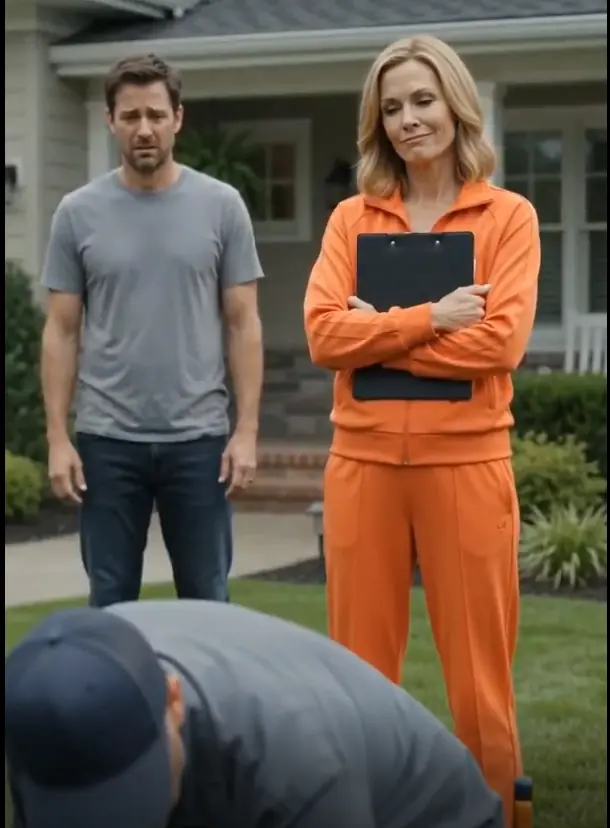
The first thing Karen Whitmore said while standing in the middle of my front yard was not hello.
It wasn't an explanation, a warning, or even one of those painfully formal statements that homeowners' association people seem to practice in front of a mirror before they come knocking on someone's door.
She simply pointed at my lawn with a black clipboard tucked beneath one arm and shouted at three landscaping workers as though she were commanding a demolition crew.
“Rip this grass out! This lawn is completely unacceptable!”
For several seconds, I stood frozen in my doorway, trying to understand what I was seeing.
It was a bright Tuesday morning in late May, the kind of morning that usually made our neighborhood look like an advertisement for suburban perfection. Sunlight spilled across identical sidewalks, sprinklers glittered in neighboring yards, and somewhere down the street, somebody was mowing grass while a golden retriever barked lazily behind a white fence.
And in the middle of all that peaceful normality, strangers were preparing to tear apart my property.
One man was unloading a sod cutter.
Another had already driven a shovel into the edge of my lawn.
And Karen Whitmore—the president of the Briar Glen Homeowners Association—stood beside them in a bright orange tracksuit, holding her clipboard like a judge preparing to deliver a sentence.
I didn't even put on shoes.
I ran outside in socks.
“Hey!”
Nobody heard me over the engine starting.
I sprinted across the porch and onto the grass.
“HEY!”
The man operating the sod cutter finally looked up.
Karen turned around.
For a moment, she actually appeared irritated that I had interrupted her.
That expression told me everything I needed to know.
This wasn't a misunderstanding.
She knew exactly whose property she was standing on.
“Karen, stay off my property!”
She stared at me as though I had said something ridiculous.
Then she pointed toward the lawn.
“You can't destroy my yard!”
I almost laughed, because the absurdity of that sentence was difficult to process.
“My yard?”
“Yes, your yard,” she snapped, emphasizing the words as though I were being deliberately stupid. “Your runoff is affecting HOA-maintained landscaping, and you've ignored repeated compliance notices.”
“I haven't received any notices.”
“You have.”
“No, I haven't.”
Karen lifted her clipboard.
“It's documented.”
That was Karen's favorite phrase.
It's documented.
Whenever she wanted something to become true, she wrote it down.
Then she acted as though the existence of ink on paper somehow transformed her opinion into law.
Unfortunately, I had spent the previous eight months learning just how dangerous that attitude could become.
And by the time Karen Whitmore finished with my lawn, the argument would no longer be about grass.
It would involve tens of thousands of dollars in property damage, a municipal drainage system, fraudulent HOA records, an emergency investigation, a landscaping company that realized it had been lied to, and one question Karen couldn't answer when a police officer finally stood in front of her.
“Then show us the authorization.”
But I'm getting ahead of myself.
To understand why Karen believed she could order strangers to destroy my property in broad daylight, you need to understand Briar Glen.
And you need to understand Karen.
...
My name is Daniel Mercer, and when I bought my house in Briar Glen, I genuinely thought I had found the quietest neighborhood in the county.
I was forty, divorced, working remotely as a civil engineering consultant, and completely uninterested in neighborhood politics.
I didn't want drama.
I didn't want committee meetings.
I didn't want to know whose trash cans had been left visible from the street for more than twenty-four hours.
I wanted a garage, a decent kitchen, enough space for an office, and a backyard where I could sit with a beer on Friday evening without listening to traffic.
Briar Glen seemed perfect.
There were sixty-eight houses arranged around three curved streets, a small playground near the entrance, two landscaped retention areas, and rows of mature maple trees that made the neighborhood beautiful in autumn.
The HOA dues were reasonable.
The rules seemed ordinary.
Keep your property maintained.
Don't paint your house fluorescent purple.
Don't park abandoned vehicles on the street.
Don't build a twelve-foot fence.
Nothing unusual.
The house I bought sat near the lowest point of Hawthorne Lane, which mattered more than I initially realized.
My front yard sloped gently toward the street, and beneath that innocent-looking stretch of grass was part of an engineered drainage system installed when the subdivision was developed.
I knew this because I had reviewed the property survey before buying the house.
Most homeowners probably wouldn't have noticed the drainage easement marked across the front portion of the lot.
I did.
Civil engineering was my profession.
Water goes somewhere.
That's one of the first lessons you learn.
Every slope, ditch, pipe, curb, lawn, retention pond, and storm drain plays a role, even when ordinary people never notice it.
The grass in my front yard wasn't merely decorative.
Its dense root structure stabilized the soil above a shallow drainage swale designed to slow stormwater before it reached the curb.
It looked like an ordinary lawn because that was the point.
The original developers had designed the drainage infrastructure to blend into the neighborhood.
For nearly twelve years, it worked perfectly.
Then Karen became HOA president.
Karen Whitmore lived three streets away in one of the largest houses in Briar Glen.
She was probably in her late forties, although she carried herself with the exhausting confidence of someone who believed age, experience, and authority were all the same thing.
Before becoming HOA president, she had chaired the landscaping committee.
Before that, she had apparently been responsible for seasonal decorations.
Nobody seemed entirely certain how she had accumulated so much influence.
She simply kept volunteering for things nobody else wanted to do.
That was her genius.
Most people hate HOA meetings.
Karen loved them.
Most people didn't want to spend Tuesday evenings debating mailbox colors.
Karen considered that a meaningful use of human existence.
While everyone else was busy working, raising children, traveling, or living ordinary lives, Karen was learning every procedural weakness in the association.
Eventually, she became president.
At first, nothing dramatic happened.
Then the notices started.
A basketball hoop was allegedly three inches too close to a sidewalk.
A family received a warning because their children's bicycles were visible from the street.
Mr. Alvarez, a retired firefighter who had lived in Briar Glen for nine years, was ordered to remove a small American flag from his garden because Karen claimed the mounting bracket violated architectural guidelines.
He fought her.
She lost.
She never forgave him.
That should have warned the rest of us.
Karen didn't treat HOA rules as community standards.
She treated them as weapons.
And eventually, she pointed one at me.
....
My trouble started with a mailbox.
Not the mailbox itself.
The post.
One winter storm had loosened the wooden post holding my mailbox, so in March, I replaced it.
I bought pressure-treated lumber, measured the original dimensions, painted it the same dark gray color, and installed it in almost exactly the same position.
Two days later, I received a violation notice.
UNAPPROVED EXTERIOR MODIFICATION.
I stared at the letter for several seconds.
Then I walked outside and compared my mailbox with the neighbor's.
They looked nearly identical.
I emailed the HOA management address.
Karen responded personally.
She informed me that replacing an exterior structure required approval from the Architectural Review Committee.
I replied that I had replaced damaged wood with identical material and had not changed the design.
Her answer came seventeen minutes later.
“Any exterior modification visible from common areas requires prior authorization.”
I asked her to cite the section.
She sent me six paragraphs from the HOA rules.
None supported what she had said.
I politely pointed that out.
That was my first mistake.
Karen didn't like being corrected.
The violation disappeared three days later, but after that, I began receiving notices with remarkable frequency.
Trash container visible at 8:10 a.m. after collection day.
Garden hose improperly stored.
Decorative planter allegedly obstructing sidewalk visibility.
Grass exceeding approved height.
That last one was particularly funny because I measured it.
Three inches.
The HOA limit was four.
I took photographs with a ruler and emailed them.
The violation was withdrawn.
Then another appeared.
After several months, the pattern became obvious.
Karen wanted compliance, but more than that, she wanted submission.
If she sent you a notice and you fixed the supposed problem without questioning her, she usually moved on.
If you challenged her interpretation, she escalated.
I challenged everything.