She Was Shamed in Front of the Entire Board — The Billionaire Holding Their $2 Billion Lifeline Never Raised Her Voic
A powerful Black billionaire enters the forty-fourth floor of a failing Manhattan aerospace company without security, assistants, or any visible sign of who she really is. She is there to finalize a two-billion-dollar rescue package that could save thousands of jobs and prevent the company from collapsing before the end of the quarter.
But the silver-haired businessman running the company has spent three months negotiating with her investment firm without ever bothering to learn what its owner looks like. When he sees her entering his private reception among bankers, directors, attorneys, and wealthy guests, he assumes she does not belong. He humiliates her in front of the room, slaps her extended hand away, and deliberately drops her investment portfolio onto the marble floor while his wife laughs.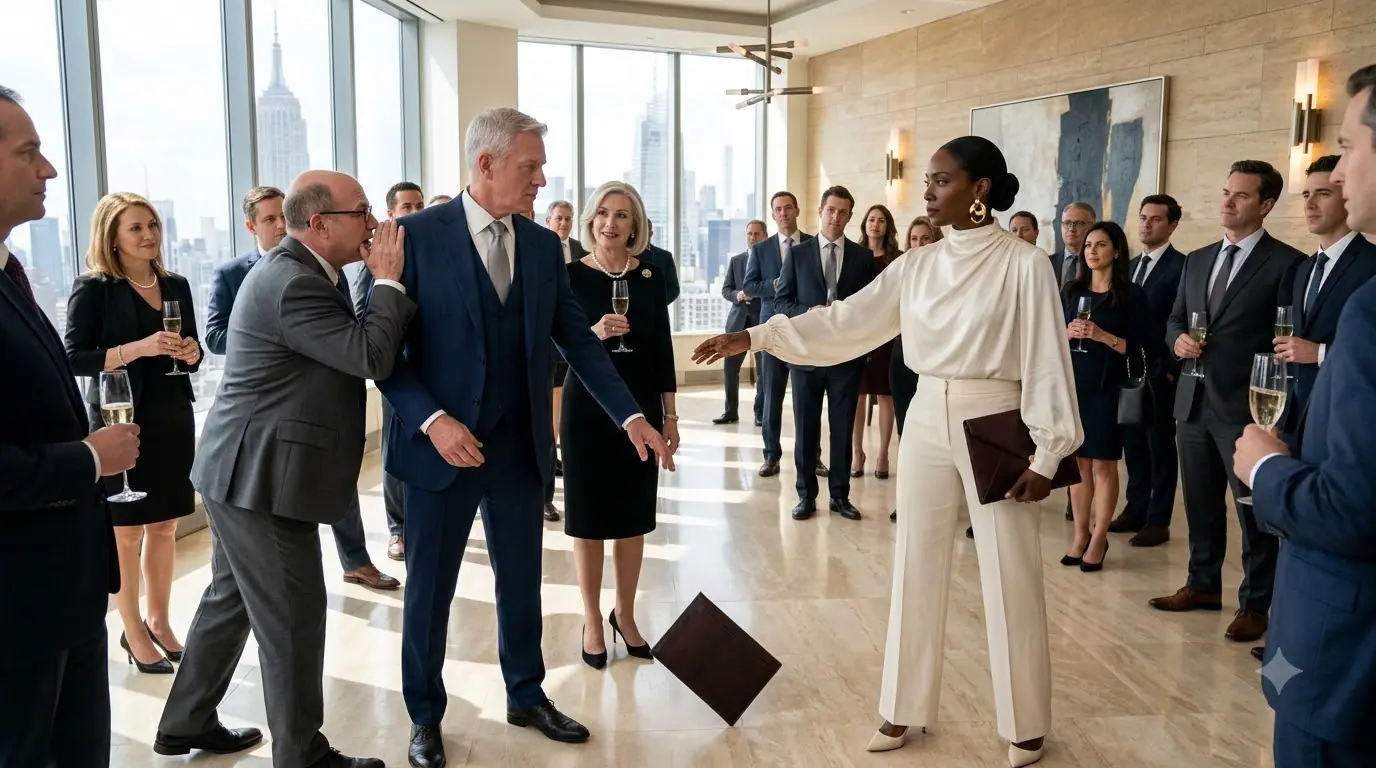
The billionaire never bends down to pick it up.
Seconds later, the businessman’s attorney rushes through the crowd and reveals the truth: the woman he just insulted personally controls the rescue deal keeping his company alive. But instead of immediately destroying him, she makes a far more dangerous decision. She gives the executives one final opportunity to prove whether the company deserves to survive without the man who brought it to the edge of collapse.
What follows becomes a battle over power, pride, thousands of jobs, hidden financial decisions, and one question the billionaire refuses to ignore: if a leader cannot recognize another person’s dignity without first recognizing their wealth, should that leader be trusted with anyone’s future?
The Black billionaire did not bend down for the portfolio.
That was the first thing everyone remembered afterward.
Not the insult.
Not the laughter.
Not even the sharp sound of the white businessman’s palm striking her hand away in the middle of the crowded executive reception.
They remembered the portfolio lying open on the polished marble floor.
A black leather folder.
Several pages had slipped halfway out.
One page showed a financing structure worth more money than most people in the room would earn in ten lifetimes.
The businessman had no idea.
He stood less than three feet from the woman whose signature could determine whether his company existed six weeks from now, and he smiled as though he had just corrected an inconvenience.
“Don’t touch me,” he said.
His wife stood beside him with a champagne flute balanced delicately between two fingers.
She laughed.
Not loudly.
That made it worse.
The kind of laugh designed for private clubs and charity galas, quiet enough to remain technically polite while still telling everyone nearby exactly who had been judged.
“Honey,” she murmured, “look at her trying.”
The Black woman lowered the hand he had slapped away.
Her face remained calm.
Her cream silk blouse fell in soft folds from the high collar to her waist. Wide-leg ivory trousers brushed the tops of pointed heels. Large sculptural gold earrings caught the winter sunlight pouring through the forty-fourth-floor windows.
Nothing about her expression revealed anger.
That unsettled the businessman more than shouting would have.
The reception around them slowly quieted.
Forty executives, attorneys, directors, bankers, and spouses stood beneath a ceiling of brass and glass.
Most held champagne.
Several pretended not to stare.
A few openly watched.
The businessman looked at the woman from head to toe.
He had spent his life evaluating people quickly.
Who mattered.
Who wanted something.
Who could hurt him.
Who could be ignored.
He had built a career on those decisions.
The woman in front of him did not fit the visual category he associated with the meeting he was about to attend.
He expected bankers.
Older men.
Lawyers.
A senior partner from the investment firm.
Perhaps one of the managing directors he had spoken with during negotiations.
He did not expect her.
So he made the mistake men like him often made when certainty became habit.
He decided before asking.
The woman looked down briefly at the portfolio on the floor.
Then back at him.
“Mr. Chairman,” she said quietly, “you’re going to remember this moment for the rest of your life.”
He laughed directly at her.
“And who exactly do you think you are?”
The elevator doors opened behind the crowd.
A gray-haired attorney stepped out carrying two phones and a red legal folder.
He was walking quickly.
Then he saw the portfolio on the floor.
He saw the woman.
He saw the businessman.
And he stopped.
The blood seemed to leave his face.
The businessman noticed.
“What?”
The attorney did not answer immediately.
He pushed through the guests.
“Sir.”
The businessman frowned.
“What is it?”
The attorney leaned close.
His voice dropped.
But not enough.
Several people heard every word.
“She’s the principal.”
The businessman’s expression did not change.
“What principal?”
The attorney stared at him.
“Sinclair Capital.”
Silence.
The businessman looked toward the Black woman.
Then back at the attorney.
“That’s not possible.”
The attorney whispered, “She owns it.”
The wife’s champagne glass lowered.
The businessman’s smile vanished.
The attorney continued, because there was no gentle way left to say it.
“She controls the rescue fund.”
Nobody moved.
The Black woman stood beneath the windows overlooking Manhattan.
Forty-four floors below, traffic crawled along Sixth Avenue.
Inside the room, men who had spent the morning discussing liquidity, covenant waivers, creditor standstills, and emergency bridge financing suddenly forgot every number.
The businessman looked at the portfolio on the floor.
Then at the woman again.
Inside it was the final structure for a two-billion-dollar capital package.
His company needed it.
Not eventually.
Not strategically.
Immediately.
Whittaker Aeronautics had thirty-nine days of usable liquidity remaining.
Forty-five if certain suppliers accepted delayed payment.
Thirty-two if two foreign customers exercised cancellation clauses.
The company had already borrowed against nearly every unencumbered asset it owned.
Its share price had fallen sixty-eight percent in eleven months.
Three factories were operating below capacity.
A defense program had suffered delays.
A commercial engine project had consumed hundreds of millions beyond budget.
And the company’s debt maturity schedule looked like a wall approaching at highway speed.
The Black woman knew every number.
She knew them because her investment firm had spent ninety-one days examining the company from the inside.
She knew which factory could be saved.
Which division should be sold.
Which debt could be refinanced.
Which executives had hidden problems.
Which ones had tried to warn the board.
Which suppliers would collapse if Whittaker Aeronautics missed another quarter of payments.
She knew the names of small towns in Ohio, Kansas, Georgia, and Arizona where thousands of families depended directly or indirectly on the company.
That was why she was there.
Not for the businessman.
For everything around him.
He swallowed.
“I think there’s been a misunderstanding.”
The woman’s eyes stayed on him.
“No.”
His wife stepped forward.
“I’m sure my husband didn’t realize—”
“That’s correct.”
The wife stopped.
The Black woman looked at both of them.
“He didn’t realize.”
The sentence sounded simple.
It was not.
The businessman straightened.
“I was expecting representatives from Sinclair Capital.”
“You got one.”
“I was told the managing director would attend.”
“He is.”
She glanced toward the elevators.
“He’s downstairs.”
The businessman looked confused.
“Then why are you—”
“I came early.”
She paused.
“Alone.”
The attorney closed his eyes for half a second.
Every senior person in the room understood what that meant.
No introduction.
No advance team.
No entourage.
No cues.
The woman had entered the building exactly as an ordinary visitor might.
And the chairman had shown her exactly what ordinary visitors could expect if he did not immediately recognize their status.
He looked around the room.
Suddenly the witnesses mattered.
A minute earlier they had made him feel powerful.
Now they made escape impossible.
A board member near the windows placed his champagne on a tray.
Another director stared at the floor.
The chief financial officer had gone completely still.
The Black woman finally crouched.
But she did not pick up the portfolio.
She closed it.
Then stood again.
The businessman moved forward.
“Let me.”
He reached for it.
She placed one heel lightly on the edge.
He stopped.
“You were comfortable leaving it there thirty seconds ago.”
Nobody breathed.
The businessman slowly withdrew his hand.
She removed her foot.
Then she looked toward the gray-haired attorney.
“Would you pick that up for me?”
He immediately did.
He gathered every page, straightened them, closed the leather folder, and handed it to her.
She thanked him.
The businessman looked as though someone had reduced his height by six inches.
The woman turned toward the reception room.
“Who here is actually attending the financing meeting?”
Hands shifted.
People glanced at one another.
The chief financial officer raised his hand first.
Then four board members.
General counsel.
Two outside attorneys.
The head of operations.
The head of engineering.
The businessman.
The woman nodded.
“Good.”
She looked toward the conference room doors.
“We start in five minutes.”
The businessman stared.
“You still want to meet?”
She looked at him.
“I didn’t fly across the Atlantic last night to discuss your personality.”
Then she walked past him.
His wife whispered, “Do something.”
He did not know what.
That frightened him more than anything.
Three hours earlier, the billionaire had been barefoot in her TriBeCa kitchen.
The Hudson River looked metallic under February clouds.
She stood beside an oak counter grinding Ethiopian coffee by hand while financial reports glowed on a tablet.