The rain had stopped less than twenty minutes earlier, but downtown Chicago still looked as though it had been dipped in black glass.
Water gleamed along the curbs, gathering in shallow pools beneath traffic lights, while the windows of high-rise hotels and office towers reflected themselves across the wet pavement in trembling ribbons of gold, white, and red. Cars hissed through the intersections. Horns sounded somewhere beyond Michigan Avenue. Men in expensive coats hurried toward waiting sedans, women ducked beneath umbrellas even though the rain had already passed, and delivery cyclists threaded between taxis with their heads lowered against the cold November wind.
Everyone seemed to be going somewhere.
Everyone except Ethan Carter.
He sat beneath the broad stone awning of the Halston Grand Hotel, motionless in a black wheelchair that cost more than some families earned in several months.
At forty-two, Ethan had the kind of life that business magazines liked to photograph.
He owned Carter Meridian Capital, an investment firm with offices in Chicago, New York, London, and Singapore. His penthouse occupied the top two floors of a glass tower overlooking Lake Michigan. His garage contained cars he could no longer drive, including a silver Aston Martin he had bought six weeks before the accident and a vintage Porsche his father would once have called an irresponsible waste of money.
He had a private driver, two assistants, a housekeeper, a chef who came five days a week, and enough money invested across enough markets that he could stop working tomorrow and still never spend all of it.
On his left wrist sat a watch worth more than the apartment in which he had grown up.
In the inside pocket of his tailored charcoal suit was a black payment card with virtually no practical spending limit.
Ethan could buy almost anything.
Almost.
He watched a young couple cross the street.
The woman laughed as she jumped over a puddle. The man caught her around the waist, nearly slipping himself, and the two of them stumbled onto the sidewalk laughing like children.
Ethan looked away.
It was the movement that bothered him most.
Not the laughter.
Not their happiness.
Movement.
People took it for granted with an innocence that had become almost offensive to him.
They ran because a light was changing. They complained about climbing stairs. They stood impatiently in lines. They danced badly at weddings. They kicked off uncomfortable shoes after long evenings. They stretched their legs beneath restaurant tables without thinking about the command traveling from brain to muscle.
Three years earlier, Ethan had done all those things.
He had run five miles before breakfast.
He had skied in Colorado.
He had played tennis badly but enthusiastically.
He had once climbed six flights of stairs because the elevator in his office building was too slow.
Then, on a rainy October night, a truck had crossed two lanes on Interstate 90.
There had been headlights.
A horn.
The violent scream of tires.
And then nothing.
When Ethan woke in Northwestern Memorial Hospital, his mother was sitting beside his bed with both hands wrapped around his right hand.
He remembered trying to move.
He remembered the strange absence below his waist.
Not pain.
Absence.
“Mom,” he had whispered.
She had looked at him.
He had seen the answer before he asked the question.
“Why can’t I feel my legs?”
Three years later, he could still remember the silence that followed.
The first surgery lasted nine hours.
The second came four days later.
Then came weeks in the hospital, months in rehabilitation, consultations with neurologists and spinal specialists, experimental therapies, electrical stimulation, stem-cell discussions, devices, braces, machines, injections, exercises, and endless appointments conducted in rooms decorated with inspirational posters.
Ethan approached recovery the way he approached business.
He attacked it.
He hired the best.
He researched everything.
He flew specialists to Chicago.
When someone told him a treatment cost two hundred thousand dollars, he asked when they could begin.
When someone mentioned a clinic in Switzerland, he booked a plane.
When a physician in California told him about an experimental rehabilitation program, Ethan rented a house nearby for three months.
He believed every problem had a price.
And if it had a price, Ethan Carter could pay it.
But the human body did not negotiate.
Neither did damaged nerves.
Progress came in fragments so small that only therapists seemed excited by them.
A twitch.
A contraction.
A little more sensation.
A little more control.
Then a plateau.
Then another disappointment.
Eventually, the language around him began changing.
Doctors stopped saying, “When you walk again.”
They started saying, “If we see additional recovery.”
Later, even that softened into phrases such as “quality of life,” “adaptive independence,” and “long-term expectations.”
The sentence Ethan remembered most came from a specialist in Boston.
The doctor had been kind, which somehow made it worse.
“I don't want to take away your hope, Mr. Carter,” he had said, “but I also don't want you spending the rest of your life waiting for your old life to return.”
Ethan had stared at him.
“So you're telling me to give up.”
“No. I'm telling you to build a life that doesn't depend on one outcome.”
To Ethan, there had been no difference.
He returned to Chicago angrier than before.
Physical therapy became irregular.
Then rare.
He stopped answering calls from friends who wanted to visit.
He sold neither the sports cars nor the running shoes still sitting in his closet, because doing so would mean admitting they belonged to somebody he had ceased to be.
His company continued making money.
In fact, it made more.
Ethan threw himself into work because numbers were obedient in ways his body was not. Markets moved according to forces he could analyze. Companies could be bought, restructured, sold. Problems could be reduced to spreadsheets and risk models.
His fortune grew.
His world shrank.
By the third anniversary of the accident, he could cross oceans whenever he wanted, yet some mornings he lacked the desire to cross his own living room.
That evening at the Halston Grand, Ethan had attended a charity dinner he had nearly canceled.
The irony was not lost on him.
He had sat beneath chandeliers while wealthy people congratulated one another for generosity, listened to speeches about changing lives, donated half a million dollars without feeling anything, and left before dessert.
His driver, Marcus Bell, had gone to bring the car around.
Ethan had insisted on waiting outside.
He needed air.
That was when he noticed the old man.
He sat perhaps twenty yards away beneath the narrow shelter of a closed jewelry store.
People had passed him all evening.
Ethan had probably passed people like him thousands of times.
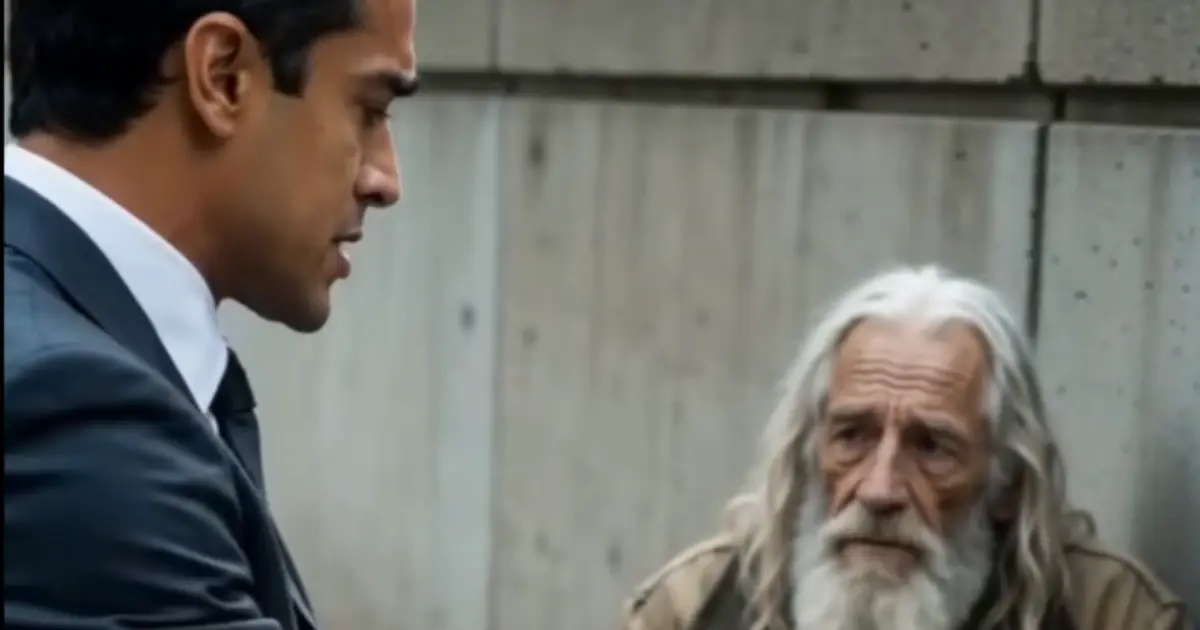
The man appeared to be in his seventies, though hardship had a way of adding years. Long silver-white hair touched the collar of a faded brown jacket, and a thick beard covered much of his weathered face. A gray blanket lay folded across his legs. Beside him sat a paper cup containing a few coins and a small cardboard sign.
ANYTHING HELPS.
GOD BLESS.
There was nothing unusual about him.
And yet Ethan kept looking.
Perhaps it was because the old man wasn't watching the crowd with the anxious attention of someone hoping for money.
He was watching the sky.
The rain clouds were breaking apart above the towers, exposing a narrow strip of dark blue.
The old man looked peaceful.
That irritated Ethan.
A man with almost nothing looked more at peace than a man who possessed almost everything.
Ethan placed his hands on the wheels of his chair.
He could have remained beneath the hotel awning.
Instead, he rolled toward him.
The old man heard the wheels approaching and lowered his gaze.
Their eyes met.
“Good evening,” he said.
His voice was deeper than Ethan expected.
“Evening.”
The old man looked at Ethan's suit, then at his face.
His eyes briefly passed over the wheelchair but did not linger.
No pity.
Ethan noticed immediately.
Most strangers had one of two reactions: they stared too long, or they tried so hard not to stare that their discomfort became obvious.
The old man did neither.
“You chose a cold night to sit outside,” Ethan said.
The old man smiled.
“So did you.”
Ethan glanced toward the hotel.
“I'm waiting for my car.”
“And I'm waiting for tomorrow.”
Ethan almost laughed.
“That sounds philosophical.”
“Only because I'm old. Young men can say foolish things and people call them foolish. Old men say the same things and people call them wisdom.”
Despite himself, Ethan smiled.
The old man noticed.
“There,” he said.
“There what?”
“You haven't forgotten how.”
“How what?”
“To smile.”
The smile disappeared.
“You don't know anything about me.”
“No,” the old man replied. “But sadness has a familiar face.”
Ethan's jaw tightened.
The old man looked toward the street again.
“You've had a difficult journey.”
Something about the sentence struck Ethan harder than it should have.
Perhaps because it wasn't phrased as a question.
“You have no idea.”
The old man nodded slowly.
“Perhaps.”
That calm answer annoyed him even more.
Ethan reached inside his jacket.
If the man wanted to play the wise beggar, fine.
Money would bring the conversation back to reality.
He pulled out his wallet.
There were several hundred-dollar bills inside, but his fingers passed over them.
Instead, almost impulsively, he removed the sleek black card.
He looked at it.
Three years of anger condensed into that little rectangle.
He extended it toward the old man.
“Take it.”
The old man looked down.
Then up.
“What is it?”
“You know what it is.”
“I know what a card is.”
“Then take it.”
The old man's eyes narrowed slightly.
“Why?”
Ethan gave a humorless laugh.
“Because apparently I'm feeling charitable.”
“You don't look charitable.”
The answer caught Ethan off guard.
“What do I look like?”
“Angry.”
Ethan's hand remained extended.
“Take the card.”
“No.”
“What?”
“I said no.”
Ethan stared at him.
The old man returned his gaze without embarrassment.
“I don't need your card.”
“You're sitting on a sidewalk asking strangers for money.”
“Tonight, yes.”
“And you're refusing mine?”
“I'm refusing your anger.”
Ethan's fingers tightened around the card.
“You don't know what you're talking about.”
“Then explain it.”
“I don't owe you an explanation.”
“No.”
The old man adjusted the blanket.
“But you're still here.”
Ethan should have left.
Instead, he heard himself say, “Do you know how much money is available through this card?”
“No.”
“Enough to get you off this street.”
“Perhaps.”
“Enough to put you in a hotel for months.”
The old man said nothing.
“Enough to buy food, clothes, whatever you need.”
Still nothing.
Ethan pushed the card toward him again.
“Take it.”
The old man studied Ethan's face.
“Why?”
The question finally broke something.
“Because it doesn't matter!”
Several pedestrians glanced toward them.
Ethan lowered his voice, but the bitterness remained.
“Do you understand? None of it matters.”
He tapped the card against his palm.
“I spent three years believing there had to be some doctor, some hospital, some machine, some treatment somewhere in the world that I could buy. I spent millions.”
The old man listened.
“I went everywhere. I paid everyone. I did everything they told me.”
His voice cracked.
“And I'm still sitting in this chair.”
The old man's expression changed.
Not pity.
Something closer to recognition.
Ethan swallowed.
“So take it.”
He held out the card one last time.
“Take this. This money is useless to me if it can't make me walk again.”
For several seconds, the old man did not move.
Then he placed one hand against the wall.
Slowly, he rose.
Ethan watched him straighten.
The blanket slid to the pavement.
The old man stood surprisingly tall.
He stepped toward Ethan.
One step.
Then another.
There was strength in his movement that seemed inconsistent with his age and appearance.
He stopped directly in front of Ethan.
Ethan looked up.
The old man reached down and gently placed one weathered hand against his shoulder.
“My child,” he said quietly, “don't be sad.”
Ethan almost recoiled.
“Don't call me that.”
The old man's hand remained where it was.
“You've been angry for a long time.”
“You think?”
“Yes.”
“You think that's going to make me walk?”
“No.”
The answer surprised him.
Then the old man leaned closer.
“Meet me here tonight.”
Ethan frowned.
“What?”
“Exactly at midnight.”
“For what?”
The old man's eyes held his.
“For the thing you believe money cannot buy.”
Ethan's heartbeat changed.
He hated himself for what happened next.
Hope.
Small.
Immediate.
Dangerous.
“What are you saying?”
The old man smiled.
“I will make you walk again.”
The city seemed suddenly quieter.
Ethan stared at him.
For three years, he had learned to distrust promises.
Doctors did not promise.
Therapists did not promise.
Even the most questionable clinics had been careful with their language.
Yet this homeless stranger had said it as calmly as though he were promising to meet Ethan for coffee.
“You're insane.”
“Possibly.”
“You can't make me walk.”
“Then don't come.”
The old man turned.
Ethan caught his sleeve.
“Wait.”
He hated the desperation in his own voice.
The old man looked back.
“Really?”
Ethan's throat tightened.
“You can do this?”
The old man looked at him for a long moment.
“Midnight.”
Then he walked away.
“Wait!”
The man did not stop.
“What's your name?”
No answer.
Ethan watched the brown jacket disappear among pedestrians beneath the streetlights.
Marcus arrived with the car several minutes later.
He found Ethan staring down the sidewalk.
“Mr. Carter?”
Ethan did not answer.
Marcus opened the rear passenger door and lowered the ramp.
“Everything okay?”
Ethan finally looked at him.
“What time is it?”
Marcus checked his phone.
“Eight forty-three.”
Ethan looked toward the place where the old man had disappeared.
“Take me home.”
At 10:17 p.m., Ethan was still thinking about him.
He sat alone in his penthouse with Chicago spread beneath the windows.
A glass of bourbon rested untouched on the table.
The black card lay beside it.
The old man had never taken it.
That detail bothered Ethan.
If the man were running some kind of scam, refusing the card made no sense.
Unless refusing it was part of the scam.
Perhaps he wanted Ethan alone at midnight.
Perhaps accomplices would be waiting.
Ethan picked up his phone.
He searched for stories about faith healers, street scams, miracle cures.
The internet offered thousands.
He threw the phone down.
“This is ridiculous.”
His voice echoed through the apartment.
He wheeled toward the bedroom.
Stopped.
Turned around.
At 10:31, he called Marcus.
“Sir?”
“Come back.”
A pause.
“Tonight?”
“Yes.”
“Where are we going?”
Ethan looked at the clock.
“Downtown.”
Marcus knew him well enough not to ask why.
“I'll be there in twenty minutes.”
At 11:34, the black sedan stopped one block from the Halston Grand.
Marcus looked at Ethan through the rearview mirror.
“Are you meeting someone?”
“Yes.”
“At midnight?”
“Yes.”
Marcus hesitated.
“Do I need to be concerned?”
Ethan almost said no.
Instead, he said, “Probably.”
Marcus turned around.
“What does that mean?”
“It means an old homeless man told me he could make me walk.”
Marcus stared at him.
Ethan waited for laughter.
None came.
“What did he ask for?”
“Nothing.”
“That worries me more.”
“It worries me too.”
“Then why are we here?”
Ethan looked through the rain-streaked window.
“Because I need to know.”
Marcus studied him, then nodded.
“I'll stay close.”
“No.”
“Ethan—”
It was rare for Marcus to use his first name.
“Please.”
Marcus exhaled.
“I'll wait at the corner. You call, I come. Immediately.”
“Fine.”
By 11:42, Ethan was alone beneath the jewelry-store awning.
The cardboard sign was gone.
So was the blanket.
There was no evidence the old man had ever been there.
At 11:48, Ethan began feeling foolish.
At 11:53, foolishness became anger.
At 11:57, he nearly called Marcus.
Of course the man wasn't coming.
Of course.
Ethan had spent millions on specialists, and now he was sitting outside at midnight waiting for a homeless stranger to perform a miracle.
He looked at his watch.
11:59.
“Idiot,” he muttered.
Then he saw movement at the far end of the sidewalk.
A figure emerged from the darkness.
The old man.
But something was different.
The worn brown jacket was gone.
He wore a simple charcoal coat over clean dark clothing. His white hair had been combed back, though his beard remained.
He walked toward Ethan without hurry.
Exactly as the minute hand reached twelve, he stopped.
“You came.”
Ethan stared at him.
“So did you.”
“I said I would.”
“Who are you?”
The old man ignored the question.
Instead, he looked down at the wheelchair.
“Do you still believe you can walk?”
Ethan almost laughed.
“That's your miracle?”
“Answer me.”
“My belief has nothing to do with my spinal cord.”
“Perhaps.”
“Not perhaps. That's medicine.”
“I didn't ask what medicine says.”
Ethan's irritation returned.
“You said you would make me walk.”
“And you came.”
“Yes.”
“Why?”
“Because you said you could help me.”
“No.”
The old man's gaze sharpened.
“You came because some part of you still believes your story isn't finished.”
Ethan said nothing.
The old man crouched until their eyes were level.
“Your doctors told you your recovery had limits.”
“Yes.”
“Your family told you to accept your new life.”
“Yes.”
“Your friends stopped asking when you would walk again.”
Ethan looked away.
“And eventually,” the old man continued, “you stopped asking too.”
“That isn't fair.”
“Truth rarely worries about fairness.”
“You have no idea what I've done.”
“I know you've suffered.”
“I worked until I collapsed.”
“I believe you.”
“I went through surgeries you can't imagine.”
“I believe you.”
“I spent hours every day in therapy.”
“I believe you.”
“Then don't stand there and tell me I stopped trying!”
The old man waited.
When he spoke again, his voice was softer.
“When was your last physical therapy session?”
Ethan froze.
“That has nothing to do with—”
“When?”
“Two months ago.”
“And before that?”
Ethan did not answer.
“Three months?”
Silence.
“Why did you stop?”
“Because it wasn't working.”
“Or because you were afraid to keep hoping?”
That landed differently.
Ethan looked at him.
The old man stood.
“Hope is painful when you've been disappointed enough times. Despair becomes easier. At least despair doesn't surprise you.”
Ethan's anger faded.
“How do you know that?”
The old man looked toward the wet street.
“Because I once chose despair too.”
For the first time, Ethan wondered whether the ragged clothing he had seen earlier had been a costume—or whether the clean coat was borrowed.
“What happened to you?”
“Tonight isn't about me.”
“You promised to make me walk.”
The old man nodded.
“Then stand.”
Ethan stared at him.
“What?”
“Stand up.”
A bitter laugh escaped him.
“You've wasted my time.”
He turned the wheelchair.
The old man caught the handle.
“Stand.”
“I can't.”
“You told me earlier that money was useless because it couldn't make you walk. Now I'm asking you to attempt the one thing you claim you want more than anything, and your first answer is no.”
“Because my legs don't work!”
“Not well.”
“They don't support me.”
“Not yet.”
“You don't know my medical history.”
“No.”
“Then what exactly are you doing?”
The old man moved in front of him.
“I'm asking you to try.”
“I've tried thousands of times.”
“Then this will be one thousand and one.”
Ethan glared at him.
The old man extended both hands.
“Stand.”
Perhaps it was anger.
Perhaps humiliation.
Perhaps some stubborn fragment of the man Ethan had once been.
Whatever the reason, Ethan locked the wheelchair.
He placed both palms against the armrests.
“Fine.”
He pushed.
His shoulders rose.
His arms trembled.
His hips barely cleared the cushion before weakness dragged him back down.
He landed hard.
“There.”
He looked at the old man.
“Happy?”
“Again.”
“No.”
“Again.”
Ethan pushed.
His body lifted.
His right knee collapsed inward.
He dropped back.
“Again.”
Five attempts.
Then six.
On the seventh, sweat formed along Ethan's forehead despite the cold.
“This is pointless.”
“Again.”
“Stop saying that!”
“Then give me a reason.”
“My spinal cord is injured!”
“That explains why it's difficult.”
“It explains why it's impossible!”
“Does it?”
“Yes!”
“Then why did your right quadriceps contract just now?”
Ethan stopped.
“What?”
“Your leg.”
The old man pointed.
“You felt it.”
Ethan had.
He didn't want to admit it.
It was a faint tightening, something he occasionally experienced during therapy.
“That doesn't mean anything.”
“Your therapist used to disagree.”
Ethan's head snapped up.
“How do you know that?”
The old man did not answer.
Instead, he extended his hands.
“One more time.”
Ethan stared at him.
“Who are you?”
“One more time.”
Ethan placed his palms on the armrests.
He closed his eyes.
For once, he did not think about doctors.
Or scans.
Or percentages.
Or the old Ethan.
He simply pushed.
His arms straightened.
His torso rose.
The old man gripped his forearms.
Ethan's knees trembled violently.
His hips cleared the chair.
“Lock your knees,” the old man said.
“I can't.”
“Try.”
Ethan concentrated.
His right leg shook.
Then tightened.
Something happened beneath his foot.
Pressure.
Not much.
But unmistakable.
Ethan opened his eyes.
“Wait.”
“Stay with me.”
“I can feel—”
“I know.”
His left leg began trembling.
The old man shifted his grip but did not lift him.
Ethan realized, with sudden terror, that most of his weight was no longer in the chair.
He was upright.
Barely.
Supported partly by his arms.
Partly by the old man.
And partly—
by his legs.
Tears filled his eyes.
“No.”
The old man smiled.
“Yes.”
“No, no…”
Ethan began laughing and crying at once.
“My foot.”
“I know.”
“I can feel my foot.”
His knees buckled.
The old man caught him and lowered him carefully into the wheelchair.
Ethan clutched his sleeve.
“Do it again.”
“Not tonight.”
“Please.”
“You've done enough.”
“What did you do?”
“Nothing.”
“Don't lie to me.”
“I didn't make your leg move.”
“You touched me yesterday. You told me to come here. You knew—”
“I knew you had more function than you believed.”
“How?”
The old man was silent.
Ethan's breathing slowed.
Then the old man reached into his coat.
He removed a photograph.
The edges were yellow and soft with age.
He handed it to Ethan.
Ethan looked down.
The world seemed to tilt.
A man stood in front of a small brick house, one arm around a smiling woman. Between them stood a boy of about ten wearing a Chicago Cubs cap and holding a baseball glove.
Ethan knew the photograph.
He had not seen it in decades.
His mother had taken it during the summer of 1994.
The woman was his mother.
The boy—
was Ethan.
And the man with one hand resting on Ethan's shoulder was his father.
David Carter.
Ethan stared at the photograph.
Then at the stranger.
“Where did you get this?”
The old man reached into his coat again.
Another photograph.
David Carter, younger, standing beside an unfamiliar man outside a repair shop.
Ethan looked more closely.
The unfamiliar man had dark hair and no beard.
But the eyes—
Ethan slowly raised his head.
“You.”
The old man nodded.
Ethan's voice became a whisper.
“You knew my father.”
“Yes.”
“How?”
The old man looked at the second photograph.
“Your father saved my life.”
His name, he finally told Ethan, was Samuel Reed.
Thirty years earlier, Samuel had not been homeless.
He had owned a small auto repair shop on Chicago's South Side.
He had a wife named Evelyn.
A daughter named Rebecca.
And, for a while, a life he believed was secure.
Then Evelyn became ill.
Cancer.
The bills came quickly.
Samuel sold equipment.
Borrowed money.
Missed payments.
His shop failed.
Evelyn died anyway.
Grief took what bankruptcy had left behind.
Samuel began drinking.
His daughter, unable to watch him destroy himself, moved to another state.
Within a year, Samuel was sleeping in his car.
Then the car was repossessed.
One February night, he found himself sitting outside a diner with seven dollars in his pocket and no reason, as far as he could see, to survive another day.
David Carter found him there.
Ethan listened without moving.
“My father?”
Samuel smiled.
“He was coming home from his second job.”
Ethan knew his father had worked constantly, but he had been a child then. He had never understood how little money the family actually had.
“He bought me dinner,” Samuel continued.
“That's how he saved your life?”
“No.”
Samuel looked at Ethan.
“He sat with me.”
The answer was so simple that Ethan almost missed its meaning.
“For three hours.”
Samuel's voice softened.
“I hadn't had a real conversation with anyone in months. People had given me coins. A church had given me a coat. A shelter had given me a bed when there was room. Those things mattered. But your father was the first person in a long time who sat across from me and spoke as if I were still a man.”
Ethan looked down.
“What did he say?”
“He asked me what I was good at.”
Samuel smiled faintly.
“I told him fixing engines.”
“And?”
“He said, ‘Then you're a mechanic without a shop. You're not a useless man.’”
Ethan could hear his father's voice saying it.
David Carter had always spoken that way—plainly, almost stubbornly.
Samuel continued.
“The next morning, your father introduced me to a friend who owned a garage. I started cleaning floors. Two months later, I was repairing cars. A year later, I was supervising the place.”
“And you kept this photograph?”
“Your father gave it to me.”
“Why?”
“Because several years later I wanted to repay him.”
Samuel laughed softly.
“By then, I had saved some money. I went to your house. Your father wouldn't take a dollar.”
That sounded like him too.
“So what did he ask?”
Samuel looked directly at Ethan.
“He asked me to make him a promise.”
The wind moved between the buildings.
“What promise?”
Samuel reached inside his coat.
This time he removed a small envelope.
It was old, folded, and worn along the edges.
Ethan saw his name written across the front.
ETHAN.
His heart began pounding.
“What is that?”
“Something your father gave me twenty-five years ago.”
Ethan stared.
“My father died twenty-three years ago.”
“I know.”
“Why didn't you give it to me?”
“Because he told me not to.”
Samuel extended the envelope.
“Until you needed it.”
Ethan took it.
His hands shook.
He recognized the handwriting immediately.
His father had written hundreds of notes in that same blocky script.
Lunch money is on the counter.
Don't forget practice.
Proud of you, son.
Ethan ran one finger across his name.
Then he opened the envelope.
Inside was a single sheet of paper.
He unfolded it carefully.
Son,
If Samuel is giving you this, then something has happened that I hoped never would.
Maybe you've lost money.
Maybe you've lost someone.
Maybe you've lost yourself.
Whatever it is, listen to me carefully.
I want you to succeed. I want you to have more opportunities than I had, and I hope one day you become wealthy enough that you never have to worry about whether the electric bill gets paid.
But I'm afraid of something too.
I'm afraid you'll become so busy building a successful life that you forget to build a useful one.
Money is a tool.
It can buy comfort, but not purpose.
It can buy treatment, but not courage.
It can buy a house, but it cannot make people want to come home to you.
If you ever reach a day when everything you own feels worthless, don't throw it away.
Use it.
Someone out there needs a chance.
Give them one.
That's how Samuel repaid me.
That's how you can repay both of us.
Dad.
Ethan reached the final word and stopped.
For a long time, he could not lift his eyes.
When he finally did, tears were running openly down his face.
“You've had this for twenty-five years?”
“Yes.”
“How did you know where to find me?”
Samuel smiled sadly.
“You're not exactly difficult to find.”
“No. I mean tonight.”
“I've been watching you for weeks.”
Ethan's expression hardened.
“What?”
“Not following you. Watching.”
Samuel sat on the low stone ledge.
“I volunteer at St. Matthew's outreach center three nights a week.”
Ethan blinked.
“You're not homeless?”
Samuel glanced at the clothes he had worn earlier.
“I was, once. These days I have a small apartment.”
“Then why were you sitting there?”
“Because sometimes I still sit with people who are.”
Ethan stared at him.
Samuel continued.
“A month ago, I saw your name in the newspaper. An article about your company mentioned the accident. I started reading.”
“So you came looking for me.”
“Yes.”
“Why didn't you just call?”
“Would you have answered?”
Ethan opened his mouth.
Then closed it.
Samuel nodded.
“I didn't think so.”
“And the wheelchair? You knew about my therapy?”
“Your mother told me.”
Ethan's eyes widened.
“My mother knows you?”
“Since before you were born.”
Ethan almost laughed from the sheer absurdity of it.
“Of course she does.”
“She told me you had stopped therapy. She also told me your doctors had never said recovery was absolutely impossible.”
Ethan looked away.
There it was.
The part he had hidden even from himself.
His injury was severe, and his prognosis had always been uncertain, but he had not been completely without neurological function. There had been small signs. Sensation. Muscle activation. Limited movement.
The specialists had told him meaningful recovery could not be promised.
Some had told him further improvement remained possible.
But possibility had eventually become unbearable.
Samuel had not healed him.
He had forced Ethan to confront the possibility he had abandoned.
“You lied to me,” Ethan said.
Samuel considered this.
“I told you I would make you walk again.”
“Yes.”
“And you stood.”
“With help.”
“Of course.”
“I didn't walk.”
“No.”
Samuel smiled.
“That part is going to take considerably more work.”
Ethan stared at him.
Then, unexpectedly, he laughed.
It began quietly.
Then grew.
For the first time in years, he laughed until his ribs hurt.
Samuel laughed too.
When Ethan finally caught his breath, he wiped his face.
“You're a terrible miracle worker.”
“I've been told worse.”
Ethan looked down at the letter.
“Why now?”
“Because when I saw you tonight, you tried to give away something enormously valuable simply because it couldn't solve the one problem you cared about.”
Samuel's expression became serious.
“That frightened me.”
“Why?”
“Because I once did the same thing.”
“With money?”
“With my life.”
The answer silenced Ethan.
Samuel pointed toward the black card visible inside Ethan's jacket.
“You called your money useless.”
Ethan nodded slowly.
“It isn't.”
Samuel looked down the street.
“There are people sleeping three blocks from your penthouse who could use a fraction of what you spend maintaining cars you can't drive.”
Ethan flinched.
“That's harsh.”
“Your father was harsher.”
Ethan smiled faintly.
“Yes. He was.”
Samuel rose.
“What do I do now?”
Ethan asked.
Samuel looked surprised.
“With your legs?”
“With everything.”
“Tomorrow morning, call your therapist.”
“And after that?”
“That's your problem.”
Ethan laughed again.
Samuel began walking away.
“Samuel.”
He stopped.
Ethan held up the black card.
“You still don't want it?”
Samuel looked at it.
Then smiled.
“No.”
“Why?”
“Because giving me your card would make you feel generous for five minutes.”
He pointed toward Ethan's chest.
“Your father asked for more than five minutes.”
At 8:03 the following morning, Dr. Rachel Monroe's phone rang.
She was Ethan's former rehabilitation specialist.
When she saw his name, she nearly let it go to voicemail.
“Ethan?”
“I want to come back.”
Silence.
Then:
“When?”
“Today.”
Another pause.
“Are you serious?”
“Yes.”
“Something happened?”
Ethan looked at his father's letter sitting on the kitchen table.
“I stood last night.”
Rachel's tone changed immediately.
“What do you mean you stood?”
“With assistance.”
“For how long?”
“I don't know. Maybe ten seconds.”
“Did you fall?”
“No.”
“Pain?”
“Some.”
“New sensation?”
“Yes.”
“Ethan, don't do anything else until I examine you.”
For the first time in years, being ordered around by a doctor made him smile.
“What time?”
“Ten.”
“I'll be there.”
The next twelve months were harder than any miracle.
There were no glowing lights.
No mystical hands restoring damaged nerves.
There were machines, sweat, frustration, braces, falls, muscle spasms, exhaustion, and days when Ethan screamed at Rachel that nothing was changing.
There were weeks when progress seemed to reverse.
There were mornings when he sat on the edge of his bed staring at the wheelchair, tempted to cancel therapy.
On those mornings, he read his father's letter.
Then he went.
Samuel occasionally appeared at the rehabilitation center.
He never offered advice.
Usually he brought terrible coffee.
“You're supposed to be my mysterious spiritual guide,” Ethan complained one afternoon.
Samuel handed him a paper cup.
“I'm retired.”
“You could at least say something profound.”
Samuel considered it.
“Your parking validation expires in twenty minutes.”
Ethan laughed so hard he nearly lost his balance between the parallel bars.
Three months into therapy, he took his first assisted step.
Rachel stood on one side.
A therapist stood on the other.
Ethan wore braces and gripped the bars so hard his knuckles turned white.
His right foot moved forward.
Six inches.
That was all.
Everyone in the room cheered.
Ethan cried.
Six months later, he could walk several yards with braces and a walker on good days.
His wheelchair remained part of his life.
Doctors were careful to explain that neurological recovery varied dramatically and that improvement did not mean complete restoration.
Ethan understood.
For once, he stopped demanding guarantees.
He worked with what existed.
At the same time, something else began changing.
One evening, Samuel took him to St. Matthew's.
The outreach center occupied an old brick building squeezed between a laundromat and a vacant storefront.
Ethan expected misery.
He found complexity.
A former teacher sleeping in her car after medical debt.
A veteran who had spent two years moving between shelters.
A twenty-six-year-old father who lost his warehouse job and then his apartment.
An elderly widower whose rent increased beyond his Social Security income.
People did not fit neatly into the category Ethan had once labeled “homeless.”
They had names.
Histories.
Skills.
Mistakes.
Bad luck.
Pride.
Fear.
Samuel introduced him without mentioning his wealth.
“This is Ethan.”
That was all.
Ethan spent the evening serving soup.
A man named Leonard asked him what had happened to his legs.
“Car accident.”
Leonard nodded.
“Life's rude like that.”
Ethan smiled.
“You?”
“Factory closed.”
Leonard shrugged.
“Thirty-one years. Friday I had a job. Monday I had a cardboard box.”
Ethan stopped smiling.
“What do you need?”
Leonard looked at him strangely.
“A job.”
“No, I mean—”
“I know what you mean.”
Leonard leaned back.
“Everybody wants to give me food. Food's good. I'm grateful. But I know how to run industrial machinery. I know inventory systems. I supervised forty people.”
He tapped the table.
“I don't need someone to keep me alive forever. I need somebody to open a door.”
Ethan heard his father's words.
Give them a chance.
That night, an idea began forming.
Not a charity gala.
Not another check.
Something structural.
Six months later, Carter Meridian announced the creation of the Second Step Foundation.
Ethan deliberately avoided naming it after himself.
The foundation purchased two abandoned residential buildings and converted them into transitional housing.
It partnered with hospitals and rehabilitation clinics.
It created employment programs with local businesses.
It funded identification recovery, transportation, counseling, and legal assistance.
More importantly, Ethan insisted on hiring people who had experienced homelessness to help design the programs.
Samuel was the first person he asked.
Samuel refused.
“You enjoy refusing me.”
“Very much.”
“I'll pay you.”
“No.”
“A lot.”
“No.”
“Why?”
“Because you don't need me running it.”
Ethan frowned.
“Then who?”
Samuel pointed toward Leonard, who was sitting across the room filling out paperwork.
“Him.”
Leonard eventually became the foundation's employment coordinator.
The former teacher became an education specialist.
A veteran named Carlos joined the outreach team.
Ethan discovered something he had never learned in finance:
Helping people was more difficult than writing checks.
Some residents relapsed.
Some disappeared.
Some rejected help.
Some programs failed.
Money could provide opportunities, but it could not control what people did with them.
Strangely, Ethan found that liberating.
For most of his life, he had believed value came from outcomes.
Profit.
Growth.
Winning.
Now he began understanding that sometimes value existed in offering someone a door even if they were not yet ready to walk through it.
A year after the night he met Samuel, Ethan stood before the parallel bars at the rehabilitation center.
Rachel was nearby.
“You ready?”
“No.”
“Good.”
Ethan looked at her.
“What does that mean?”
“It means you're finally normal.”
He rolled his eyes.
He wore lightweight braces beneath his trousers.
A cane waited beside him.
His wheelchair sat several feet behind.
Ethan inhaled.
Then stepped forward.
One.
Pause.
Two.
His left leg trembled.
Three.
Rachel did not touch him.
Four.
Sweat formed along his forehead.
Five.
He stopped.
For a second, he simply stood there.
No one cheered this time.
Rachel knew better.
Ethan looked down at his shoes.
They were polished black dress shoes.
Three years earlier, he had hated looking at shoes because they reminded him of feet he could not control.
Now they stood beneath him.
Not perfectly.
Not permanently.
But enough.
He looked at Rachel.
“Five.”
She smiled.
“Five.”
Ethan laughed.
“Samuel is going to pretend he isn't impressed.”
“Samuel pretends he isn't impressed by anything.”
“Exactly.”
But Samuel did not answer his phone that afternoon.
Nor the next morning.
Ethan called St. Matthew's.
“He hasn't been here in several days,” Carlos told him.
That was unusual.
Ethan drove to Samuel's apartment.
No answer.
The landlord eventually opened the door.
The apartment was almost empty.
The bed had been neatly made.
The closet contained three shirts and an old jacket.
On the kitchen table sat an envelope.
ETHAN.
Ethan's chest tightened.
He opened it.
Samuel's handwriting was smaller and less confident than his father's.
Ethan,
You once asked me who I really was.
The answer is less interesting than you hoped.
I was a man who lost his wife, lost his work, lost his daughter, and nearly lost himself.
Your father reminded me that losing everything is not the same as becoming nothing.
Years later, I had the opportunity to return the favor.
You believed I made you stand.
I didn't.
Your doctors preserved your body.
Your therapists taught it.
You did the work.
I merely arrived at the moment when you had decided not to try again.
Never confuse the person who opens the door with the strength that carries you through it.
Your father would be proud of what you're building.
But don't turn me into a saint, and don't turn that night into a miracle.
The miracle, if there was one, was that two strangers stopped long enough to see each other.
Keep going.
Samuel.
Ethan read it twice.
Then a third time.
Beneath the letter was the childhood photograph.
His father.
His mother.
Ten-year-old Ethan.
He turned it over.
Three words had been written across the back.
KEEP YOUR PROMISE.
Ethan closed his eyes.
“Where did he go?” he asked.
The landlord shrugged.
“He didn't say.”
Ethan searched.
He called hospitals.
Shelters.
Friends at St. Matthew's.
Samuel's daughter was eventually located in Oregon, but when Ethan spoke to her, she began crying.
“My father contacted me six months ago,” Rebecca said.
Ethan sat silently.
“We hadn't spoken properly in years.”
“Did he tell you about me?”
“Yes.”
“What did he say?”
Rebecca laughed through her tears.
“He said he had one last debt to repay in Chicago.”
“Do you know where he is?”
“No.”
Then she added, “But I think he's coming to see me.”
Ethan smiled.
“I hope he does.”
“So do I.”
Before hanging up, Rebecca asked a question.
“Mr. Carter?”
“Yes?”
“Did my father really help you?”
Ethan looked toward his wheelchair.
Then at the cane beside it.
“Yes.”
“How?”
Ethan thought about the answer.
“He reminded me I was still here.”
Two years later, Second Step opened its fourth residential center.
Reporters gathered outside.
Politicians arrived.
Donors posed for photographs.
Someone had placed a podium at the entrance and expected Ethan to give a triumphant speech about overcoming adversity.
The old Ethan would have enjoyed it.
The new Ethan kept his remarks short.
“My father once helped a stranger when he had very little to give,” he told the crowd. “Years later, that stranger helped me when I had almost everything except the one thing I needed.”
People listened.
“I used to think helping someone meant solving their problem. It doesn't. Sometimes you can't solve it. Sometimes you shouldn't pretend you can.”
He looked toward Leonard, Carlos, Rachel, Marcus, and his mother standing together near the entrance.
“But you can see them. You can sit with them. You can give them an opportunity. You can remind them that their worst day is not necessarily their final chapter.”
He stepped away from the podium.
No dramatic music played.
No miracle occurred.
Ethan still used his wheelchair when traveling long distances.
His gait remained uneven.
Cold weather made his legs stiff.
Some days were better than others.
But that afternoon, he walked from the podium to the front door using only his cane.
Thirty-seven steps.
He counted every one.
Later that evening, after the reporters had gone, Ethan asked Marcus to drive him downtown.
“To the hotel?”
Marcus smiled.
He knew.
“To the hotel.”
The Halston Grand looked almost exactly as it had on the night everything changed.
Cars came and went.
People hurried beneath the lights.
A cold drizzle had begun.
Ethan asked Marcus to stop at the corner.
“You want me to come?”
“No.”
Ethan transferred carefully from the car into his wheelchair.
The cane rested across his lap.
He rolled toward the jewelry store.
Someone else sat beneath the awning now.
A young man.
Maybe twenty-five.
His clothes were dirty, and a backpack rested beside him.
He stared at the pavement while pedestrians passed.
Ethan stopped.
The young man looked up defensively.
“I don't want trouble.”
“Neither do I.”
Ethan looked at the empty space beside him.
“Mind if I sit here?”
The young man glanced at the wheelchair.
“You already are.”
Ethan laughed.
“Fair point.”
For several minutes, neither spoke.
Cars passed.
Rain tapped against the awning.
Finally, Ethan asked, “What's your name?”
“Tyler.”
“I'm Ethan.”
“I know.”
Ethan raised an eyebrow.
Tyler nodded toward the Carter Meridian building visible several blocks away.
“Your face is on business websites.”
“Unfortunately.”
Tyler smiled faintly.
Ethan waited.
He had learned that silence sometimes accomplished what questions could not.
Eventually, Tyler spoke.
“I used to cook.”
“What kind of food?”
“Anything.”
“That's not an answer.”
Tyler shrugged.
“French mostly. Worked at a restaurant in River North.”
“What happened?”
Tyler's face closed.
“Does it matter?”
“Yes.”
“Why?”
Ethan looked toward the street.
“Because somebody once asked me a question when I thought nothing mattered.”
Tyler studied him.
Then slowly began talking.
Ethan listened.
He did not reach for his wallet.
He did not offer the black card.
He did not promise to fix Tyler's life.
He listened.
An hour later, Ethan called Carlos at Second Step.
“Do we still need someone in the kitchen?”
Carlos sighed.
“Ethan, it's nine-thirty.”
“That's not an answer.”
“Yes.”
Ethan smiled.
“I've got someone you should meet.”
Tyler looked at him.
Suspicion and hope fought across his face.
Ethan recognized both.
Before leaving, Tyler asked, “Why are you doing this?”
Ethan looked at the wet pavement.
For a moment, he saw an old man with a white beard sitting against the wall.
He saw his father in a faded photograph.
He saw himself standing between parallel bars, terrified to move one foot six inches.
“Because somebody did it for me.”
Tyler looked at the wheelchair.
“Made you rich?”
Ethan laughed.
“No.”
He looked toward the crowd moving beneath umbrellas.
“Made me useful.”
Tyler did not understand.
Not yet.
That was all right.
As Ethan prepared to leave, something across the street caught his attention.
A dark umbrella.
Beneath it stood an elderly man.
White beard.
Charcoal coat.
Ethan froze.
Traffic moved between them.
“Samuel?”
The man across the street appeared to smile.
Ethan grabbed his cane.
“Wait here.”
“What?”
Ethan locked the wheelchair.
He pushed himself upright.
His legs trembled.
He stepped forward.
One.
Then another.
A bus passed between them.
For several seconds, Ethan lost sight of the opposite sidewalk.
When the bus moved away, the man was gone.
Ethan stood in the rain staring across the street.
Tyler came beside him.
“You okay?”
Ethan smiled.
“Yes.”
“You know that guy?”
“Maybe.”
“Who was he?”
Ethan looked at the empty sidewalk.
For years, he had wondered the same thing.
Was Samuel simply an old friend of his father?
A former homeless man repaying a debt?
A clever stranger who had known exactly when Ethan needed to be challenged?
Or had there been something else about that midnight meeting that neither medicine nor coincidence could completely explain?
Ethan no longer needed the answer.
That was perhaps the greatest change of all.
Once, he had wanted certainty about everything.
Investments.
Markets.
Doctors.
Recovery.
Life.
Now he understood that some of the most important things arrived without guarantees.
Hope was one of them.
So was kindness.
So was a second chance.
Ethan looked at Tyler.
“Come on.”
“Where?”
“There's a place I want to show you.”
Tyler glanced at the wheelchair.
“You need help?”
Ethan considered the question.
Then smiled.
“Sometimes.”
He sat back down.
Tyler walked beside him as they headed toward Marcus's waiting car.
Behind them, the sidewalk slowly disappeared into rain and reflected city light.
Neither noticed the small object lying beneath the jewelry-store awning.
It was a photograph.
Old.
Worn.
The picture showed two younger men standing outside an auto repair shop.
David Carter was on the left.
Samuel Reed was on the right.
On the back, beneath the words KEEP YOUR PROMISE, another sentence had recently been written.
A promise isn't something you keep once.
It's something you pass on.
And somewhere beyond the rain, an old man walked through Chicago carrying no black card, no fortune, and no miracle in his hands.
He didn't need any of them.
Because twenty-five years earlier, a tired working man named David Carter had stopped for a stranger whom everyone else had passed.
David had bought him dinner.
He had listened.
He had opened one door.
Samuel had spent decades remembering that kindness.
Then, on another rainy Chicago night, he had found David's son sitting in a wheelchair, surrounded by wealth and convinced that his life had become worthless because all his money could not purchase the one thing he wanted most.
So Samuel had done for Ethan exactly what David had once done for him.
He stopped.
He listened.
And he opened a door.
Ethan had been the one who chose to go through it.
Perhaps that was why, years later, whenever journalists asked Ethan Carter about the mysterious homeless man who supposedly made him walk again, Ethan always corrected them.
“He didn't make me walk.”
The reporters would usually look disappointed.
“Then what did he do?”
Ethan would smile.
“He reminded me that I had stopped moving long before my legs did.”
And whenever they asked whether he believed Samuel's appearance had been a miracle, Ethan never gave them the answer they expected.
He would look down at his cane.
Then at the wheelchair he still sometimes needed.
Then toward the doors of Second Step, where people entered every day carrying lives that had been damaged, interrupted, abandoned, or nearly destroyed.
“No,” Ethan would say.
Then he would pause.
“Or maybe we're looking for miracles in the wrong places.”
Because perhaps a miracle was not always a paralyzed man suddenly rising from a wheelchair.
Perhaps sometimes it was a grieving mechanic surviving one more night.
A stranger buying him dinner.
A father writing a letter his son would not read for twenty-five years.
A wealthy man finally realizing that money did not become meaningless merely because it could not cure him.
A former factory supervisor receiving another opportunity.
An estranged father calling his daughter after decades of silence.
A young cook sitting beneath an awning being asked his name instead of being ignored.
One person stopping.
One person listening.
One person deciding that another human being was still worth the trouble.
And perhaps Samuel had understood something Ethan needed years to learn:
Walking was never merely about putting one foot in front of the other.
Sometimes a man could cross entire continents and still be standing still.
Sometimes he could possess everything and have nowhere meaningful to go.
And sometimes the most important step of his life began not with his legs—
but with the decision to move forward again.
That night, Chicago continued around them as it always had.
Thousands of people hurried home beneath umbrellas.
Cars moved through wet intersections.
Office towers glowed against the clouds.
Most people never noticed Ethan Carter leaving the sidewalk with a young stranger beside him.
And no one noticed the elderly man who appeared briefly at the far end of the street beneath a dark umbrella.
He stopped beneath a streetlamp.
For just a moment, he turned.
Across the distance, he watched the black sedan pull away.
A faint smile appeared beneath his white beard.
Then he continued walking.
By the time the traffic light changed, he had disappeared among the shadows.
Whether Samuel Reed was simply keeping an old promise, whether he had understood Ethan's condition better than Ethan realized, or whether something greater had placed him on that particular sidewalk at precisely the right moment remained a question Ethan never managed to answer.
Eventually, he stopped trying.
Some mysteries, he learned, lose their beauty when we demand that they explain themselves.
What mattered was what remained afterward.
A letter.
A photograph.
A foundation.
A second chance.
And a promise passed from one man to another across twenty-five years.
David had given it to Samuel.
Samuel had given it to Ethan.
And now Ethan understood what he was supposed to do with it.
Not keep it.
Pass it on.