The Boy Who Wouldn't Bury Him
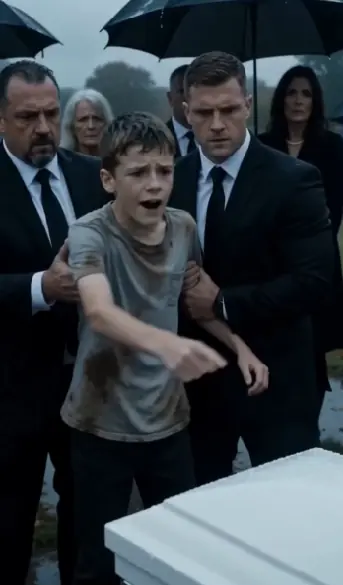
The rain had been falling since midnight, and by the time the funeral procession reached Millbrook Cemetery, it had settled into the kind of steady, merciless downpour that seemed to erase the line between sky and ground. The hills beyond the iron gates had vanished into gray. The headstones, rows of them stretching toward the tree line, looked like teeth in a mouth that never closed.
Elias Cole was eleven years old, and he had not cried once. Not at the hospital, not at the wake, not in the black car that drove too slowly through streets he used to run down on his bike. His aunt Carol had commented on it twice — quietly, to his uncle Frank, as if Elias couldn't hear — he's holding it in, that boy, it isn't healthy. But Elias wasn't holding anything in. He was waiting. He had been waiting for three days, ever since the men in the gray suits came to the house and told his mother that his father, Daniel Cole, had died in a car accident on the county road outside of town.
He was waiting because none of it made sense.
His father built things for a living — bridges, mostly, spans of steel that other engineers said couldn't hold their own weight until Daniel Cole showed them a drawing that proved otherwise. He was the kind of man who checked his mirrors three times before pulling out of a driveway, who wore his seatbelt across town even to fetch milk, who had, only four days before the accident, sat Elias down at the kitchen table with a folded road map and traced a route in red pen.
If anything ever happens to me, his father had said, and Elias remembered the seriousness in his father's eyes, a seriousness that didn't belong to a man planning nothing more than a family trip, you go to your grandfather's cabin. Not to your aunt's. Not to the police, not right away. To the cabin. You remember the way?
Elias had laughed it off at the time. His father had a strange sense of humor sometimes, dry and sideways, and Elias had assumed this was one of those jokes that never quite explained itself. Now, standing under a borrowed black umbrella that dripped water down the back of his collar, he understood that it had not been a joke at all.
Because the coffin they were lowering into the ground did not weigh what a body should weigh.
He had noticed it at the funeral home two nights before, during the viewing, when the pallbearers — his uncle Frank among them — had lifted the casket to move it from one room to another for a private family moment before the public viewing began. Six grown men had carried it like it was nothing. Like it was full of nothing.
Nobody else seemed to notice. Nobody else had spent every Saturday of the last three years helping his father haul steel samples and drafting tables and toolboxes, learning exactly how heavy things were supposed to be by the way they bent a man's shoulders. Elias knew weight. And that coffin did not carry the weight of his father, whose hands were thick and scarred, whose shoulders alone probably weighed more than what six men had lifted so easily.
He hadn't said anything. He didn't know who to say it to. His mother had not been the same since the night the officers came to the door — she moved through the house like a woman underwater, and when Elias tried to tell her about the coffin, about the map, about the strange calm certainty in his father's voice four days before he died, she had only pressed her lips together and said, Baby, grief does strange things to us. Please, not today.
So Elias had waited. He waited through the wake, through the long line of people he barely knew offering him small, sad smiles and saying things like he's in a better place and you have to be strong for your mother now. He waited through the church service, sitting rigid in the front pew while a priest who had never met his father described him in vague, warm generalities that could have applied to anyone. He waited in the black car on the way to the cemetery, watching the gray world slide past the window, his mother's hand cold and unmoving in his.
And now, standing at the edge of the grave with the rain soaking through his good shirt, watching six men lower an empty box — he was almost certain it was empty — into the earth, Elias Cole stopped waiting.
He ran.
He didn't plan it. One moment he was standing beside his mother, the next his feet were moving, splashing through the wet grass, weaving between headstones, his lungs burning with something that was not quite crying and not quite screaming but some terrible combination of both clawing its way up out of his chest. He didn't know where he was running to. He only knew he could not stand there another second and watch them put nothing into the ground and call it his father.
"Dad didn't die!" The words tore out of him, raw and cracking, swallowed almost instantly by the rain. "That's not him! That's not him in there!"
Behind him he heard his mother's voice, sharp with a fear that didn't sound like grief at all — it sounded like panic, like she knew something and didn't want him to say it out loud — and then the heavier sound of men's shoes slapping through the wet grass in pursuit.
He made it almost to the tree line before hands closed around his arms.
Two men in dark suits — men Elias didn't recognize, men who had stood near the back of the church and who he'd assumed, in the haze of the last three days, were simply more of his father's coworkers — hauled him backward with a grip that was far too strong, far too practiced, to belong to men who had come only to mourn. He twisted against them, his sneakers skidding uselessly in the mud, and looked up to see a third man stepping into his path — tall, broad-shouldered, his face pale with a fury that had nothing to do with sadness. This man wore an expensive black suit that the rain had darkened to the color of wet slate, and when he crouched down to bring his face level with Elias's, his eyes were the flat, cold eyes of someone doing a job, not a man burying a friend.
"Enough," the man said, low and hard, his breath fogging in the wet air. "You are done making a scene."
"You put an empty box in the ground," Elias said. His voice shook, but he did not look away. "I know what my dad weighs. I know how heavy he is. That casket didn't weigh anything."
Something flickered across the man's face — not surprise, exactly, but the sharp, calculating look of someone recalculating a plan that had just gone wrong in a small but dangerous way. He glanced past Elias's shoulder, toward the crowd of mourners gathered thirty yards back under their black umbrellas, most of them too far away to hear, though a few had turned to watch, murmuring to each other the way people do at funerals when something is not going according to script.
"Your father died in a car accident," the man said, enunciating each word like it was a fact he was placing carefully on a shelf. "You are a grieving child. That is all anyone here needs to understand."
"Then let me see him," Elias said. "Let me see the body. If he's really in there, let me see him."
The man's jaw tightened. One of the men holding Elias's arm shifted his grip, and for a moment Elias thought he saw something pass between the man in the black suit and the man restraining him — not words, but a small motion of the head, an instruction of some kind, the kind of silent communication that passes between people who have worked together on things that never get written down.
"You're hysterical," the man said. "Understandably. It happens." He straightened up, brushing rain from his sleeve, and when he spoke again it was louder, pitched for the small audience that had begun drifting closer. "Someone get the boy back to the car. He needs rest."
"No!" Elias thrashed against the hands holding him, twisting hard enough that pain shot through his shoulder. "You're lying! Everybody's lying! Where is he? Where's my dad?"
His mother reached them then, breathless, her umbrella abandoned somewhere behind her, rain plastering her dark hair to her face. She didn't look at the man in the black suit. She looked only at Elias, and there was something in her expression — beneath the fear, beneath the desperate need to quiet him — that made Elias's stomach drop, because it wasn't grief. It was the look of someone who had been keeping a terrible secret and had just watched her son come within a single sentence of unraveling it in front of everyone she was most afraid of.
"Eli, baby, please," she said, her hands closing over his face, forcing him to look only at her. "Please, not here. Not now."
"You know," Elias whispered. Rain ran down between them, mixing with something that might have been tears on his mother's face, might have been only rain. "You know it's not him in there."
Her breath caught. For one fraction of a second — so brief that later, replaying it in his mind a hundred times, Elias would wonder if he had imagined it — her eyes flicked toward the man in the black suit, and something passed between them too. Fear. Or a warning. Or both.
"Take him to the car," the man in the black suit said again, and this time it was not a suggestion.
The two men half-carried, half-dragged Elias back across the wet grass, his shoes leaving long furrows in the mud, his voice raw from shouting words that the wind and rain tore apart before they could reach anyone who might have believed him. He caught a last glimpse of the grave over his shoulder — the dark, rain-slicked wood of the coffin lid already half-lowered into the earth, his mother standing frozen at its edge with one hand pressed to her mouth, the man in the black suit watching Elias go with an expression that had settled, now, into something far colder and more final than anger.
They put him in the back of the black car. One of the men climbed in beside him, not touching him now, just sitting close enough that Elias understood he wasn't going anywhere. Through the rain-streaked window, blurred and distant, he could see the funeral continuing without him — the priest's mouth moving in words Elias couldn't hear, the dirt beginning to fall, shovel by shovel, onto a box that Elias was now more certain than ever held nothing of his father inside it.
He sat very still, breathing hard, his soaked clothes clinging cold to his skin, and made himself remember every word his father had said four nights before at the kitchen table, tracing a red line across a folded map.
If anything ever happens to me, you go to your grandfather's cabin. Not to your aunt's. Not to the police, not right away.
Why not the police, Dad? he had asked, and his father's face had gone strange and tight in a way Elias had never seen before.
Because I don't know yet which of them I can trust, his father had said. Just remember the cabin. Promise me.
Elias had promised, half-laughing, thinking it was nothing, thinking his father was simply tired, simply strange that week in a way grown-ups sometimes were. He had not asked what his father meant. He had not asked who them was, or what his father had done, or why a man who spent his life proving bridges could hold weight had suddenly needed to know his son could find his way to a cabin two hundred miles north without anyone's help.
Now, sitting in the back of a car that smelled of leather and rain and the cold cologne of the man beside him, watching his father's funeral shrink into the gray distance through a rear window fogged with his own breath, Elias understood that his father had known something was coming. That the man in the expensive black suit had come not to mourn Daniel Cole, but to make certain of something — to close a book that his father, somehow, had left open.
The car pulled away from the cemetery gates and turned onto the county road, the same road, Elias realized with a cold lurch in his stomach, where his father was supposed to have died.
Nobody spoke. The man beside him stared straight ahead, his hands folded in his lap, patient as a held breath. Outside, the rain kept falling, the gray fields blurring past, and somewhere behind them, in the ground of Millbrook Cemetery, they were finishing the job of burying a coffin that Elias was now completely certain was empty.
He thought of the map folded in his desk drawer at home, the red line his father had drawn from their house to a cabin Elias hadn't visited since he was seven years old. He thought about the word his father had used — them — and about the flicker of fear he had seen cross his mother's face at the edge of the grave.
He thought about the fact that nobody in that black car was taking him home.
The car slowed, and turned again — not toward the house Elias had lived in his whole life, but onto a narrower road he didn't recognize, one that curved away from town and toward the dark line of hills where the rain was falling even harder, where the last of the daylight was already beginning to drain out of the sky.
Elias pressed his hand flat against the cold glass of the window and, for the first time since the men in the gray suits had come to his door three days ago, felt something colder than grief settle into his chest.
He was not being taken home.
He was being taken somewhere else entirely — and no one, not even his mother, standing alone now at the edge of an empty grave in the pouring rain, was coming to stop them.