The Cop Called His Lamborghini Stolen | Then The Car Exposed The Real Thieves
The first thing Officer Grant Harlow noticed was not the license plate.
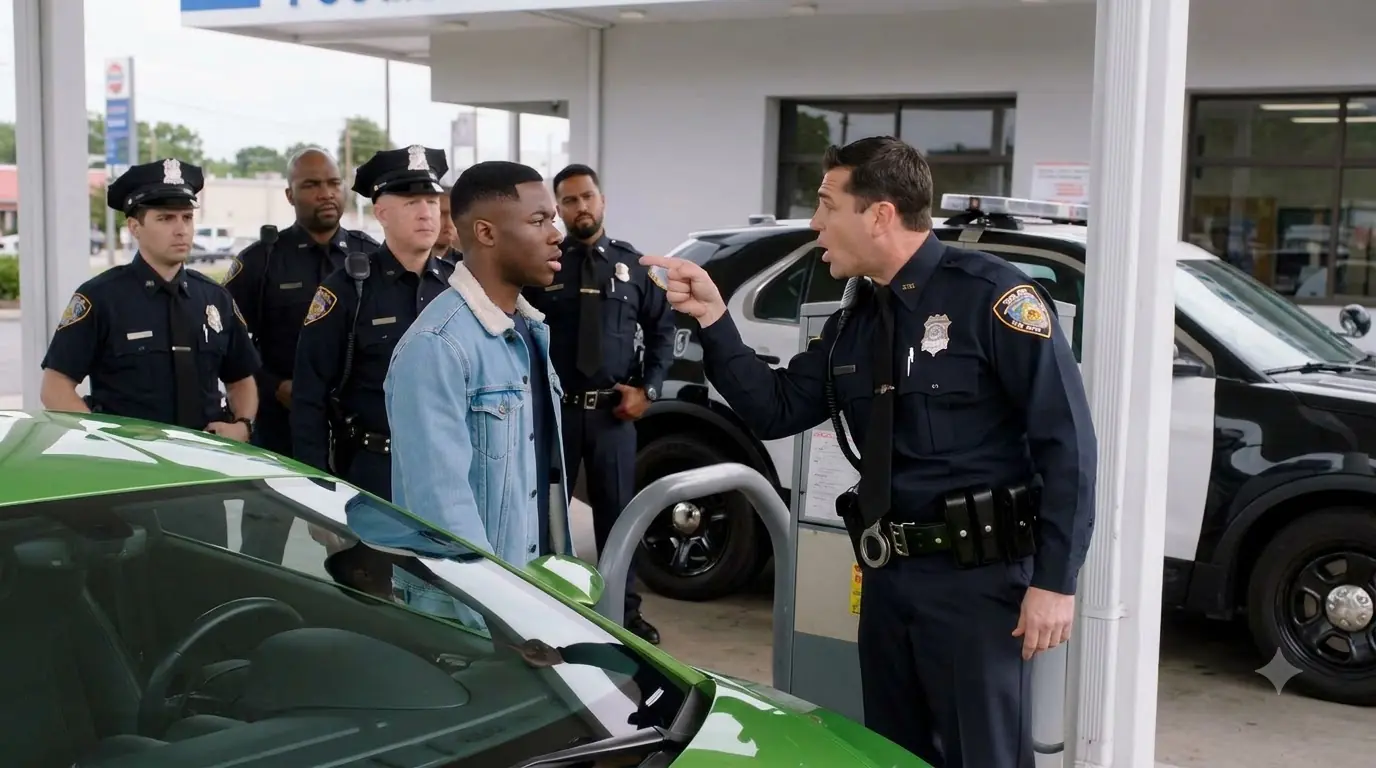
It was the driver.
The Lamborghini sat at pump number six like a lightning strike, low, sharp, and painted a deep electric orange that made every other car in the gas station look unfinished. Its engine had already gone quiet, but people still stared as if the sound remained in the air. A father filling his minivan had stopped mid-squeeze on the pump handle, and two teenagers near the snack shop window were already recording on their phones.
Then they saw Malik Bennett step out.
He was nineteen, Black, lean, and dressed in a plain gray hoodie under a dark denim jacket. No gold chain. No designer sunglasses. No entourage, no camera crew, no performance. He looked younger than he was, which had been inconvenient his whole life because people often mistook youth for weakness and Black youth for guilt.
Malik slid his card into the pump and tried to ignore the stares.
He had learned that skill before he owned a supercar.
When he was twelve, people stared at him in stores as if his pockets had already confessed. When he was sixteen, security guards followed him through malls while white kids his age pocketed lip balm and laughed at nobody noticing. When he was eighteen and his software company closed its first million-dollar contract, a hotel clerk still asked whether he was checking in with a guest.
The Lamborghini made the stares louder.
That was all.
He bought the car after three years of building Bennett Trace, a vehicle-authentication company that detected title fraud, VIN cloning, stolen-car laundering, and database tampering. His software had started as a school project in his grandmother’s kitchen. By nineteen, it had contracts with insurance companies, repossession auditors, and two state agencies that wanted to clean up their vehicle records.
The Lamborghini was not just a reward.
It was a test unit.
Hidden inside the dashboard was a prototype authentication module that recorded every digital touch connected to the car: plate queries, VIN scans, title checks, insurance requests, remote database lookups, and suspicious attempts to alter its status. Malik had installed it because he wanted to prove the product worked in real life, not because he expected the car itself to become evidence.
That afternoon, he was on his way to the largest meeting of his life.
A state transportation investment board wanted to review Bennett Trace for a six-million-dollar anti-fraud contract. If the deal closed, Malik’s company would move from promising startup to statewide infrastructure partner. His board was nervous, his investors were excited, and his grandmother had ironed his shirt that morning even though he told her he could do it himself.
He stopped for gas because the car was at half a tank.
A simple stop.
Five minutes.
That was all it should have been.
A woman in a business suit drifted closer to the Lamborghini, phone in one hand, curiosity pretending to be politeness.
“Is that yours?” she asked.
Malik looked at her.
“Yes, ma’am.”
She smiled, but the smile carried doubt in its teeth.
“You look awfully young for something like that.”
Malik put the nozzle back into the pump.
“I worked for it.”
Before she could answer, a police cruiser rolled into the station.
Its lights were off, but the effect was the same. The small crowd shifted, widened, and then tightened again. People who had only been staring now looked ready to witness something, as if the arrival of a badge had confirmed the suspicion already growing in their heads.
Two officers stepped out.
Officer Grant Harlow came first.
He was white, mid-thirties, thick through the neck, with close-cropped hair and a hard mouth that looked more accustomed to commands than questions. He walked toward Malik with one hand resting near his belt, not on the weapon, but close enough for the message to be clear.
Behind him came Sergeant Dean Calder.
Calder was older, quieter, and more careful. His uniform looked clean enough for a ceremony, and his face carried the calm of a man who knew how to make a bad decision look official after the fact. He did not speak first. He did not need to.
Harlow stopped beside pump number six and looked at the Lamborghini.
Then he looked at Malik.
“You really expect me to believe a kid like you bought this?”
The crowd reacted before Malik did.
A few laughs.
A few whispers.
A few phones rising higher.
Malik kept his hands visible.
“The registration, title, and insurance are all in my name, Officer. I can show you.”
Harlow held out his hand.
Malik reached slowly into his jacket, moving carefully, because careful movement was something Black boys learned before they learned taxes. He handed over his license, registration, and insurance card. Harlow took the papers, glanced at them for maybe two seconds, and then smirked toward the crowd like the joke had written itself.
“This paperwork means nothing if the story sounds fake.”
“It’s not fake.”
Harlow flicked the registration with two fingers.
“Title says Malik Bennett.”
“That’s me.”
“You own a Lamborghini at nineteen.”
“Yes.”
“What do you do, sell shoes online?”
“I own a technology company.”
Harlow laughed.
It was not a big laugh.
It was worse.
It was the laugh of a man who had already decided truth was entertainment when spoken by the wrong person.
Calder walked around the car and radioed in the plate. Malik watched him, listening for any change in tone. The car was clean. The title was clean. The VIN, the insurance, the registration, the payment record, everything would match.
At least, it should have.
Calder returned with his radio in one hand.
His face had sharpened.
“Vehicle comes back flagged as stolen.”
Malik’s chest went cold.
“That’s impossible.”
Harlow stepped closer.
“There it is.”
“No. Run it again. Check the title. Check the insurance. There has to be an error.”
Calder’s voice stayed smooth.
“The system says stolen property.”
“Show me the report.”
Harlow leaned in.
“You don’t get to demand reports while standing next to a stolen car.”
“It is not stolen.”
“Young men like you always say that until the cuffs come out.”
Malik heard someone near the pumps mutter, “Knew it.”
He did not look at them.
The crowd was no longer just watching. It was participating. Their suspicion had been given a uniform, and now they felt safe letting it breathe.
“I want a supervisor,” Malik said.
Calder looked at him.
“You have one.”
“You are not listening.”
Harlow’s eyes hardened.
“Don’t tell us how to do our job, boy.”
The word landed across the gas station.
Not loudly.
Not even with force.
But everyone heard it.
A mother near pump three pulled her child closer. A man by the ice machine lowered his eyes, then slowly raised his phone again. An older gas station employee named Samuel Ortiz stood near the side door, pretending to wipe the glass while recording from waist level.
Malik forced himself to breathe.
“My company builds vehicle fraud detection software,” he said. “If your system is showing stolen, somebody entered bad data. The car has clear title.”
Harlow grabbed Malik by the arm.
“Nice speech.”
“Officer, do not touch me without cause.”
That made Harlow smile.
“Without cause?”
Then he shoved Malik against the hood.
The impact sent a metallic thud through the station lot.
Pain shot through Malik’s ribs.
People gasped.
Phones lifted higher.
The Lamborghini’s hood reflected Malik’s face back at him, distorted in the orange paint, younger-looking than he felt and calmer than he was. Harlow pulled one wrist behind him, then the other. The handcuffs clicked shut too tight.
“Turn around slowly,” Harlow ordered, though Malik was already pinned.
“I am not resisting.”
“Keep talking and I’ll add it anyway.”
Malik went silent.
That silence saved him.
He knew that even as anger burned behind his eyes.
Calder walked to the Lamborghini with yellow police tape and wrapped it around the mirror and door handle. Harlow announced to the crowd that the vehicle was being impounded pending investigation. Someone laughed. Someone else said, “That car was too much for him anyway.”
Samuel kept recording.
His hand shook.
But he kept recording.
At the police station, Malik sat in a cold holding room with red marks around his wrists.
Everything that proved who he was sat in a plastic evidence bag outside the door: wallet, phone, keys, watch, and the slim black card that opened the Bennett Trace office downtown. Without those things, he looked exactly how Harlow wanted him to look. Just another young Black man in a gray hoodie sitting under fluorescent lights, waiting for someone else’s story to become paperwork.
Through the glass, he watched Harlow type slowly.
Too slowly.
Carefully.
A report was being built.
Not written.
Built.
The door buzzed open.
A woman in a navy suit entered carrying a leather briefcase and a folder thick with tabs. She was in her early forties, South Asian, with sharp eyes and the kind of composure that made rooms organize themselves around her. Malik had met her twice, both times at board meetings where investors stopped joking the second she began asking questions.
“Malik Bennett?” she said.
“Yes.”
“I’m Priya Lawson. Your grandmother called me.”
Malik exhaled.
“Grandma got you?”
“She called me, your board chair, your CFO, and someone named Aunt Della who apparently threatens people in alphabetical order.”
Despite everything, Malik almost smiled.
Priya opened her folder and laid documents across the metal table.
Clear title.
Insurance.
Bank transfer.
Manufacturer purchase verification.
State registration.
Corporate ownership disclosures.
Venture funding letters.
Everything neat.
Everything real.
“You own the Lamborghini outright,” Priya said. “No lien, no lease, no financing issue, no reported theft, no fraud flag before today.”
“Before today?”
She looked at him.
“That is where this becomes interesting.”
The door opened again.
Calder entered first.
Harlow followed, arms crossed, still carrying himself as if the room belonged to him.
Priya did not stand.
“Gentlemen,” she said, “my client is being unlawfully detained.”
Calder’s mouth tightened.
“We are verifying documentation.”
“No, you are trying to repair a mistake before it becomes liability.”
Harlow scoffed.
“Lady, nineteen-year-olds don’t just own Lamborghinis.”
Priya looked at him.
“That sentence is going to age badly in a deposition.”