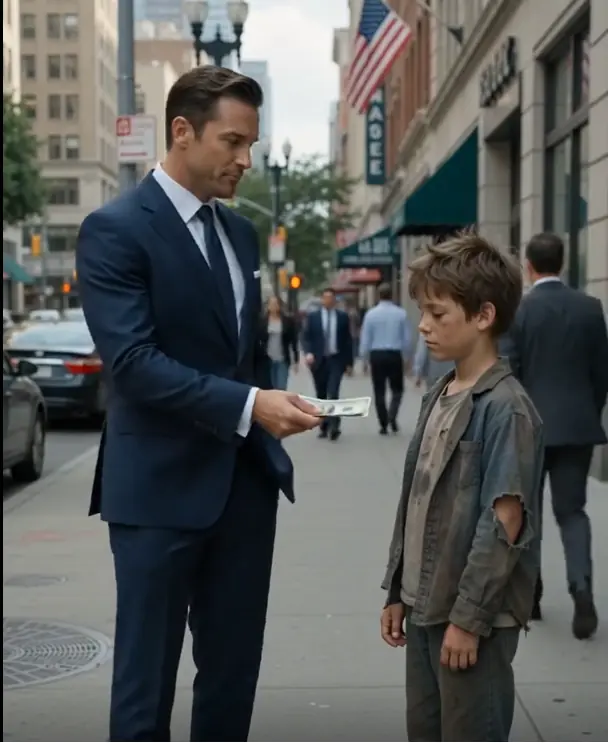
By eight o’clock every morning, the city had already surrendered itself to noise.
Taxi horns ricocheted between towers of glass and steel, impatient commuters hurried along the sidewalks with coffee in one hand and phones in the other, delivery trucks blocked intersections while drivers shouted at one another, and street musicians fought to make themselves heard above the endless mechanical pulse of a city that had forgotten how to be quiet.
Everyone seemed to be going somewhere important.
Everyone seemed to be late.
And almost no one had time to notice the people who had nowhere to go.
Among those invisible people was a boy who sat quietly at the corner of Madison Avenue and Forty-Second Street, beneath the shadow of Coleman Industries Tower.
He looked no older than ten.
His clothes were faded from countless washes, the sleeves of his gray sweatshirt ended slightly above his wrists, and his battered sneakers had worn so thin that one sock showed through a hole near the toe. His dark hair was untidy, his cheeks were pale from the cold, yet there was something strangely composed about him, something that made him seem less like a frightened child surviving on the street and more like someone who had simply chosen that corner as a place to wait.
Beside him sat a dented metal cup containing a handful of coins and several crumpled dollar bills.
He never shook it.
He never called out.
He never stretched a hand toward anyone.
Instead, a small piece of cardboard rested against the brick wall behind him, and written across it in careful black letters were five simple words:
GOD SEES EVERY CHOICE.
Most pedestrians barely glanced at the message before continuing on their way.
A few slowed down.
Some dropped money into the cup.
Whenever they did, the boy looked up and offered the same gentle smile.
“Thank you.”
Nothing more.
No dramatic gratitude, no desperate plea, no story designed to make strangers feel guilty.
Just two quiet words, spoken as though even the smallest kindness deserved to be remembered.
That morning, an elderly woman wearing a grocery-store uniform stopped beside him. She searched through her handbag, found two dollar bills, and placed them carefully into the cup.
“I wish it could be more,” she said.
The boy looked at her name tag.
MARTHA.
“This is enough.”
She smiled sadly.
“You should get somewhere warm, sweetheart. They say it'll freeze tonight.”
“I will.”
Martha started to leave, then hesitated.
“Do you have family?”
For the first time, the boy's expression changed.
Not much.
Just enough for her to notice.
“Everyone does,” he replied.
Before she could ask what he meant, someone behind her complained that she was blocking the sidewalk, so she gave the boy one last concerned glance and hurried away.
Several minutes later, a young man in an expensive coat dropped a five-dollar bill without stopping.
The boy thanked him.
The man never heard.
Across the street, precisely at 8:17 a.m., a polished black SUV pulled to the curb in front of Coleman Industries Tower.
The rear door opened.
Richard Coleman stepped out.
At fifty-three, Richard had become the kind of man business magazines described with words like visionary, relentless, and self-made. He owned three enormous manufacturing plants, controlled a national industrial supply network, sat on the boards of two banks, and possessed a personal fortune estimated at more than four hundred million dollars.
He considered the estimate conservative.
His suits were tailored in London, his shoes were handmade in Italy, and the watch beneath his cuff cost more than many of his employees earned in three years.
Yet Richard had not been born into wealth.
He had grown up in a two-bedroom apartment above a laundromat in Ohio, where his mother worked double shifts as a hospital cleaner and his father repaired industrial machinery until an accident crushed three fingers on his right hand.
Richard remembered poverty.
That was precisely why he hated it.
As a child, he had watched his mother count coins at the kitchen table, deciding which bills could wait another week. He remembered pretending not to be hungry so his younger sister could have the last piece of chicken. He remembered wearing secondhand shoes to school and learning, at twelve years old, that children could be extraordinarily cruel when they discovered someone had less than they did.
On the day Richard turned sixteen, he made himself a promise.
No one will ever look down on me again.
For decades, that promise had driven him.
He worked through college, borrowed money, built his first small machine shop, nearly went bankrupt twice, survived a divorce, outmaneuvered competitors, purchased failing factories, and transformed them into profitable operations.
Eventually, the frightened boy who had once watched his mother count coins disappeared beneath tailored suits, private aircraft, and quarterly earnings reports.
Richard told himself he had escaped poverty.
What he never realized was that he had simply spent his life running from it.
His personal assistant, Melissa Grant, met him outside the building.
“Morning, Mr. Coleman.”
“Morning.”
“You have the Henderson meeting at nine, the board at eleven, lunch with Senator Wallace at one, and the insurance renewal call at three-thirty.”
“Move Wallace to Thursday.”
“He's flying to Washington tonight.”
“Then cancel lunch.”
Melissa nodded, already typing.
Richard crossed the sidewalk, but before reaching the revolving doors, his attention drifted toward the opposite corner.
The boy.
Richard slowed.
There was something about homeless children that made him uncomfortable, although he would never have admitted it. They reminded him too much of things he had spent a lifetime trying to forget.
His eyes moved toward the cardboard sign.
GOD SEES EVERY CHOICE.
Richard gave a quiet, humorless laugh.
“What a waste.”
Melissa looked up.
“Sir?”
“Nothing.”
He could have continued inside.
Instead, perhaps because two junior executives were approaching behind him, perhaps because a photographer from a financial newspaper happened to be waiting near the entrance, or perhaps because Richard enjoyed moments when generosity could be witnessed, he suddenly reached into his wallet.
Four twenty-dollar bills.
Eighty dollars.
To Richard, it was meaningless.
To a homeless child, he assumed it would feel like a fortune.
He walked toward the boy.
Several pedestrians noticed him immediately.
Richard Coleman was recognizable in this part of the city, and the moment people realized the billionaire CEO was approaching a homeless child, phones began to appear.
Richard noticed.
And because he noticed, his posture changed almost imperceptibly.
He stopped several feet away.
Instead of bending down and handing the money to the boy, Richard flicked the bills toward him.
They fluttered through the cold morning air before landing across the dirty pavement, one bill stopping against the child's sneaker.
“There,” Richard said loudly. “Buy yourself some food.”
A woman nearby smiled approvingly.
Someone lifted a phone higher.
Richard felt a small surge of satisfaction.
He expected the boy to grab the money.
Instead, the child looked down at the bills.
Then he looked up.
His expression contained neither gratitude nor humiliation.
“Keep it.”
Richard blinked.
“What?”
“You'll need that money soon.”
The sidewalk seemed to grow quieter.
Melissa stopped typing.
A few pedestrians exchanged amused looks.
Richard stared at the boy before laughing.
“You think I'm going to need eighty dollars?”
The child said nothing.
Richard stepped closer.
“Do you know who I am?”
“No.”
That answer irritated him more than an insult would have.
“I'm Richard Coleman.”
The boy remained silent.
“I own three factories. Thousands of people work for me, and I have more money than you'll probably see in your entire lifetime.”
He leaned slightly toward him.
“So if I were you, I'd worry about myself.”
The child studied him for several seconds.
Then he smiled.
“I hope you're right.”
Richard straightened.
“Unbelievable.”
He turned away.
He had taken exactly three steps when Melissa's phone rang.
She glanced at the screen.
Her expression changed.
“Mr. Coleman…”
Richard kept walking.
“Take it upstairs.”
“Sir.”
Something in her voice made him stop.
Melissa answered.
“Grant speaking.”
Richard watched as the color slowly disappeared from her face.
“What?”
She turned away, pressing the phone against her ear.
“Is everyone out?”
A pause.
“How many?”
Another pause.
“When did this start?”
Richard walked toward her.
“Melissa?”
She didn't answer him.
“Melissa.”