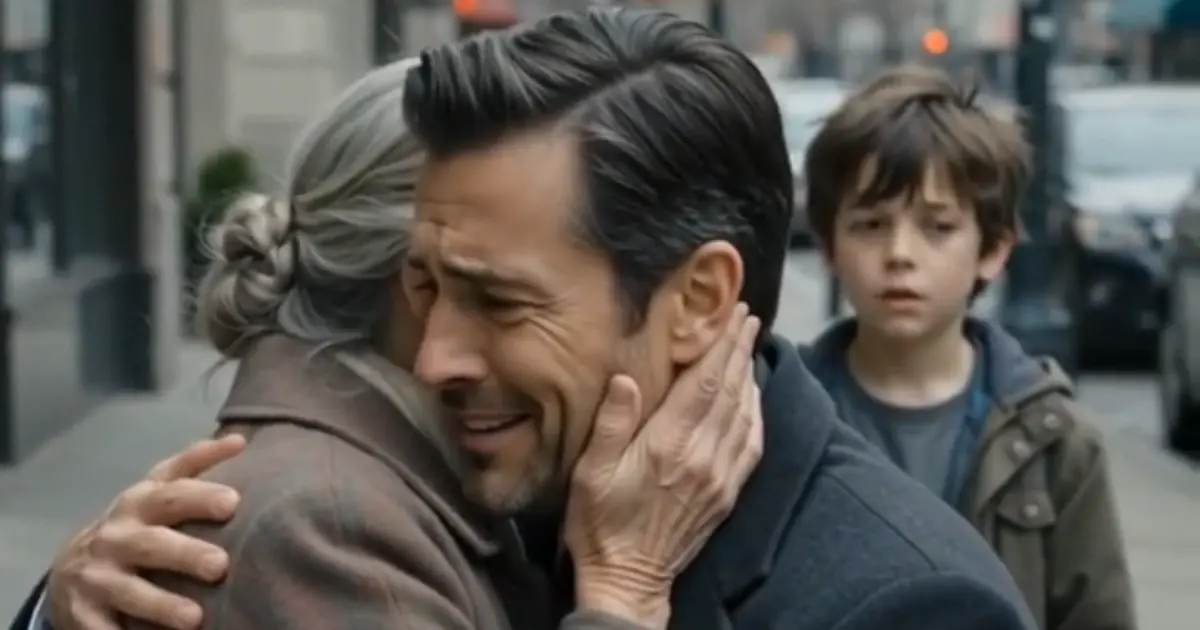
Paris had a way of making poverty look almost invisible.
On bright mornings, when sunlight spilled across the pale stone buildings and turned the windows along Boulevard Saint-Germain into sheets of gold, tourists noticed the cafés first, then the flower stalls, the elegant balconies, and the fashionable men and women who hurried along the pavement carrying expensive bags. They heard the bells of bicycles, the distant horns of impatient taxis, the laughter spilling from bakeries, and the clatter of porcelain cups being set onto little round tables.
What they rarely noticed were the people who had learned how to disappear while sitting in plain sight.
Madame Claire Moreau was one of them.
She sat behind a small folding table near the corner of a busy street, where pedestrians streamed past from morning until evening, and although thousands of eyes moved in her direction, very few actually saw her.
The table was old enough to wobble whenever a bus passed. A piece of folded cardboard had been pushed beneath one leg to keep it steady, while on its faded wooden surface Claire had arranged everything she hoped might earn a few euros: two cracked porcelain cups, a stopped pocket watch, several tarnished silver spoons, a box of mismatched buttons, a chipped music box that no longer played, three old postcards, and a handful of trinkets whose histories were worth far more than their prices.
At the center of the table lay a small golden locket.
It was scratched and darkened with age, its chain had been repaired more than once, and the tiny hinge resisted whenever someone tried to open it. To anyone passing by, it looked like another worthless piece of old jewelry.
To Claire, it was the last piece of a life she had spent decades mourning.
Beside her stood her eight-year-old grandson, Julien.
His coat was too thin for the cold morning, his shoes were worn at the toes, and although he had learned not to complain often, hunger had a way of making even the most patient child forget his pride.
For nearly ten minutes, Julien had been staring across the street.
There was a bakery there.
Every time the glass door opened, warm air escaped into the street carrying the smell of fresh bread, butter, sugar, and coffee. Julien followed each customer with his eyes as they emerged holding baguettes wrapped in paper.
Finally, he tugged gently at his grandmother's sleeve.
“Grandma?”
Claire looked down.
“Yes, sweetheart?”
“Will we be able to buy bread today?”
The question was so quiet that the traffic almost swallowed it.
Claire glanced at the table.
They had been there for nearly three hours.
They had sold nothing.
She reached into the pocket of her coat and felt the coins inside, although she already knew exactly how much money remained.
Two euros and seventeen cents.
Not enough for bread, milk, and the medicine she needed for her cough.
She forced a smile.
“If we sell at least something today, we'll buy bread.”
Julien looked toward the bakery again.
“And maybe cheese?”
Claire's smile trembled.
“If we have enough.”
He nodded as though this were a perfectly acceptable answer, but after a few seconds he whispered, “Grandma... I'm hungry.”
Those three words hurt more than any accusation could have.
Claire reached up and stroked his hair.
“I know.”
She wished she could tell him that dinner would be waiting at home, that the cupboard was full, that there was soup warming on the stove and fruit on the table. She wished she could be the kind of grandmother who spoiled her grandson with pastries instead of asking him to wait while strangers decided whether an old spoon was worth three euros.
Instead, she said softly, “Just a little longer.”
Julien leaned against her shoulder.
Claire kissed the top of his head.
She had once believed she had already endured the worst thing a mother could survive.
She had been wrong.
There was another kind of suffering, quieter but no less cruel, in watching a child you loved go hungry while you had nothing left to give him.
Claire had buried one son and lost another.
Or, at least, that was what she had believed for most of her life.
Her elder son, Daniel, Julien's father, had died three years earlier after an illness that progressed far faster than anyone expected. Julien's mother had disappeared from his life before he was old enough to remember her clearly, leaving Claire as the only family he had left.
Yet Daniel had not been Claire's first child.
Before Daniel, there had been another little boy.
Alex.
Even after more than thirty years, Claire could still remember the weight of him sleeping against her chest, the sound of his laughter in their tiny kitchen, and the way he used to mispronounce “chocolat” when he begged for hot chocolate on winter mornings.
He had been five years old when she lost him.
Not to illness.
Not to death.
To confusion.
To distance.
To a terrible accident followed by a chain of decisions made by strangers who believed they were helping.
For years, Claire had searched.
Eventually, the world had convinced her to stop hoping.
But she had never stopped remembering.
And now, on this ordinary Paris morning, the last object she possessed from Alex's childhood sat among worthless trinkets on a folding table because hunger had finally become stronger than sentiment.
Claire looked at the locket.
She had promised herself she would never sell it.
Yesterday, Julien had eaten only half a bowl of soup.
Promises became complicated when children were hungry.
“Excuse me.”
Claire lifted her head.
A woman in an expensive coat stood in front of the table, holding one of the porcelain cups.
“How much?”
“Five euros,” Claire said.
The woman turned it over.
“There is a crack.”
“Yes, but it doesn't go all the way through. It's very old.”
“Two euros.”
Claire hesitated.
She needed the money.
“Three?”
The woman put the cup down.
“No.”
Then she walked away.
Julien watched her disappear into the crowd.
“Why didn't she buy it?”
“Maybe she didn't need a cup.”
“She looked like she had money.”
Claire smiled sadly.
“Having money doesn't mean you need everything you see.”
Julien thought about this before asking, “If we had lots of money, would we buy everything?”
“No.”
“What would we buy?”
Claire looked at him.
“Bread.”
That made him laugh.
It was a small laugh, but it was enough to make her heart ache.
Across the street, traffic slowed.
A long black car approached the curb, polished so perfectly that the gray Paris sky reflected across its surface. It was the kind of vehicle that caused people to glance toward it even before they knew who was inside.
The rear door opened.
A man stepped out.
He was in his early forties, tall and composed, dressed in a charcoal suit beneath a dark wool coat that had clearly been tailored for him. His shoes were immaculate, his watch discreet but expensive, and everything about him suggested a life governed by appointments, assistants, and decisions involving sums of money most people would never see.
His name was Alexandre Laurent.
To the financial press, he was the founder and chief executive of Laurent International, a logistics and infrastructure company whose operations stretched across Europe and North America. He owned apartments in Paris and Geneva, a house outside London, and enough shares in enough companies that magazines occasionally tried to calculate his net worth.
They usually got it wrong.
Alexandre rarely corrected them.
Money had stopped impressing him years ago.
He had spent the morning in negotiations over an acquisition worth nearly four hundred million euros, yet when he stepped from the car, his thoughts were not on contracts or shareholders.
They were on a headache he had been carrying since dawn.
“Mr. Laurent,” his driver said, “shall I wait here?”
“I'll walk the rest of the way.”
“The meeting begins in twenty minutes.”
“I know.”
Alexandre closed the door.
He needed air.
He had been awake since four in the morning after another dream he could not completely remember.
There had been rain.
A woman's voice.