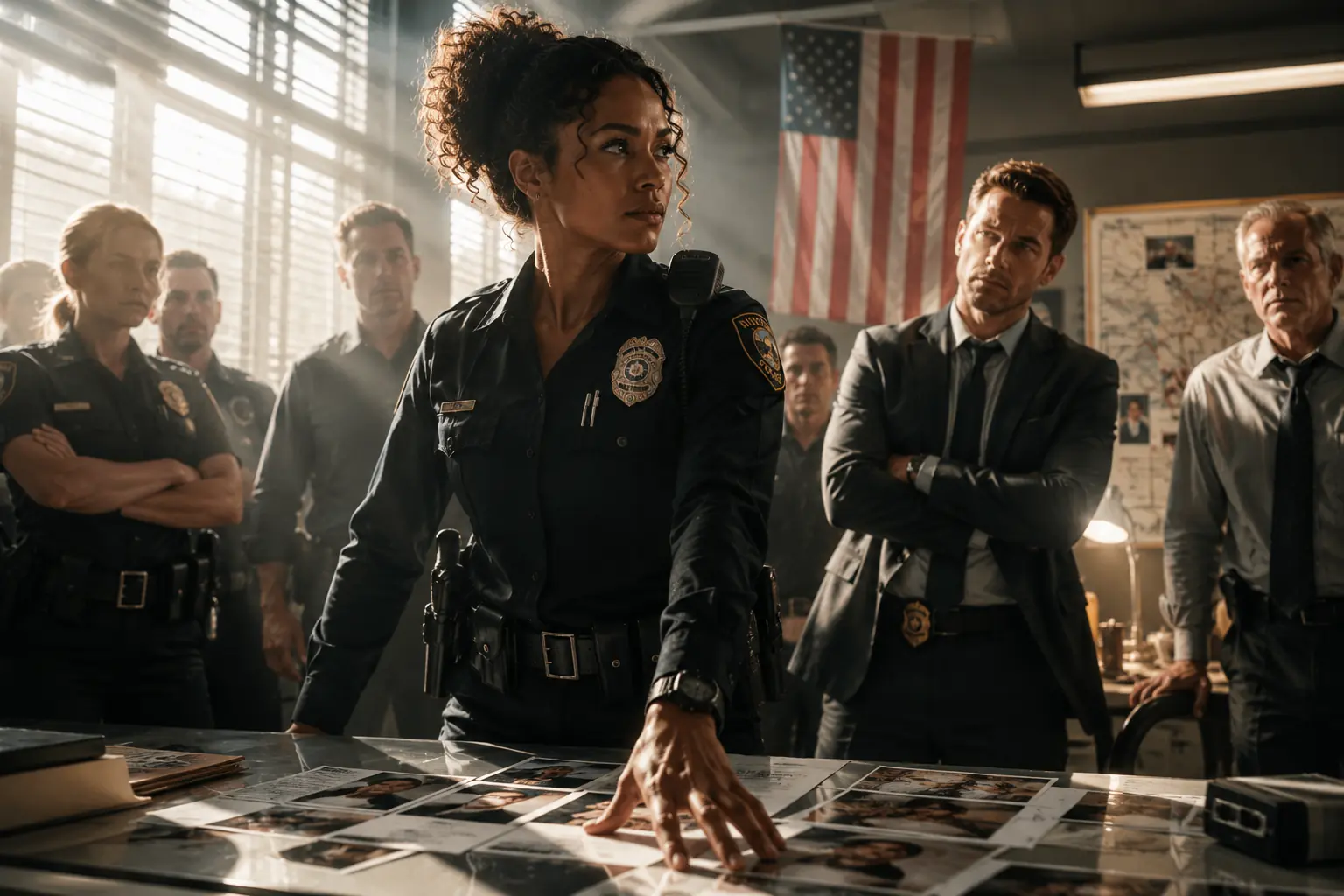
## Chapter 1 — Roll Call
Every morning at Ridgemont PD started the same way, and every morning I heard the same joke land somewhere behind me.
"Careful, guys, Carter's here. Better fill out our diversity forms."
Low laughter. The kind that's engineered to be just loud enough. I didn't turn around. I'd learned a long time ago that turning around is what they want — it tells them the hook went in.
I took my seat in the back row of the briefing room, the one nobody fought me for, and I set my coffee down and I waited for Sergeant Ruiz to run the board. On paper I'd been a Ridgemont patrol officer for fourteen months. In the eyes of the room, I was a checkbox the department got to point at whenever the city council asked why every framed photo on the wall was a white man with a mustache.
Detective Grant Powell leaned against the front wall like he owned the oxygen. Golden boy. Thirty-eight, square jaw, a closure rate the local paper loved, and a way of looking at a patrol officer like she was a traffic cone that had learned to talk.
"Anything from the overnight?" Ruiz asked the room.
"Nothing that matters," Powell said. "Quiet town. That's the job — keep it quiet." He looked at me when he said it. "Some people forget that. They come from someplace loud and they go looking for noise."
More laughter.
I sipped my coffee. In my jacket pocket, my thumb found the thing it always found — a small brass whistle, worn smooth, that had belonged to my father. *The badge doesn't make them see you, baby,* he used to say. *The work does. So do the work, and let them catch up.*
I'd been letting them catch up for fourteen months.
I didn't know yet that this was the morning the work would finally get loud enough to hear.
Because at 8:52, while Powell was still explaining to the room how quiet his town was, a woman in a housekeeping uniform pushed through the front doors of the station, and she was shaking, and she was holding a photograph of a fifteen-year-old girl, and she was saying the same three words over and over to a front desk that had already decided not to hear her.
"Please. My daughter."
---
## Chapter 2 — Ridgemont
You have to understand Ridgemont to understand what happened, so let me draw it for you fast.
It's the kind of town that puts its name on a water tower and its property values in its brochures. Good schools, low crime, tree-lined streets where the leaves get picked up by a service. The people who live in the big houses on the hill have a word for the town: *safe.* They say it a lot. Safe is the product Ridgemont sells, and a police department in a town like that isn't really there to solve crime. It's there to make sure crime never appears in the newsletter.
And then there's the other edge of town, down past the highway, where the people who *clean* the big houses actually live. We called it the Flats. Trailer courts, a check-cashing place, a laundromat, the bus line that carried the housekeepers and the landscapers and the line cooks up the hill at six a.m. and back down at nine p.m. Ridgemont depended on the Flats to function and pretended it didn't exist, the way a stage depends on the room behind the curtain.
I'd requested the Flats as my patrol zone. Powell thought that was hilarious — "you can have it," he'd said, like he was handing me the worst section. He didn't understand that I'd asked for it on purpose. The Flats was where the calls came from that nobody up the hill wanted. Which meant the Flats was where the actual work was.
My name is Naomi Carter. I'm thirty-four years old. I'm a Black woman in a department that had never had a Black detective and a town that liked its help invisible. And I had come to Ridgemont, a year and change ago, specifically because I wanted a place where nothing ever happened.
I'll tell you why later. For now, just know that I'd come here to stop looking at the worst thing people do to each other.
And a woman with a photograph had just walked into my station to tell me it had followed me.
---
## Chapter 3 — The Girl Nobody Looked For
Her name was Denise Reeves, and she cleaned houses on the hill six days a week, and her daughter Aaliyah had not come home.
I got to the front desk while the desk officer, Bryson, was still doing the thing they train the fear right into you to do — being calm at someone in a way that's really just being a wall. "Ma'am, I understand, but at fifteen, most of the time these kids just—"
"She is not a runaway." Denise's voice cracked down the middle. "You don't know her. She's an honor student. She had a chemistry test today she studied two weeks for. She texts me when she leaves the library. She texts me. She didn't text me."
"Kids surprise their parents all the—"
"Officer." I stepped in. "I've got this."
Bryson looked relieved to hand the wall to somebody else. Powell, passing through, glanced at the housekeeping uniform and the address on the form and I watched him file it in half a second: *Flats. Teenager. Runaway. Not a Ridgemont problem.* "Carter, when you're done taking the report," he said, already walking, "code it a nineteen and let the family cool off. She'll turn up when she's hungry."
A nineteen. Runaway. The code that closes a case before it opens.
I sat Denise down. I got her water. And I did the thing that, it turned out, not one other person in that building had done: I looked at the photograph.
Aaliyah Reeves, fifteen. School picture. Honor cords already, as a sophomore. A face caught mid-laugh, like whoever took it had said something funny right as the shutter went.
"Tell me about yesterday," I said. "Everything. Start with breakfast. Don't leave anything out because you think it's small. The small thing is usually the whole thing."
Denise stared at me — this Black woman in a Ridgemont uniform actually holding a pen over a page — and something in her let go, and she started to cry, and then she started to talk.
I wrote down every word. And by the third sentence, the part of my brain I had come to Ridgemont to put to sleep woke all the way up.
Because this was not a runaway. And I already knew it.
---
## Chapter 4 — The Thing I Came Here to Forget
I have to tell you a little about who I used to be, or none of the rest of this makes sense. I'll keep it short, because it still costs me.
Before Ridgemont, I spent nine years with the FBI. Behavioral Analysis Unit — the people field offices call when a crime doesn't make sense, when they need someone to look at the pattern of a thing and tell them the shape of the person making it. I was good at it. Not modest, not bragging — just a fact I have to put on the table so you understand what Ridgemont was sitting on without knowing.
Until a case in my last year, when I told a room full of people with more rank than me that a missing child was still alive, held by someone she trusted, that we had maybe seventy-two hours, and that we were looking in the wrong direction. The room decided I was wrong. They had a theory that was cleaner and a suspect who fit the headline better, and by the time they came back around to my way, we were eleven hours past the window.
Her name was Lily. She was eight. I don't say her name often.
After that I couldn't look at another file. I put in my papers, I drove until the FBI stopped being a place I could feel behind me, and I landed in a town that advertised itself as safe and asked for the beat where nothing happened. I traded profiling serial offenders for writing parking citations in the Flats, and I told myself it was peace.
For fourteen months, it almost was.
And then Denise Reeves put a photograph on my desk and told me her honor-student daughter had missed a chemistry test she'd studied two weeks for and hadn't texted, and every alarm I'd spent fourteen months disconnecting rang at once.
I could have coded it a nineteen. Powell told me to. It would have been the safe thing, the Ridgemont thing.
I looked at Aaliyah Reeves laughing in a school photo, and I thought about Lily, and I closed my notebook and I made a decision that was going to cost me the quiet I'd driven a thousand miles to find.
"Mrs. Reeves," I said. "I'm going to look for your daughter. Personally. Starting now."
---
## Chapter 5 — Reading the Room
I drove out to the Reeves place in the Flats on my own lunch hour, because officially there was no case.
Here's the thing about a scene: it talks. Most people walk into a room and see furniture. I walk into a room and see decisions — where a person sat, what they touched last, what they were and weren't afraid of. It's not magic. It's ten thousand hours of being taught to notice, and then not being able to turn it off.
Aaliyah's room told me three things in the first ninety seconds.
One: she was not a runaway. A runaway takes the charger. She takes the specific hoodie, the shoes that matter, the shoebox of things that mean something. Aaliyah's charger was still plugged in by the bed. Her savings — two hundred and eleven dollars, Denise said, from a summer job — was still folded in a sock in the drawer. Kids who run take their money. Every single time.
Two: she was careful and she was scared of something recent. Her window had a new secondary lock, the cheap kind you buy yourself and screw in without asking your mom, installed maybe in the last month. Something had made this girl want an extra lock on her own window and not want to explain why.
Three — and this is the one that turned my stomach cold — there was a flyer on her desk, under her chemistry notes, for a free after-school ride program. *Getting home safe shouldn't cost anything. — Ridgemont Community Van.* A cartoon of a smiling van. Aaliyah had circled the evening pickup times.
A girl who was scared enough to lock her own window. And a free van that picked her up in the dark.
I stood in that small, tidy, terrified room, and fourteen months of sleep fell off me like a coat.
"Mrs. Reeves," I said. "Who drives the community van?"
---
## Chapter 6 — Stay in Your Lane
I made the mistake of doing it the right way first. I went to Powell.
I laid it out clean, the way I'd have briefed a task force: no charger, no money taken, self-installed window lock, the circled van times. A fifteen-year-old with every marker of an abduction and none of a runaway. I kept my voice flat and my conclusions modest, because I know how a room hears a Black woman who sounds certain.
Powell listened with his arms crossed and a small smile that told me he'd stopped listening at "the Flats."
"You went out there on your lunch," he said. "To a scene. On a case that isn't yours. That I coded a nineteen."
"The code's wrong."
"The code's mine." He uncrossed his arms and leaned on the desk, friendly, which was worse than shouting. "Carter. I'm going to help you, okay? Because I don't think anybody ever told you. This is a patrol job. In a quiet town. Your lane is tickets, fender-benders, and keeping the Flats from spilling up the hill. That's it. That's the whole lane." He tapped the desk. "You come from someplace where you got to play detective. Fine. But here? You stay in your lane, and you let the people with the gold shields do the thinking. You understand what I'm telling you?"
"A child is missing," I said.
"A teenager took off from a trailer park," he said, "which happens on a Tuesday, and if you make it a headline, you make Ridgemont look unsafe, and *that* is the actual crime in this town." He straightened. "Drop it. That's not a suggestion, it's your sergeant's boss telling you. Nineteen it and move on."
I went back to my cruiser. I sat in the lot for a minute with my father's whistle in my hand.
Then I did the math the way I used to do it in the Bureau, the cold clock nobody wants to look at: a girl locks her own window, then gets into a van in the dark, and doesn't come home. If I was right, she had days, not weeks. Maybe less.
I'd stayed in my lane once before, when a room with more rank told me to. Her name was Lily.
I put the whistle back in my pocket, and I pulled out of the lot, and I drove to the Flats to work a case that officially did not exist.
---
## Chapter 7 — Denise
The people up the hill would have told you the mother was the problem. Too emotional, too poor, probably a bad home, probably the kid ran for a reason. They'd never met her. I had.
Denise Reeves worked houses from six to two, then a register at the pharmacy from three to nine, six days a week, and in the margins of that she had raised a daughter with honor cords. Her apartment was clean the way a place is clean when cleanliness is the one thing you can control. On the fridge was Aaliyah's report card, and a college brochure — the University of Michigan, circled — and a hand-drawn chore chart in a fifteen-year-old's careful bubble letters.
"She wants to be a chemical engineer," Denise told me, and then caught the tense she'd used, *wants,* and held onto it like a railing. "Wants. She's going to be. She reads the college brochure like it's a magazine. She's got the whole thing planned."
"Tell me about the van," I said.
"It's free." Denise's hands twisted. "It's supposed to be a good thing. Somebody in the churches set it up, for the kids down here whose folks work nights. So they don't wait at the bus stop in the dark. Everybody trusts it. The driver, he coaches the middle school soccer, he's at every fundraiser, he—" She stopped. "You think it's him."
And that was what turned the back of my neck cold — because I'd seen him. Not by name, not yet, but by face. Three weeks earlier, at a pancake breakfast the department co-sponsored, a soft-spoken man in an apron had been ladling batter with a line of people waiting to put a hand on his shoulder, and I had stood in that room and felt nothing, because he was exactly what a room like that is built to trust. That's how they hide, the worst of them. Not in the shadows. In the light everyone has already agreed not to question.
"I think I need to know his name," I said, "and I think you need to trust me, and I know I haven't earned that, because everyone with a badge you've ever met treated you like a nuisance." I looked at her. "I'm not going to do that. I don't have a case number and I might lose my job over this. But I'm going to find your girl. You hear me? I'm not going to stop looking."
Denise Reeves looked at me for a long time. Then she went to a drawer and took out a second photograph — Aaliyah, younger, gap-toothed, on a bike — and she pressed it into my hand.
"So you don't forget she's real," she said, "when the ones up the hill tell you she isn't."
I have carried a lot of photographs in this job. That one I still have.
---
## Chapter 8 — The Pattern
That night, off the clock, at my kitchen table, I did the thing I swore I'd never do again. I built a board.
Not a real one — a legal pad and my laptop and every open-source scrap I could pull. I started with Aaliyah and I worked outward, and within three hours the back of my neck was cold, because Aaliyah wasn't the first.
It took digging, because the whole point was that these cases were built to disappear. But when you know how to read the gaps, the gaps have a shape. Over four years: a sixteen-year-old from the Flats, coded a runaway, "returned to family out of state" — except no one could produce the family. A seventeen-year-old, foster kid, case closed in nine days. A fifteen-year-old two towns over, homeless outreach, filed and forgotten. Four girls, maybe five. All poor. All Black or brown. All the kind of missing that a town like Ridgemont codes a nineteen and never prints in the newsletter.
And all of them — I checked it four times, because I didn't want it to be true — within the service radius of a "free community van" program that had quietly expanded across three towns, run by a man who showed up at every fundraiser and coached the middle school soccer.
This is how a predator hunts in a place like this. He doesn't take the girl from the hill, the one who'd bring a task force and a TV crew. He takes the invisible ones, the ones the system has already agreed not to look for, and he uses the town's own bias as camouflage. Every time a tired detective coded one of these girls a runaway to keep the numbers clean, they didn't just miss him. They *hid* him.
I sat back from the table at two in the morning, and I understood exactly what I was looking at, and I understood that I had no badge behind me, no task force, no rank — a patrol officer told to stay in her lane, sitting alone in a kitchen with a legal pad.
I'd been here before. The last time, I'd let the room win.
Not again.
---
## Chapter 9 — Who I Really Am
I want to stop here and tell you the part the department didn't know, because it's about to matter.
When I left the Bureau, I didn't just leave a job. I left a reputation. In the BAU, the work is quiet and the world never learns your name, but inside those walls, people knew mine. I'd taught at the Academy. I'd written two of the analytical frameworks they still train new agents on. My old unit chief, Daniel Okafor, had tried three times to talk me out of resigning, and when he finally accepted it, he said the thing I couldn't stop hearing: "You didn't fail Lily. The room failed Lily. Don't punish the one person who was right."
I hadn't spoken to Daniel in two years. I'd changed my number, moved, gone quiet on purpose. The whole point of Ridgemont was to be nobody. A patrol cop in a nowhere town. A checkbox in the back row.
But sitting at that kitchen table at two a.m., staring at four or five invisible girls and a smiling cartoon van, I realized the thing I'd been running from was the exact thing those girls needed: somebody who could look at a pattern and see the person underneath it. That was the one thing on this earth I was better at than almost anyone alive. And I had buried it in a town that thought I was good for parking tickets.
I picked up the phone. It was 2 a.m., which in Daniel's world means the same thing it always did.
He answered on the second ring, wary of the unknown number. "Okafor."
"Danny," I said. "It's Naomi."
A silence with a whole history in it. Then, carefully, like he was afraid I'd vanish again: "...Carter? My God. Where have you *been?*"
"I need you to listen to something," I said, "and I need you to not tell me to stay in my lane." I looked down at Aaliyah Reeves, gap-toothed, on a bike. "I think I found one. A live one. And I think if we're fast, this time we don't lose her."
I heard him sit up in the dark. I heard the agent come back into his voice.
"Talk to me," Daniel said. "Tell me everything. From the top."
For the first time in two years, somebody with the power to matter was going to hear the whole thing.
---
## Chapter 10 — The Nicest Man in Town
Before I called Daniel, there was one thing I had to be sure of — because a pattern on a legal pad is a theory, and I had promised myself I would never again send people chasing a man I hadn't read with my own eyes.
So that afternoon, before the two a.m. board, I drove to the rec center and I watched Wesley Dunham for forty minutes, and I have not been able to unfeel it since.
He was running a free Saturday clinic, a dozen middle-schoolers on a scuffed field. And here is the part I need you to understand: he was *wonderful.* I don't mean he faked it well. I mean the warmth was real. He knelt to tie a kid's cleat. He learned the shy ones' names first. When a boy missed an easy goal and his face crumpled, Wesley jogged over and said something that turned the crumple into a laugh, and three parents on the sideline smiled the smile of people who have decided, permanently, that this is a good man. He coached the way my father whistled — like it was the truest thing he did all week.
I stood at the fence and I let the read come, the way it comes, unwanted.
And I saw it. Not in the warmth — in the *selection.* Watch a man long enough and you see where his attention actually rests when he thinks the warmth is covering him. Wesley was lovely to all of them. But his eyes went back, again and again, to the two kids nobody had come to watch. The ones who'd walked from the Flats. The ones whose parents were up the hill cleaning houses at four on a Saturday. He clocked which children had a sideline and which didn't, and the ones who didn't got the extra minute, the ride offered, the hand on the shoulder that lingered a half-second past kind.
He wasn't hunting the children the town would miss. He was hunting the ones it had already agreed not to.
I drove home shaking, and I built the board, and at two in the morning I called the one man alive who would believe me.
---
## Chapter 11 — Off the Books
Daniel listened the way he always had — no interruptions, then three questions that each did the work of an hour.
"The van program's nonprofit filings," he said. "Who's the registered agent?"
I already had it open. "A Wesley Dunham. Runs it out of a rented lot behind the rec center. Coaches middle school soccer. Volunteer of the Year, two towns over, last year." I heard how ordinary it sounded, which is exactly how the worst ones always sound. "Danny, everybody loves this guy. That's the camouflage. He didn't sneak past the town's guard. He *is* the town's guard."
"You have a pattern, a victimology, a plausible offender, and a live clock," Daniel said. "What you don't have is a case, a warrant, or a single person with a badge standing next to you."
"I have you."
A pause. "You have me unofficially, from four states away, at two in the morning. If I bring this to the field office as it stands, they open a file, they do it by the book, and by the book takes days you told me this girl doesn't have." He exhaled. "Naomi. I can be there tomorrow night with a real team. But if you're right about the clock—"
"She doesn't have tomorrow night."
"Then you need your own department to move today," he said. "Which means you need to walk into that station and make them listen to a patrol officer they've already decided is wrong. Can you do that?"
I thought about Powell's small smile. About *stay in your lane.* About fourteen months of the back row.
"No," I said. "They won't hear me. Not in time." I looked at the legal pad, at five girls the system had erased. "So I'm going to build it so airtight that they can't not hear me. And then, if they still won't move—" I stopped.
"Naomi." Daniel's voice was very quiet. "Don't do the thing you're about to say you'll do."
"Get on a plane, Danny," I said. "I'll leave you everything. If this goes sideways, somebody with your credentials needs to be able to pick it up and finish it."
I hung up before he could tell me no. Then I spent what was left of the night turning a legal pad into the cleanest case file I'd built since the Bureau — timelines, radius maps, the filings, the five girls, all of it — and at dawn I put on my uniform, and I drove to work to give Ridgemont PD exactly one chance to be better than I expected.
---
## Chapter 12 — One Chance
I brought it to Chief Hollis directly, with Powell in the room, because I wanted witnesses.
I laid the file on the Chief's desk and I briefed it in eleven minutes flat — no emotion, no accusation, just the architecture: the victimology, the self-installed lock, the money left behind, the five girls across three towns, the single overlapping variable wearing a Volunteer of the Year pin. It was, if I'm honest, the best briefing of my life. Everything I'd buried for two years, poured into eleven minutes for a girl I'd never met.
When I finished, the room was silent.
Then Chief Hollis took off his glasses, rubbed his eyes, and said the thing I will remember for the rest of my life for how tired and how ordinary it was.
"Do you have any idea," he said, "what it would do to this town if we announced we think a serial predator's been operating a children's charity out of Ridgemont for four years?"
Not *is it true.* Not *my God, five girls.* What it would do to the town.
"Chief—"
"Wesley Dunham has had dinner at my house," Hollis said. "He coached my nephew. You're telling me, on a patrol officer's hunch, with no physical evidence, that I should tear the throat out of this town's reputation and arrest its favorite son."
"I'm telling you a girl is going to die if we don't move today."
Powell spoke up, gentle, reasonable, and that was when I understood he wasn't just arrogant — he was afraid. "Chief, respectfully — Carter's got a history. She washed out of some federal job. It's in her file, the gap, the stress leave." He'd pulled my file. He'd been building this the moment I got loud. "This is exactly the kind of thing they warned about. She sees a monster because she needs there to be one. It's not about the girl. It's about whatever happened to her before she got here."
He said it kindly. That was the cruelest part. He'd taken the truest, most private wound I had — Lily — and he'd turned it into the reason to ignore me. And I watched it work on the Chief's face, because it gave him permission to do the easy thing.
"Go home, Carter," Hollis said. "You're on administrative leave, effective now. Leave the badge and the file." He wasn't even angry. "For your own good. Before you hurt yourself."
I set my badge on his desk.
I did not set the file down. I'd made three copies. The one I left them was real. It just wasn't the only one.
---
## Chapter 13 — The Name They Didn't Know
They took my badge at 9:40 in the morning. By noon I was a civilian with a legal pad and a clock, parked across the street from a rented lot behind the rec center, watching a smiling man in a windbreaker wash a van with a cartoon on the side.
I want to be clear about something, because it matters to how this ends: I did not go over there. I'm not that story. A washed-out patrol officer with no warrant kicking down a door gets a girl killed and a case thrown out, and I had already lost one child to people who did the dramatic thing instead of the right thing. I sat in my own car, off duty, stripped of my badge, and I did the disciplined thing, which is the hardest thing there is when a clock is running.
I called Daniel. "He's here. The van's here. Danny, if she's alive she's within a few miles of this lot — the radius on all five cases centers here. Tell me you're close."
"I'm at the field office in the city," he said, and I could hear him moving, hear a room organizing behind him. "Naomi, listen to me carefully. I ran your file up the chain the second we hung up. You need to know what happened when I said your name."
"Danny, we don't have time for—"
"The SAC stopped the meeting," he said. "Naomi. There are people in this building who teach your frameworks to new agents. When I said 'Naomi Carter thinks she's found a live abduction and a four-year series,' I did not have to convince anyone of anything. I had to ask them to *slow down.*" His voice caught. "You've been hiding in a parking-ticket job for two years, and the Bureau's been treating your absence like a wound. You're not a washed-out patrol cop. You never were. You're the best profiler this unit ever lost, and we're about to prove it to a town that doesn't know who's been writing its tickets."
I sat in my car, and my eyes stung, and across the street a monster wrung out a chamois cloth.
"We're rolling," Daniel said. "Ninety minutes. Warrant's being drawn on your file — your file, Naomi, your analysis is the affidavit. Do not move until we're there. Can you give me ninety minutes?"
Then Dunham dried his hands, and looked at his watch, and walked toward the van with his keys out, and I knew — the way I know things, the way they'd once put in a textbook — that he was about to go somewhere, and that wherever he went, a girl's ninety minutes might not exist.
"Danny," I said, already turning my key, "I don't think I have ninety minutes."
---
## Chapter 14 — The Long Way
Here is what I actually did, because I've told you I'm not the kick-the-door story, and I want you to see the difference. The difference is the whole point.
I didn't stop Dunham. I *followed* him — three cars back, the way I'd taught agents to do it, while I narrated every turn to Daniel on speaker so that a federal team had a live location and I had witnesses to every legal inch of what I was doing. If he was going to her, he was going to lead me to her, and a man leading you to a victim is worth more than a man in handcuffs with his mouth shut.
He drove out past the Flats, past the last of the streetlights, to a storage facility off the county road — the kind of place nobody in Ridgemont ever thinks about, rows of orange doors and a manager who's never there. He unlocked a unit near the back. And when he rolled that door up, for just a second, before he stepped inside and pulled it down behind him, I saw movement in the dark.
She was alive.
I called it in — unit number, exact location, "I have eyes on a live victim, I am off duty and unarmed, I am not making entry" — and I heard Daniel relaying it, heard sirens spin up somewhere behind the whole county, and I did the math one more time, the cold clock, and the math said the federal team was eleven minutes out and the girl behind that door might not have eleven minutes with him inside it.
I've lived my whole career in the space between the rules and the clock. I lost Lily to people who chose the rules. I was not going to lose Aaliyah to the same choice.
I got out of my car. I did not have a gun; they'd taken it with the badge. What I had was my father's brass whistle, and thirty-four years of being a person nobody looks at, and one thing I knew how to do better than almost anyone alive: I knew how to read a man and tell him the exact shape of himself.
I walked up to that orange door, and I did not touch it, and I called out the one kind of thing that makes a certain kind of man open a door on his own.
"Wesley," I said, warm, calm, using the voice, the profiler's voice, the one that knows him. "It's over, and I think part of you is relieved. I've read all of them. I know how careful you were. I know you're the only one who ever saw them at all. Come out and talk to me before the other people get here, because they won't understand you. I will."
Silence.
Then, slowly, the orange door began to roll up.
---
## Chapter 15 — Eleven Minutes
I'll tell you the truth: those were the longest minutes of my life, and I spent them talking.
He came out — just him, pulling the door down behind him to keep me from what was inside, which told me she was alive and he still thought he was in control. And I did the only thing an unarmed woman with a whistle can do against a man who has spent four years hunting: I kept him looking at me. I kept him *talking.* Every second his attention was on me was a second it wasn't on her. I let him explain himself. I let him believe I understood, because a piece of understanding him was, God help me, true — that's the job, that's the thing that broke me the first time and the thing that saved a girl the second time. I stood in a storage lot and I gave a monster the most attentive audience of his life, and I counted sirens.
He was mid-sentence, telling me why the girls "needed" him, when the county road lit up.
I have never been so happy to be interrupted.
It happened fast after that, and not like the movies. No standoff, no speech. A federal team and two county units came around the row of orange doors, and Wesley Dunham, Volunteer of the Year, who had counted on a whole town agreeing not to look, put his hands up the moment there were finally enough people looking. Cowards usually do.
Daniel reached me first. He didn't say anything. He just gripped my shoulder, hard, the way he used to, and then he nodded at the door, because he knew — he always knew — that I needed to be the one.
I rolled it up.
Aaliyah Reeves was in the back corner, dehydrated, terrified, four days thinner, and alive. Alive. She flinched from the light, and then she saw me — a Black woman in plain clothes crouching down slow with her hands open — and something in her decided I was safe, the way her mother had decided the same thing across a station desk four days before.
"Aaliyah," I said. "My name's Naomi. Your mom sent me. She never stopped. Not for one second." My voice broke on it. "Can I take you home?"
She nodded, and she reached for me, and I want to tell you that I held it together, but I didn't, and I didn't try to.
Somewhere in the city, in a file, an eight-year-old named Lily. And here, in my arms, a fifteen-year-old named Aaliyah who was going to grow up and be a chemical engineer.
At the hospital, they wouldn't let me back at first — I wasn't family, wasn't even an officer that night, just a woman in the waiting room with dirt on her knees. Then the doors opened and Denise Reeves came through them at a run, and she went past every doctor and nurse and badge in that hallway straight to me.
She didn't say thank you. Thank you is a word for small things. She put both arms around me and she held on the way you hold the one railing on a bridge in a high wind, and she shook, and I held her back, and neither of us said anything for a long time because there was nothing that would fit.
When she finally pulled back, she had her hands on my face. "You looked," she whispered. "Everybody in this whole town looked away, and you looked." And I thought of the second photograph in my pocket — Aaliyah, gap-toothed, on a bike, *so you don't forget she's real* — and I understood that I never would.
You don't get to fix the first one. But sometimes, if you refuse to stay in your lane, you get to save the second.
---
## Chapter 16 — The Reckoning
The story broke by morning, and it broke the way these things do — all at once, and everywhere.
Wesley Dunham was charged in the abductions of five girls across three counties; two were recovered alive because Aaliyah's rescue reopened cases a dozen departments had coded closed. The word *serial* did, in the end, appear in the Ridgemont newsletter. The town survived it. Towns always survive the truth; it's only the reputation that dies, and the reputation was never worth a child.
Chief Hollis submitted his resignation within the week. I'll give him this — in his statement, he didn't hide behind procedure. He said, "An officer brought me the truth and I chose comfort over the truth, and a girl nearly died of my comfort." I didn't forgive him, exactly. But I respected that he said it out loud, which is more than most men in his chair ever do.
And Grant Powell.
Powell came to find me while I was cleaning out the locker they'd been about to give away. He stood in the doorway a long time before he spoke, and when he did, the golden boy was gone.
"I pulled your file to end your career," he said. "I found your stress leave and I used the worst thing that ever happened to you to make everyone stop listening to you." He swallowed. "And you were right. About all of it. While I was protecting my clearance rate, there was a man taking kids twenty minutes from my desk, and the only person in this building who saw it was the one I told to stay in her lane."
"Why are you telling me this?" I asked. It's a question I seem to ask a lot of men who show up too late.
"Because I've been the golden boy of a department that measures the wrong thing my whole career," he said, "and I never once had to be good, only shiny. You were good in a place that punished you for it, and you did the work anyway, with no badge and no backup and every reason to quit." His voice was unsteady. "I don't know how to be that. But I'd like to learn, if you'd ever be willing to teach a guy who doesn't deserve the lesson."
It wasn't nothing. Men like Powell don't usually get built new; they get built once, shiny, and stay that way. But I've learned that the ones who show up and name it out loud — Hollis, Powell — are at least standing at the start of becoming someone. Whether they walk the rest of it is on them.
"Do the work," I said. It was my father's line, the only wisdom I had. "Nobody's going to hand you seeing people. You've got to do the work until you can't not see them. Start with the case files you closed too fast. There are girls in those."
He nodded, and he went to do it. I heard, later, that he did.
---
## Chapter 17 — Home
They offered me everything, after.
Daniel offered me my old seat in the BAU, no questions, and the SAC personally called to say the door had never been closed. Ridgemont's interim chief offered me a gold shield — detective, the first Black one in the department's history, a headline they were suddenly very eager to have. The town that had called me a diversity hire wanted very badly to call me a hero, because a hero was better for the brochure.
I turned all of it down. For a while, anyway.
Because here's what I figured out, sitting with Denise and Aaliyah Reeves at their small clean table with the Michigan brochure on the fridge: the reason I'd been good at hunting monsters was never that I loved the hunt. I hated the hunt. I was good at it because I could not stand to see a person get looked past — and the BAU had spent nine years pointing that at the darkest thing in the world until it nearly killed me. What I wanted wasn't to go back to the darkness. It was to make sure the looking-past stopped happening in the first place.
So I took the shield, but not the way they meant it. I stayed in Ridgemont. I built a unit — small, unglamorous — that did one thing: it re-examined every case the department had ever been too comfortable to work. The runaways that weren't. The Flats calls that got a nineteen. The invisible people. I hired a young dispatcher named Kayla who'd been the only other person to flag Aaliyah's case as strange. I stopped being the checkbox in the back row and became the reason the back row got read at all.
Denise went back to cleaning houses on the hill, because good work is good work and she's not ashamed of it, and Aaliyah went back to school, to her honor cords and her chemistry and her plan.
And I kept my father's whistle in my pocket, where it had always been, and for the first time since a little girl named Lily, it didn't feel like a thing I was holding onto so much as a thing that was holding onto me.
*The badge doesn't make them see you, baby. The work does.*
I finally understood he'd never meant it as a complaint. He'd meant it as a promise.
---
## Chapter 18 — Cadet Reeves *(Aaliyah's POV, seven years later)*
*My name is Aaliyah Reeves, and I'm not going to be a chemical engineer.*
I know. My mom keeps the Michigan brochure on the fridge to this day, a little yellow now, and every time I come home she looks at it and then looks at me and doesn't say anything, because she already knows. I got into Michigan. I even went, for a year. I'm good at chemistry; that part was always true.
But you don't spend four days in the dark at fifteen and come out wanting to spend your life in a lab. You come out wanting to be the person who opens the door.
I don't remember most of those four days, and the parts I do remember, I've made a kind of peace with. What I remember with my whole body is the light coming up, and a woman crouching down slow with her hands open, saying *your mom sent me, she never stopped,* and how I knew before she finished the sentence that I was going to be okay, because of how she looked at me. Like I was real. Like I had always been real, even when a whole town had decided I wasn't worth looking for.
Everyone else had a code for me. *Runaway. Flats kid. Not our problem.* One person read past the code. One person did the work when it cost her everything and nobody was making her.
So today I'm standing in the front row — the front row, not the back — of the academy graduation, in a uniform, and my mom is crying in the audience next to a retired chief named Powell who runs a foundation now for the cases everyone else closed too fast, and the woman pinning the badge onto my chest is Detective Naomi Carter, who is grayer now and still keeps something small and brass in her pocket.
She pins the badge. Then she takes the brass thing out of her pocket — a whistle, worn smooth, her father's — and she presses it into my hand and closes my fingers around it.
"Somebody gave me a promise once," she says, just for me. "Now it's yours. You already know the whole job. You learned it at fifteen, the worst possible way." Her eyes are wet and steady. "The badge won't make them see you, Aaliyah. Some of them never will. But you do the work anyway. You be the one who reads past the code. You be the one who opens the door."
"I will," I tell her. And I mean it with everything I am.
Behind us, a room full of people who once would have looked straight through both of us stands up to applaud.
And I think about all the girls, in all the towns, whose cases are sitting in a drawer right now under the wrong word, waiting for somebody to refuse to stay in their lane.
I'm coming, I think. Hold on. I'm coming.
The world's not done with you yet.
---
*— The End —*
They Called Her a Diversity Hire and Told Her to Stay in Her Lane — Nobody Knew the Patrol Cop They Mocked Was the Best Profiler the FBI Ever Lost
Theme:
Font Size:
24px