THIEVES Tried to ROB a Diner — Until They Realized HELLS ANGELS Were Sitting Inside
"Everybody down, hands on your heads now." The shotgun barrel swung across the diner like a scythe. Leo Danton's voice cracked with desperation, meth sweat glistening on his forehead under fluorescent light. He thought this was going to be easy. He thought the diner was empty. He thought tonight was his night.
He was wrong about all three. Because in booth 9, four men in leather slowly set down their coffee cups. No panic, no screaming, just four pairs of eyes, cold patient, and absolutely certain of what came next. Leo Danton had been making bad decisions his entire life, but he had a talent, a genuine God-given talent for convincing himself that the next one was going to be different. That's the thing about men like Leo.
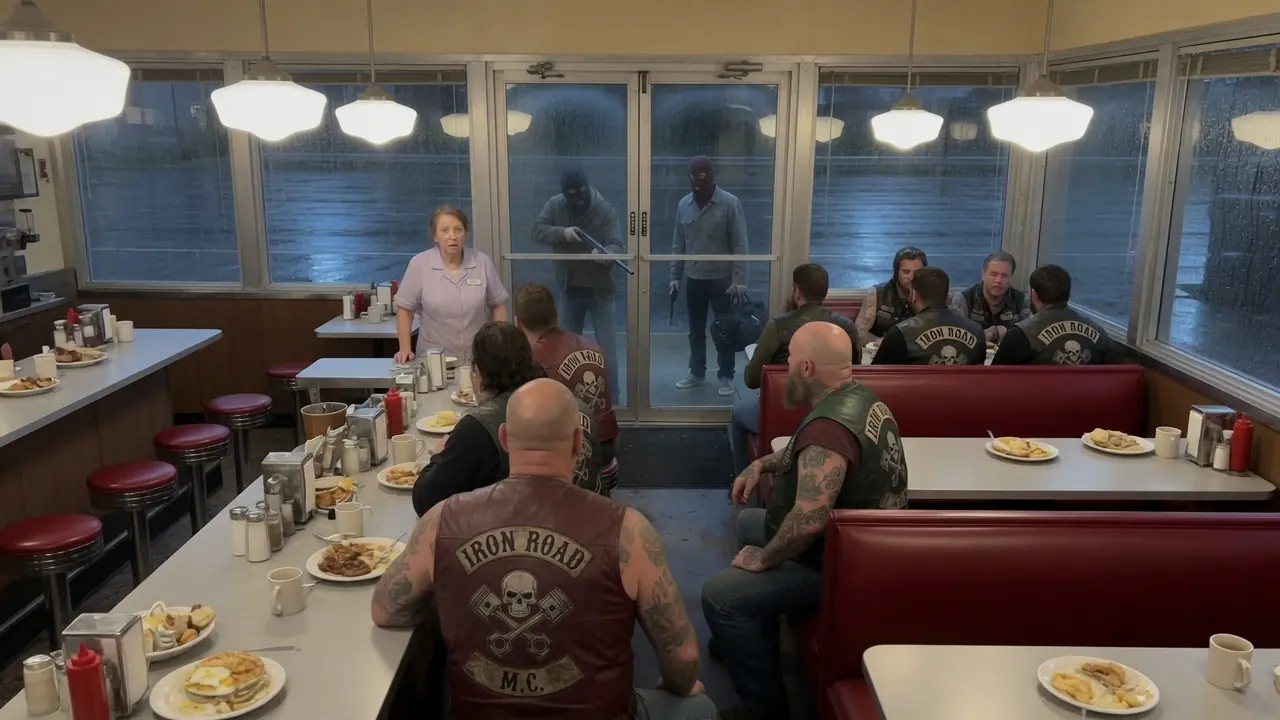
They don't think of themselves as desperate. They think of themselves as resourceful. They don't see a robbery. They see a solution. And at 2:09 in the morning, sitting in a stolen Honda Civic on the shoulder of Interstate 40 outside Barstow, California, Leo Danton looked at that flickering diner sign and saw the most elegant solution he had come across in weeks.
Ali's 24/7. The sign read half the letters buzzing like they were arguing with a bad electrical connection. A roadside diner that had probably been serving truck drivers and insomniacs since before Leo was born. Concrete parking lot. One security camera mounted above the entrance that Leo clocked immediately.
Old model probably recording to a VHS somewhere in a back closet. Probably hadn't been checked since the Clinton administration. Two cars in the lot. A beat up Chevy pickup that likely belonged to whoever was working the overnight shift. A sensible Toyota sedan that screamed insurance salesman or some guy driving through to Vegas.
And that was it. That was the whole threat assessment Leo Danton performed before deciding to rob the place. Cory Baxter sat in the passenger seat, his knee bouncing like a piston, his jaw working side to side the way it did when he hadn't slept, and the meth was still burning through his bloodstream. Cory was 26 years old, but looked 40 in the wrong light. He had a rusty .38 revolver tucked into the waistband of his jeans, a gun that Leo privately wasn't sure actually fired anymore, and the kind of eyes that hadn't been calm in so long that calm had become a foreign concept.
"How many inside did you think?" Cory asked, not looking away from the diner. "Two, maybe three," Leo said. "It's 2:00 in the morning on a Tuesday. Could be just the waitress." "And if there are more?" Leo picked up the Mossberg from the back seat and laid it across his lap. Sawed-off.
Illegal. Absolutely terrifying to anyone who didn't know guns well enough to know that at close range it was less precise than people assumed. "Doesn't matter how many," Leo said. "Nobody argues with this." Cory exhaled through his nose a long shuddering breath. "Toad's going to want the money by Friday." "I know." Cory said, "If we don't pay—" Leo's voice went flat.
"I know what Toad said. That's why we're here." Hector 'Toad' Velasquez wasn't the kind of man you owed money to. He was connected to a distribution network that ran product from the border up through the Inland Empire. And he operated with a particular philosophy. Debts were sacred.
Not in the religious sense, in the territorial sense. The kind of sacred that meant someone showed up at your door or your mother's door or wherever you happen to be sleeping if you stop showing up at doors. Leo and Cory owed Toad $6,000. They had at last count $240 between them. "In and out in five minutes," Leo said, and he almost believed it.
He pulled the ski mask over his face. Inside Ali's, Brenda Kowalski was on hour 7 of a 12-hour shift, and her feet were reminding her of that fact in explicit anatomical detail. Brenda was 60 years old, had worked the overnight shift at Ali's for going on 11 years, and had long ago made peace with the particular loneliness of that shift, the way time moved differently at 2 a.m. Slower, and somehow heavier, like the darkness outside had weight to it. She'd raised two kids on this shift, paid off a car, survived a divorce. The overnight diner shift, she always said, taught you more about human nature than any university course ever could.
Because the people who came in at 2:00 in the morning, weren't performing for anybody. They were just exactly who they were. She refilled the coffee for the man in booth 3, Dennis Parish, a medical equipment salesman out of Phoenix, who had checked in 40 minutes ago and fallen asleep over his eggs within 15 minutes of sitting down. His head was tipped back, his snoring rhythmic and unapologetic. Brenda had let him sleep.
He looked like he needed it. She carried the coffee pot back to the counter, humming something to herself that she couldn't quite name, and glanced at the clock above the piecase. 2:13 a.m., 47 more minutes until she could take her break. She didn't look toward booth 9, not because she was ignoring the four men seated there, but because in 11 years of overnight shifts, Brenda Kowalski had developed an instinct for which customers wanted engagement and which ones wanted to be left alone. The four men in booth 9 had walked in at 1:47 a.m., ordered coffee and food with the economy of people who knew exactly what they wanted and didn't need to discuss it and had been eating in a silence so complete and so comfortable that Brenda had recognized immediately these were men who had known each other a long time.
You didn't get that kind of silence with strangers. That kind of silence was earned. She hadn't looked too closely at the patches on their leather. She didn't need to. In 11 years on Interstate 40, you learn to treat everyone with the same professional courtesy.