Boy Saves Biker From 6 Bullies In 8 Seconds — Then 1500 Bikers Came For Him
Boy Saves Biker From 6 Bullies In 8 Seconds — Then 1500 Bikers Came For Him
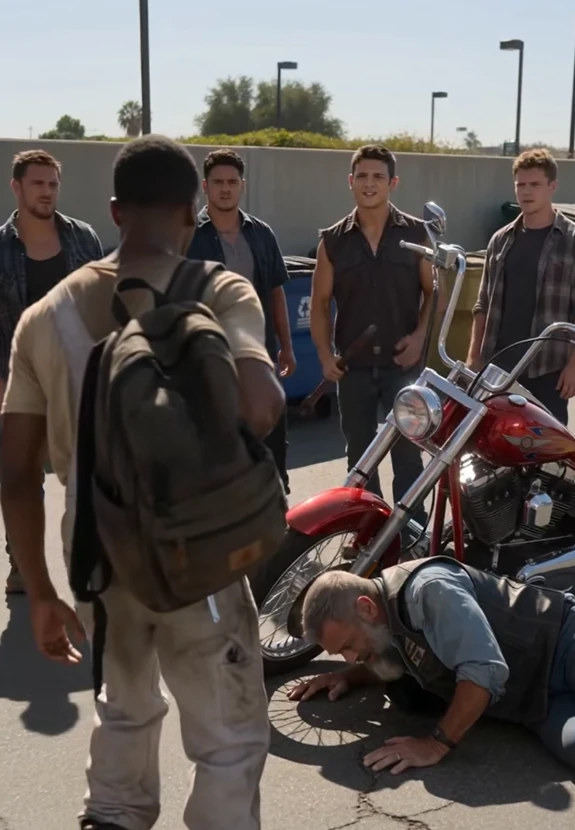
“Walk away. This is none of your business.”
Brandon looked at the six young men surrounding the elderly biker.
“Six against one?” he asked. “You call that fair?”
One of them stepped forward.
“Go back where you belong before we put you on the ground beside him.”
The old biker lying on the pavement slowly turned his head.
His voice cracked.
“Help me.”
He struggled to breathe.
“Please.”
Something broke open inside Brandon’s chest.
Trent stepped between them with a rusted pipe wrench in his fist and tapped it against the motorcycle’s engine.
“Stay out of this, or pay what he owes us. Then maybe I will leave the old man alone.”
“He asked for help,” Brandon said.
He reached toward the small adjustable wrench he always carried in his back pocket.
“I am helping him.”
Trent laughed sharply through his nose.
The five boys behind him spread into a wide line.
Six bullies.
One young Black man.
One elderly biker injured on the pavement.
By Monday, the story of the man begging for help would appear on news stations across the country.
The hardest part of Brandon Sullivan’s life had never been the work.
It was being watched as though he were always about to take something that did not belong to him.
At five in the morning, the kitchen light was already on.
Grandma Maylene sat at the counter checking her blood sugar with the same testing kit she had used for three years.
The reading was high.
She did not say anything.
She simply recorded the number in a small notebook.
Brandon kissed the top of her head as he walked toward the stove.
The oven door would not close properly.
He had been meaning to repair it.
Brandon removed a screwdriver from his back pocket, beside the adjustable wrench he carried everywhere, and tightened the loose hinge in less than a minute.
“There,” he said. “It should hold until payday.”
Maylene smiled without looking up.
“You do not have to repair everything around here, baby.”
“Somebody has to.”
On his way toward the door, Brandon counted the money inside his pocket.
Thirty-four dollars.
He stopped beside the rent jar on the counter.
After glancing over his shoulder, he slipped a folded twenty-dollar bill between the money already inside.
He was almost through the door when Maylene called his name.
“Brandon.”
He froze.
She stood in the kitchen doorway with her arms crossed.
She was not angry.
She looked worse than angry.
She looked sad.
“Bring that back.”
“Grandma.”
“Bring it back, baby.”
Brandon returned to the counter, removed the twenty from the jar, and held it in his palm.
Maylene lowered her voice.
She had never needed to shout to make herself understood.
“Listen to me this one time.”
She looked directly into his eyes.
“Our family, from your great-grandfather down, does not take what it did not earn.”
“And we do not take money from our children to pay for ourselves.”
Her voice remained gentle.
“Do you understand me?”
“Yes, ma’am.”
“That medical bill belongs to me, not you.”
“It is a lot of money.”
“It is still mine.”
Maylene placed one hand against his cheek.
“I do not need you to save me, Brandon.”
“I need you to become a man I will be proud of when I am gone.”
She smiled faintly.
“That is how you repay me.”
“Do you understand?”
Brandon nodded.
He placed the twenty-dollar bill back inside his wallet.
Then he kissed her again and walked outside.
The chain on his bicycle had snapped two weeks earlier.
He had not found time to repair his own transportation, so he walked twenty-two blocks to Hartman’s Auto.
The summer heat was already rising.
At a corner gas station, a woman watched him suspiciously while he purchased a soda.
“Do you work here, son?”
“No, ma’am. I am only a customer.”
She did not apologize.
Brandon did not expect her to.
Three blocks later, a patrol car slowed beside him.
The officer looked him up and down but never lowered the window.
Then the car continued down the street.
Brandon did not react.
His expression remained unchanged as he kept walking.
He had been experiencing moments like that since he was twelve.
Cole Hartman was already inside the garage with the hood raised on a Honda Civic, quietly arguing with its alternator.
He looked up when Brandon entered.
“You are early.”
“The bus did not come, so I started walking early.”
“The bus arrives at six fifteen.”
“I know.”
Cole grunted.
That was the closest thing to a compliment he usually offered.
Brandon pulled on his coveralls and went directly to a 1986 BMW R-series motorcycle parked near the rear of the shop.
The motorcycle was old and stubborn.
It was exactly the kind of machine nobody else wanted to touch.
Brandon worked on it the way some people prayed.
Quietly.
Patiently.
Without showing off.
He understood machines.
They made sense in ways people rarely did.
Around ten, a man wearing a polo shirt entered with the keys to a Lexus.
He looked past Brandon and asked Cole whether the mechanic was available.
Brandon kept his head lowered over the BMW.
He did not say anything.
Cole pointed toward him.
“He is the mechanic.”
The customer blinked.
He hesitated while trying to recover from the assumption he had made.
Brandon simply nodded politely and returned to work.
He had been experiencing that reaction since he was twelve too.
During lunch, he opened his backpack and removed a library book with a sticker on its spine.
Modern Custom Builders: A Visual History.
He had already borrowed it twice that year.
Brandon opened the book to a page softened by repeated use.
It showed a cherry-red 1959 Panhead with custom pinstriping across the fuel tank.
The caption read:
Henry “Iron Hank” Callaway, founder of Callaway Custom Cycles.
Brandon traced the lines of the motorcycle with one finger.
He whispered the names of famous builders the way other young men repeated the names of athletes.
“Callaway. Monroe. Roder. Foose.”
Cole walked past carrying a cup of coffee.
“You ever want to build something like that?”
“One day.”
Cole stopped.
“Yeah,” he said. “You will.”
It was the kindest thing he had said in months.
Brandon walked home that evening with aching arms and the adjustable wrench still inside his back pocket.
He passed a billboard advertising the West Coast Custom Bike Show.
The entrance fee for a builder was $350.
It was $350 Brandon did not have.
At the corner of Pine and Sixth, Mrs. Davies stood on her porch struggling with two grocery bags and a cane.
Brandon crossed the street without thinking.
“Let me carry those for you, ma’am.”
“Oh, Brandon, you do not have to.”
“It is nothing.”
He carried the bags up the steps.
He did not wait for thanks.
He waved and continued walking.
Mrs. Davies watched him leave and smiled as she shook her head.
“That boy.”
Brandon did not hear her.
He was already thinking about the following day’s shift.
He thought about the medical bill on the kitchen counter.
He thought about a cherry-red Panhead he had only seen in a library book.
He wondered whether he would ever see one in real life.
The following afternoon, Brandon almost did not take the shortcut behind the Sunoco station.
He almost remained on Main Street.
Almost.
It was four in the afternoon, and the summer heat had reached its peak.
His shift had run late.
His arms ached, and the library book felt heavier inside his backpack than it had that morning.
Brandon turned behind the Sunoco station on Fifth Street.
He had not yet seen the motorcycle.
Two blocks away, the man who built it was filling its tank with gasoline.
His name was Henry Callaway.
Most people called him Hank.
He was sixty years old.
His motorcycle was a cherry-red 1959 Panhead with a polished fuel tank and pinstriping Hank had painted with his own hands when he was thirty.
He was alone.
His phone had lost power an hour earlier.
Hank had ridden alone because he had always enjoyed riding alone.
He noticed the young men when they climbed out of the Chevrolet.
He noticed the way they looked at his motorcycle before they looked at him.
He had lived long enough to understand what that meant.
Hank did not move.
He continued filling the tank.
Trent Vaughn approached first.
He was twenty-two years old and possessed the dangerous confidence of someone with little to lose.
He whistled as though impressed.
“Look at this antique.”
Trent glanced at his friends.
“Grandpa rode his tricycle into the wrong part of town.”
Hank did not answer.
Cody spat onto the pavement two feet from Hank’s boot.
“Are you lost, old man? The retirement home is in the other direction.”
Hank remained silent.
Brett laughed.
The other three spread out behind them.
There were six now.
Six against one.
“What is wrong?” Cody asked. “Are you deaf, or too old to hear?”
Hank returned the fuel nozzle to the pump.
He still did not turn around.
Trent slowly circled the Panhead and pretended to admire it.
He whistled again.
“How much do you think this thing is worth?”
He looked at the others.
“Eight thousand? Ten?”
Trent grinned.
“Grandpa probably will not remember where he parked it tomorrow.”
A pickup truck passed the gas station.
The driver looked toward the six men and the elderly biker.