“Nobody else was going to.”
Hank studied him for a long time.
Then he slowly stood.
His back cracked, and he briefly winced before ignoring it.
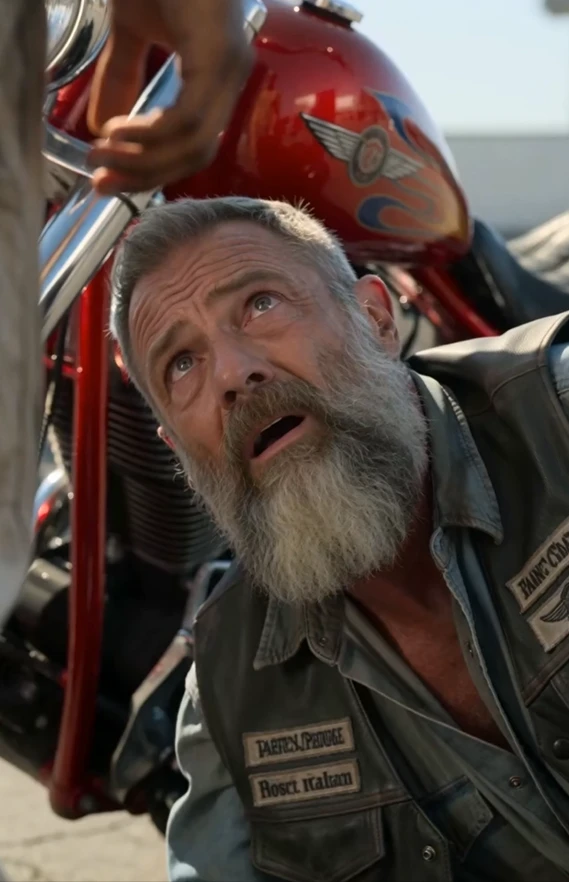
Hank looked toward his Panhead twenty feet away.
The young men had never reached it.
Then he looked back at Brandon sitting on the curb and holding his injured arm.
Hank almost smiled.
“Kid, you have no idea who you just helped.”
Behind them, the faded mural caught the late-afternoon sunlight.
The winged wheel.
The incomplete lettering of Callaway Custom Cycles.
Brandon did not look at it.
He was still thinking about the older man’s hands.
The compass ring.
The way the bandana had been tied.
Something in the back of his mind had begun whispering.
He did not yet understand what it was.
Hank reached into his vest.
Brandon assumed he was reaching for a phone.
He was not.
Hank removed a thick roll of money.
There were several thousand dollars in large bills.
He held it toward Brandon.
“Take it.”
He nodded toward the injured arm.
“For that and for your trouble.”
Brandon looked at the money and then at Hank.
He shook his head.
“I am not accepting money for helping you, sir.”
“You took a wrench across the shoulder for a man you did not know.”
Hank extended it again.
“Take it.”
“No, sir.”
Brandon kept his voice respectful.
“I appreciate the offer, but no.”
Hank pushed the money forward one more inch.
His voice softened.
“For your mother, then.”
Something flickered in Brandon’s eyes.
Hank did not know that Brandon’s mother had died when he was nine.
He did not know about the rent jar.
He did not know about the medical bill on the kitchen counter.
He did not know about the woman who had told Brandon that morning, “We do not take what we did not earn.”
Brandon heard Maylene’s voice as clearly as though she were standing beside him.
He shook his head once more.
“I did not do it for that.”
Hank kept the money extended for one more second.
Then he nodded slowly.
He returned the roll to his vest without arguing.
Hank studied Brandon the way a craftsman might examine a remarkable tool found unexpectedly in an ordinary place.
“All right,” he said.
“All right.”
Brandon slowly pushed himself up from the curb.
His left arm remained stiff against his side.
He began walking past Hank toward the road and home.
Then he passed the Panhead.
Brandon stopped.
His eyes moved across the fuel tank.
The hand-painted pinstriping surrounding the cap.
The polished cherry-red finish.
The small brass badge near the rear of the seat.
He had seen the motorcycle before.
It was on the dog-eared page of the library book beside his bed.
Cherry-red 1959 Panhead.
Henry “Iron Hank” Callaway.
Founder of Callaway Custom Cycles.
Brandon’s mouth opened slightly and closed.
He did not speak.
He looked at the motorcycle.
Then at Hank.
Then back toward the motorcycle.
Hank watched recognition form inside his expression.
He neither confirmed nor denied anything.
One corner of his mouth lifted into the closest thing to a smile he had shown that afternoon.
Brandon swallowed and continued walking.
Hank called quietly from behind him.
“Son.”
Brandon stopped.
“We do not forget.”
Brandon turned to ask what the words meant.
Hank was already placing the helmet over his head.
The Panhead started with a sound like distant thunder moving across hills.
Hank gave Brandon one small nod, lifted the stand, and rode from the gas station onto Fifth Street.
Brandon remained there with his bandaged arm.
He watched the cherry-red fuel tank disappear along the road.
Then he began walking home.
Inside the Sunoco station, the clerk waited until the motorcycle was gone.
He waited until Brandon turned the corner and the parking lot became empty.
Then he picked up the telephone and called a number he had not used in many years.
When someone answered, he kept his voice low.
“It was him.”
He looked through the glass.
“Yes, the builder from the magazine.”
The clerk paused.
“Some kid pulled him out. Young Black mechanic, skinny, maybe eighteen.”
“Hartman’s Auto, I think.”
He ended the call.
Brandon reached home at 6:40.
Maylene sat at the kitchen table with her notebook and a glass of water.
She looked up.
Her eyes moved toward the bandana on his arm.
Then she saw the dirt on his jeans and the way he favored his right leg.
She placed her pen on the table.
“Brandon.”
“I caught my arm on a fence on the way home.”
He tried to smile.
“It is fine.”
Maylene looked at him for a long and quiet moment.
She did not believe him.
Brandon could see that she did not believe him.
However, she was tired.
The numbers in her notebook were wrong again.
Her grandson was home.
“Sit down,” she said. “Let me see it.”
Brandon sat.
Maylene removed the bandana, examined the bruising, cleaned the skin gently, and rewrapped his arm with gauze from the medicine cabinet.
She carefully folded the blue bandana and placed it beside her notebook.
Maylene did not ask again.
Brandon did not volunteer the truth.
That night, he lay on his bed and stared at the water stain spreading across the ceiling.
His arm throbbed.
His shoulder throbbed.
Three words continued circling through his mind.
We do not forget.
We do not forget.
We do not forget.
By the following morning, three different things had already begun moving.
Brandon knew nothing about any of them.
The first was a black sport utility vehicle climbing a private road into the hills outside town.
Wyatt Donovan sat in the passenger seat.
Everyone called him Preacher.
He was speaking on the telephone.
He was not smiling.
“Yes, Hank is all right.”
Preacher listened.
“Two cracked ribs, perhaps. He refuses to say.”
He looked through the windshield.
“Some young man helped him. Black kid, eighteen, skinny, from the East Side.”
Preacher nodded.
“Yes, I understand.”
“Hank wants the entire table at the shop tomorrow.”
He paused.
“Bring the photographer.”
The call ended.
The vehicle passed through a gate and continued toward the house in the hills.
The second development was happening downtown.
Linda Brennan, a reporter at the local television station, frowned while listening to a voicemail at her desk.
She played it twice.
Then she walked into the records room and removed an old manila folder from a cabinet nobody had opened in years.
The label read:
CALLAWAY, HENRY. CUSTOM CYCLES. 1995 TO PRESENT.
Linda opened the folder.
The first photograph showed a man in his thirties standing outside a small motorcycle shop.
A cherry-red Panhead was parked behind him.
She picked up the telephone.
“Hello, it is Linda.”
She turned the photograph toward the light.
“I think I found something.”
The third development was happening inside the chapter clubhouse near the edge of town.
The room contained wooden walls, leather chairs, and a long oak table.
Behind Hank’s chair was a wall covered with framed photographs of motorcycles and the people who built them.
Hank sat at the head of the table.
Ten men occupied the remaining chairs.
Nobody touched the coffee in front of them.
Hank spoke quietly.
Like Maylene, he did not need to raise his voice.
“There is a young man working at Hartman’s Auto on the East Side.”
He looked down the table.
“I want to know about his family, school, medical bills, employment, difficulties, and friends.”
One of the older members leaned forward.
“What are we doing with this, Hank?”
Hank studied him.
“I have sat at this table for twenty-five years.”
“We have spent those years remembering what came before us.”
Hank’s hand rested on the wood.
“Now I want to know whether it is time to begin passing something forward.”
Nobody responded.
Hank tapped the table once with his compass ring.
Steel created a small, clean sound against oak.
“Find everything.”
His gaze moved across the men.
“Nobody approaches him.”
“Not yet.”
Across town, Brandon arrived early for work.
He had slept badly, and his arm ached with every movement.
Cole looked up from a tire iron.
“What happened to your arm?”
“I walked into a fence.”
Cole grunted and returned to work.
That afternoon, Brandon noticed a man standing across the street pretending to read a newspaper.
The performance was unconvincing.
Brandon paid little attention.
He was tired.
He had no idea that more than forty motorcycles were already preparing to ride toward his street.
Brandon was changing the oil in a Honda Civic when he heard the sound.
At first, he thought it was thunder.
He stood, wiped his hands against a rag, and listened.