Sheriff Wade Hollister Spent Ten Years Teaching Oak Hollow to Fear Him. Then Three Black SUVs Rolled Toward Ruby Lane Diner—and for the First Time That Morning, He Stopped Laughing.
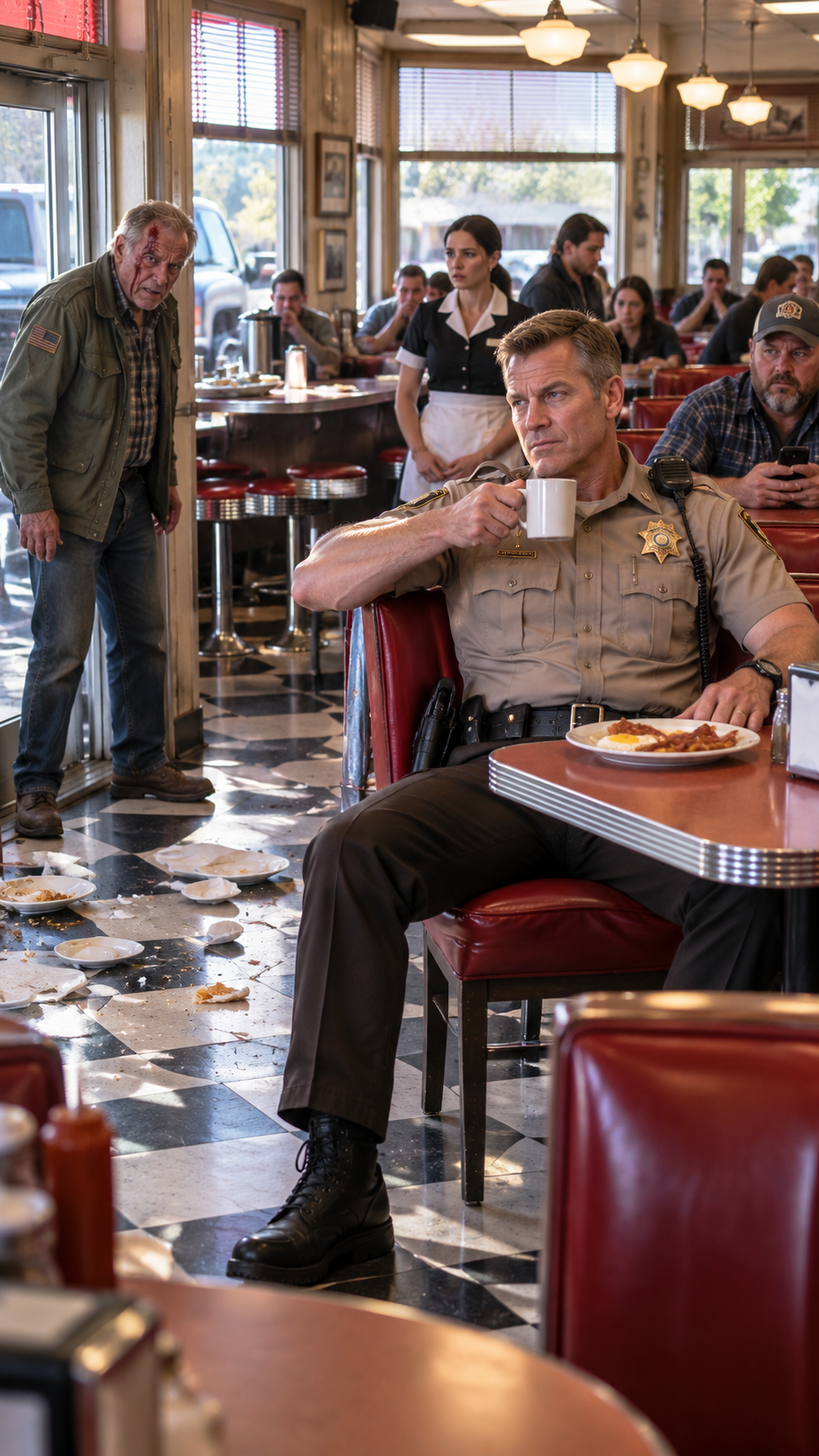
Sheriff Wade Hollister Spent Ten Years Teaching Oak Hollow to Fear Him.
Then Three Black SUVs Rolled Toward Ruby Lane Diner—and for the First Time That Morning, He Stopped Laughing.
Chapter 1
Sheriff Wade Hollister had spent ten years teaching Oak Hollow one lesson: resistance always cost more than obedience. He never needed speeches, public threats, or dramatic warnings because fear worked best when people learned to carry it quietly. By the time Saturday morning sunlight spilled through the windows of Ruby Lane Diner, most people in town no longer recognized their fear as fear. It had become habit.
Servers lowered their eyes. Customers learned when not to hear things. That was why Wade noticed immediately when the room stopped behaving the way it was supposed to. It was nothing obvious at first—just a waitress holding his gaze half a second too long, a truck driver failing to look away quickly enough, and one customer keeping his phone unlocked beneath the table.
No one challenged the badge pinned to Wade’s chest. No one spoke a word against him. But a silence had entered the diner, and Wade could feel it spreading. Fear was more than an emotion to a man like Wade.
It was currency. Men who built entire kingdoms with it could detect the smallest change in its value. For years, everyone in Oak Hollow had understood that one wrong word could mean a traffic stop, a surprise inspection, a missing permit, or a visit from someone wearing a badge. Most people decided survival was easier than courage.
Only minutes earlier, Wade had reminded everyone why. A seventy-two-year-old veteran had dared to argue with him near the front of the diner. Wade responded by manhandling the old man and throwing him hard against a parked vehicle outside. Plates had shattered during the chaos, breakfast scattered across the floor, and blood had run down the veteran’s face.
Wade returned inside afterward as though nothing important had happened. Now he sat comfortably in my chair. My chair. He ate eggs and bacon with the casual appetite of a man absolutely certain that consequences were reserved for other people.
Broken ceramic still glittered near the counter. A dark smear on the floor remained where someone had tried to clean the aftermath too quickly. Wade never looked at any of it. Nobody confronted him.
Nobody stared directly at him. Nobody dared. That confidence had always been Wade’s greatest weapon. Not the sidearm on his belt.
Not the sheriff’s star. Not even the authority attached to his office. His real power came from believing—correctly, for many years—that every person around him would calculate the cost of resistance and decide it was too high. Cruel men rarely stop after violence because violence itself is not always what they want.
They need witnesses. They need silence afterward. Most of all, they need everyone nearby to remember exactly who owns the room. Wade had always owned Ruby Lane when he walked through the door.
Until that morning. The young waitress kept looking toward the front windows. A heavyset truck driver at booth seven slowly unlocked his phone underneath the table. Another customer stopped pretending to read the newspaper.
Wade took another bite of bacon. Then three black SUVs turned onto Ruby Lane. At first, almost nobody moved. The vehicles came slowly down the road, dark windows reflecting the pale morning sky.
They did not move like lost tourists searching for breakfast. They did not hesitate at intersections or slow down to read signs. They moved with certainty. The first SUV entered the gravel lot.
Then the second. Then the third. Every conversation inside Ruby Lane died almost simultaneously. Coffee cups stopped halfway to mouths.
Forks hovered above untouched breakfasts. Chairs went still. Even Wade’s laugh disappeared. Only for a heartbeat.
But a heartbeat was enough. The first SUV stopped directly outside the diner. The second positioned itself several yards behind it. The third pulled in last, completing a quiet line across the gravel.
One engine shut down. Then another. Then the third. The silence afterward somehow felt louder than the vehicles had.