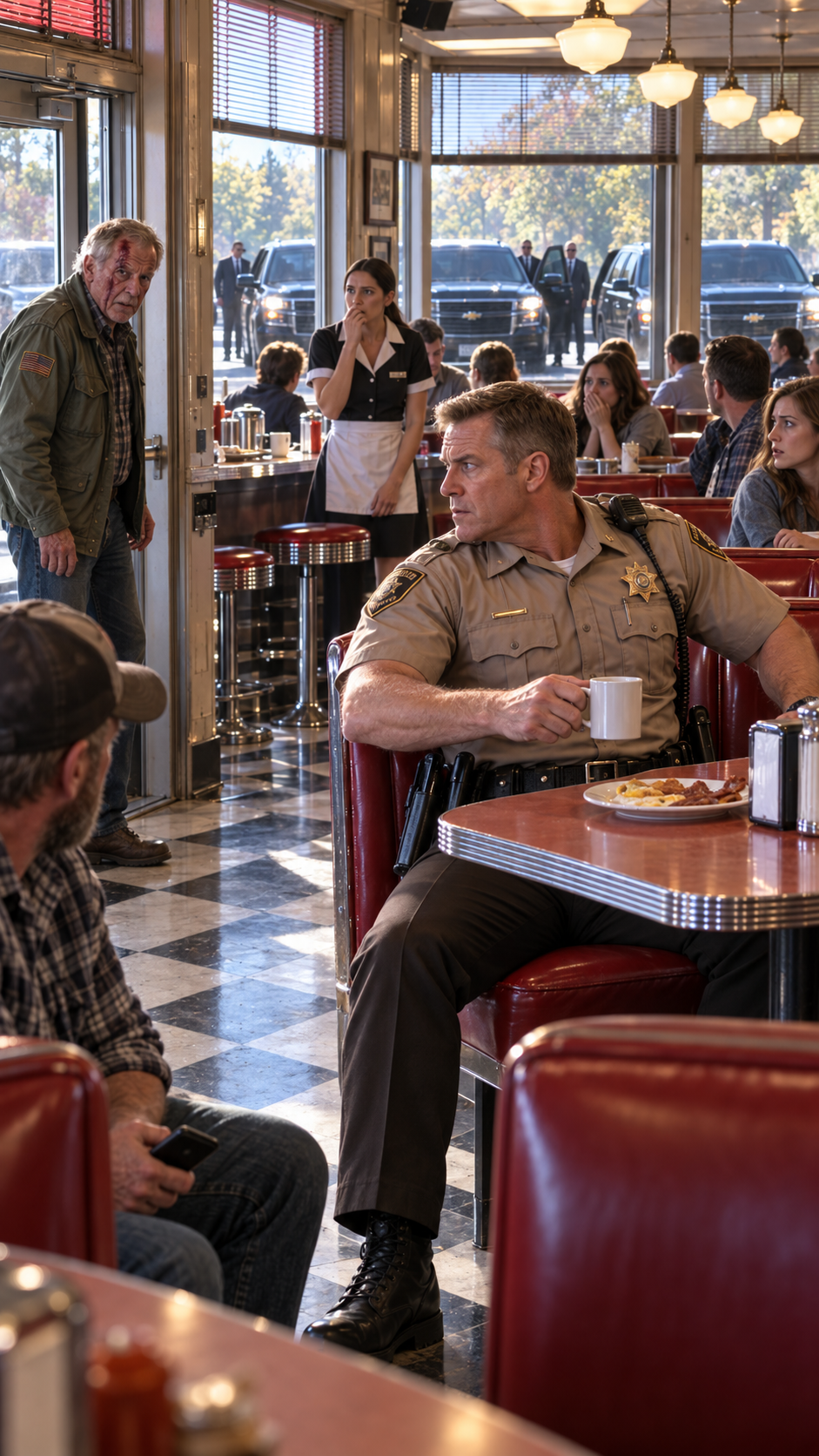
Nobody inside moved. Nobody spoke. They simply watched. Some primitive instinct had moved through the room, telling everyone that whoever had just arrived was not passing through Oak Hollow by accident.
The driver’s door of the first SUV opened. Then the second. Then the third. Three men stepped onto the gravel.
They did not rush. They did not look around uncertainly. They did not consult phones or maps. They simply started walking toward Ruby Lane Diner.
There was something unsettling about the way they moved—not aggressive, not theatrical, just controlled and purposeful. They carried themselves like men who never needed to announce authority because authority had spent years learning how to walk beside them. One wore a dark charcoal suit. Another had a folder tucked beneath one arm.
The third scanned the diner windows once, then looked directly toward the entrance. Inside, every pair of eyes followed them. Including Wade’s. The sheriff slowly lowered his fork.
For the first time that morning, something unfamiliar appeared beneath the confidence on his face. Not fear. Not yet. Recognition.
As the three strangers crossed the gravel, the waitress beside the coffee station took one quiet step backward. The truck driver raised his phone above the table. Somewhere in the kitchen, a plate stopped clattering. Wade stared through the window.
His smile was gone. And for the first time in ten years, Oak Hollow watched Sheriff Wade Hollister look at someone approaching him and wonder whether fear still belonged to him.
Chapter 2
The three men entered Ruby Lane without touching their jackets, raising their voices, or looking around for permission. Wade leaned back in the booth and forced a smile, but the hand holding his coffee mug tightened visibly. The man carrying the folder stopped five feet away and said, “Sheriff Hollister?” Wade answered, “Depends who’s asking.”
The tallest man removed a leather credential case and opened it just long enough for Wade to see what was inside. **“Daniel Mercer, United States Attorney’s Office. This is Special Agent Thomas Reed and State Bureau investigator Marcus Hale.”** Every fork in the diner seemed to become heavier. Wade’s smile disappeared again.
“What federal business do you have in my county?” he demanded. Mercer looked toward the elderly veteran near the entrance and then toward the shattered plates still scattered across the floor. “Today? Assault, intimidation, obstruction, and possibly witness tampering.” Wade laughed once, but nobody joined him.
The veteran stepped forward. His name was Samuel Grady, a retired Army sergeant major who had lived outside Oak Hollow for almost forty years. Wade had always considered him harmless because Samuel complained loudly, filed paperwork constantly, and never seemed to accomplish anything. **What Wade did not know was that Samuel had spent the previous eleven months wearing a federal recording device.**
Wade’s face changed. Samuel touched the small cut on his forehead and said, “You should’ve let me finish breakfast.” The truck driver at booth seven stood next. He was not a truck driver at all.
He introduced himself as Special Agent Paul Bennett from the Treasury Department. The phone hidden beneath his table had been transmitting audio to a surveillance van parked two streets away. Around the diner, people began looking at one another differently.
Wade slowly stood. “You set me up.” Samuel shook his head. **“No, Sheriff. We gave you a room full of choices, and you made every one yourself.”**
Chapter 3
Wade reached for his radio, but Mercer calmly told him not to summon deputies. Federal teams were already securing the sheriff’s office, evidence room, county records building, and Wade’s personal residence. Four of Wade’s deputies had been separated for interviews before the SUVs ever entered Ruby Lane. Two were already cooperating.
For ten years, Wade had operated what residents jokingly called the Oak Hollow tax. Business owners who wanted inspections handled quickly paid cash. Drivers who wanted citations forgotten paid cash. Families fighting zoning disputes discovered that obedience could make problems vanish.