I knew exactly what she looked like when she wanted the world to see her being a mother.
That was why her refusal hurt even though I should have expected it.
“I refuse to walk my greatest regret to the altar.”
There are sentences that hurt because they surprise you.
That one hurt because it confirmed something I had spent most of my life being told was not real.
My mother had finally said plainly what years of smaller decisions had suggested.
Paige and Lauren heard it.
My father heard it.
Daniel heard it.
People in the bridal suite heard it.
And still, my first instinct was not to scream.
I tightened my fingers around my veil.
That was all.
Lauren’s response told me just how normal my pain had become inside our family.
“Don’t cry, Emma. You’ll ruin your makeup.”
She said it like she was reminding me not to spill something on the carpet.
Paige adjusted her diamond bracelet.
My father stood near the doorway.
He had every opportunity to say my mother had gone too far.
Instead, he defended her right to feel whatever she felt.
That was when I told him the thing I should have said years earlier.
“My feelings never mattered when I was the one being hurt.”
He looked away.
Daniel stepped toward us immediately.
I could see the anger in his face.
I touched his arm before he could speak.
“Not yet.”
He did not understand everything behind those two words.
Neither did my sisters.
My mother probably thought I was trying to keep the wedding from becoming a scene.
She was wrong.
I was waiting because the scene had already begun.
The door opened.
Grandpa came in leaning on his black cane.
At eighty-one, he moved more slowly than everyone else in the room.
Nothing about the way people reacted to him was slow.
My mother froze when he said her name.
“Margaret.”
There was no speech.
No dramatic accusation.
Just her name.
“What did you just say to her?”
My mother tried to close the circle immediately.
“This is family business.”
Grandpa answered with three words.
“I am family.”
My father told him not to create a scene.
Grandpa ignored him.
He came to me.
Then he offered me his hand.
“I’ll walk you.”
I had spent the morning trying not to cry over the mother who refused me.
I almost lost control because of the grandfather who did not.
“Grandpa…”
His fingers tightened around mine.
“You were never a regret, Emma.”
Then he told me I had been the only one brave enough to search for the truth.
My mother reacted before she could hide it.
It lasted perhaps a second.
That was enough.
Grandpa saw it.
So did I.
Whatever happened next, I no longer needed anyone to tell me I had imagined the fear behind her anger.
She knew what I had been examining.
She knew Grandpa knew.
And for the first time, the people who had spent years controlling every explanation no longer controlled who was allowed to speak.
The church doors opened.
The organ began.
Relatives were waiting inside.
Family friends were waiting.
Business partners were waiting.
People who knew the version of the Carter family that existed in photographs and at formal gatherings were waiting.
They knew Paige.
They knew Lauren.
They knew my parents.
Some of them knew me only through stories told by the same people who had called my questions difficult.
Grandpa offered his arm.
I took it.
My mother followed us out of the bridal suite.
Paige and Lauren came behind her.
My father came too.
Daniel waited at the opposite end of the church.
He was supposed to be the person I focused on during that walk.
And I did see him.
But I also felt every step beside Grandpa.
The soft drag of his pace.
The pressure of his arm beneath my hand.
The measured placement of his cane.
Nobody hurried him.
That mattered to me.
For most of my life, I had been asked to move past things before anyone had admitted they happened.
Move on.
Be mature.
Do not ruin the holiday.
Do not embarrass the family.
Do not make everything about yourself.
Now an eighty-one-year-old man was walking slowly enough that nobody could rush the moment away.
About halfway down the aisle, his hand tightened.
He stopped.
I stopped beside him.
The organ faltered.
Guests began looking from us toward the rear of the church.
I could feel Daniel watching me.
Behind us stood my mother, the woman who had walked my sisters proudly and refused to take the same walk with me.
I did not know exactly how Grandpa intended to say what he knew.
I only knew he had asked me for permission.
That mattered more than I expected.
My mother had spent years deciding what I could know, what I should accept, and which injuries I was supposed to reinterpret as love.
Grandpa did the opposite.
He asked.
“Emma, do you still want me to tell them?”
That question carried more weight than the entire room.
Because there was still time to protect the family image.
There was still time to finish the ceremony, smile for photographs, and let everyone leave believing whatever they already believed.
There was still time for me to decide that my wedding should not become the day everything came apart.
I looked toward Daniel.
He did not gesture.
He did not nod.
He simply waited.
The decision remained mine.
I looked back toward my mother.
She had refused to walk me because she expected humiliation to make me smaller.
Instead, I had reached the middle of the aisle beside the one family member who had told me I was not a regret.
I thought about the vanished college money.
The letters that stopped.
The explanations that shifted.
The eighteen months I had spent comparing records and forgotten details because every direct question had somehow become an accusation against me.
And I thought about how easily I could spend another eighteen years asking myself whether I should have spoken when I finally had the chance.
“Yes,” I said.
Grandpa nodded.
My father stepped into the aisle.
For once, his attention was not on me.
It was on my mother.
“Margaret, don’t.”
She stared at him as if he had betrayed her merely by saying her name with resistance in it.
Maybe that was the first time she understood something I had only just understood myself.
The truth did not need every person in my family to become brave at once.
It only needed one person to stop cooperating with the silence.
Grandpa turned.
His black cane remained planted beside him.
His hand still held mine.
My mother stood behind us with Paige and Lauren.
The room that had spent years seeing the Carter family from the outside was finally watching all of us at the same time.
And Grandpa began to speak.
Eight words.
Nothing more.
But they were enough to threaten every explanation I had been given about why I was treated differently, why my questions had frightened my parents, and why the people who called me difficult had worked so hard to keep me from finding my own answers.
The wedding had not stopped because my mother refused to walk me.
It had stopped because, halfway down the aisle, she was about to lose the one thing she had controlled for most of my life:
the story everyone believed about me.
General Morrison became completely still.
“What did you say?”
The recruit swallowed hard, but this time he didn't look at Marcus.
“There were others before her.”
That sentence changed the field more than my rank ever could.
Until then, everyone had been staring at me—the scars, the torn uniform, the salute, the medals Marcus hadn't known about.
Now they were looking at one another.
Private Diaz stepped fully out of formation.
Marcus pointed at him. “You need to stop talking.”
“Caldwell,” Sergeant Tanaka warned.
Diaz kept his eyes on the General.
“He's been doing this all week. Not just to her.”
Another recruit spoke before Marcus could interrupt again.
“So have some of the others.”
The laughter that had followed me through the mess hall suddenly felt different in my memory.
It hadn't always been people laughing because Marcus was funny.
Sometimes they had laughed because staying silent was easier than becoming his next target.
General Morrison looked down the line of recruits.
Nobody was smiling now.
I pulled the torn side of my uniform closed with my good hand, but for the first time since Marcus had started targeting me, I didn't feel like I was standing there alone.
The General turned back toward Marcus.
“Caldwell, don't move.”
Marcus didn't answer.
Then Morrison looked at the rest of the formation.
His voice wasn't loud.
It didn't need to be.
“I want every name.”
And suddenly Marcus wasn't the only person on that field who looked afraid.
The rain had stopped less than twenty minutes earlier, but the field was still slick beneath our boots.
Water clung to the edges of the training obstacles, and mud darkened the knees of almost every uniform in formation.
Mine was worse.
One shoulder seam was ripped open, the fabric hanging loose where Marcus had grabbed me.
I kept my good hand over it.
Not because I was ashamed of the scars.
I had spent too many months learning how to look at them without remembering the exact moment I got them.
I covered them because they were mine.
Marcus had taken enough from me that afternoon.
He wasn't going to take my privacy too.
General Morrison seemed to understand that without my saying a word.
He shifted slightly so that his body blocked part of the formation's view of me.
It was a small thing.
Nobody else probably noticed.
I did.
Eighteen months earlier, small things had been the difference between coming home and not coming home at all.
Back then, I hadn't been the woman Marcus Caldwell thought he could push around because she was five-foot-four and favored one arm.
I had been Staff Sergeant Maya Reeves.
Ghost Unit 7.
Operation Nightfall.
Seventy-two hours behind enemy lines.
Fourteen people from my unit never returned.
I did.
For a long time, I wasn't sure whether surviving should have felt like winning.
There were surgeries first.
Then more surgeries.
Then rehabilitation.
Then the slow, frustrating work of teaching my damaged arm to do things that had once required no thought at all.
Pick up a cup.
Button a shirt.
Carry weight.
Hold steady.
Sleep without waking because a muscle had seized.
People liked to talk about recovery as though it were a staircase.
You climbed.
You improved.
Eventually you reached the top.
Mine wasn't like that.
Some mornings I could do almost everything I had done the day before.
Other mornings, tying my boots felt like a negotiation.
Eventually, an administrative decision put me back into a training pipeline.
I knew what people would see when I arrived.
A short woman.
A stiff arm.
Scars.
Someone starting over.
I also knew what I could have done.
I could have walked in carrying my old rank like armor.
I could have told everyone about Ghost Unit 7.
I could have let my history enter the room before I did.
I didn't.
I needed to know something more important.
Without the title, without the medals, without the story people would whisper after I left the room, could I still earn my place?
For several days, I thought the hardest part would be proving the answer to myself.
Then Marcus noticed me.
The first comments were small enough that anyone could pretend they were jokes.
He said I was too short.
He asked whether someone had made a mistake letting me into the pipeline.
He looked at my damaged arm during drills and smirked.
When I didn't react, he became less subtle.
The scars became his favorite subject.
He called them disgusting.
He asked loudly whether I thought anyone wanted to look at them.
He joked that someone “damaged” shouldn't be wearing a uniform.
A few recruits looked uncomfortable.
A few laughed.
Most did what groups often do when cruelty hasn't chosen them yet.
They stayed out of it.
The mess hall was where I realized Marcus wasn't trying to be funny.
I walked in one afternoon and saw three empty seats at the table where he was sitting.
When I moved toward one, he stretched an arm across it.
“Not here.”
I stopped beside the table.
“There are three empty seats.”
“I said not here.”
He looked me over slowly, making sure the people beside him were watching.
Then he nodded toward another table.
“Go sit somewhere you fit in.”
Several recruits laughed.
He never said what he meant.
He didn't need to.
I picked up my tray and walked away.
Behind me, Marcus called, “That's right. Keep walking.”
I kept walking because turning around would have given him exactly what he wanted.
I hadn't come back to prove I could win an argument in a cafeteria.
But every time I refused to react, Marcus seemed to treat restraint as surrender.
At the range, that confidence took its first real hit.
Corporal James laid a disassembled M4 on the table.
The recruits around me shifted into position.
Marcus watched from two places down.
I put the weapon together in twelve seconds.
For the first time since I'd arrived, the laughter stopped without someone ordering it to.
Then we fired.
Forty rounds.
Controlled pairs.
When the targets came back, my grouping sat tight around center mass.
Marcus stared at it.
“Lucky.”
I didn't answer.
The course moved to moving targets.
Fifteen appeared.
Fifteen dropped.
Sergeant Tanaka studied my target, then studied me.
“That isn't beginner shooting.”
Marcus heard her.
I watched his expression change.
Not into respect.
Into resentment.
The following afternoon he challenged me in the combat pit.
He had nearly sixty pounds on me.
He knew it.
Everyone watching knew it.
Marcus came at me hard enough that the first step told me he wasn't interested in demonstrating technique.
I moved aside.
He turned and rushed again.
This time I redirected his momentum, used controlled contact, and put him down.
Eight seconds.
When he stopped advancing, I stopped.
That part mattered to me.
I had spent too many years learning the difference between force and control to confuse the two.
Marcus ended on one knee.
I offered him my hand.
For one second, I thought training might take over and he would accept it.
Instead, he slapped my hand away.
Several recruits laughed.
I watched the heat climb into his face.
That was when the problem changed.
Until then, Marcus had been trying to prove I was weak.
After the combat pit, he needed to prove I had humiliated him.
The next day, rain covered the obstacle course.
Marcus ran hard and crossed the finish line first.
8:45.
I came across thirteen seconds later.
I was breathing hard, my injured arm aching from the wet cold, when he followed me away from the line.
“You think you're better than me now?”
“No.”
That was the truth.
I wasn't interested in being better than Marcus.
I was interested in being capable of doing the job in front of me.
I tried to pass him.
He blocked my path.
“Look at me when I'm talking to you.”
“Move, Marcus.”
His hand struck my shoulder.
I stepped back.
Across the field, Sergeant Tanaka saw it.
“Caldwell!”
Marcus heard her.
He grabbed me anyway.
His fist closed in the fabric near my shoulder.
“You don't belong here!”
Then he yanked.
The sound of my uniform tearing cut across the field.
Everything stopped.
Part of the shirt pulled open.
The scars showed first.
Old, uneven lines crossing the shoulder and the skin around them.
Then the tattoo.
A skull.
Crossed rifles.
Coordinates.
Two words.
GHOST 7.
Private Diaz stopped smiling.
“Oh my God.”
Someone else whispered one word.
“Nightfall.”
Marcus looked around.
“What?”
Nobody answered.
The same people who had laughed at his jokes were staring at the tattoo.
Marcus looked back at me.
For the first time since I had met him, uncertainty entered his face.
“What is Ghost 7?”
I didn't answer.
I wasn't going to explain myself to the man whose fist was still twisted into my shirt.
Then a voice behind the formation shouted, “Attention!”
Nearly two hundred recruits straightened.
A senior officer was crossing the field.
General Morrison.
Marcus immediately let go of my uniform.
Too late.
The General had seen the shove.
He had seen the grab.
He had seen the torn fabric.
He walked straight toward us.
His attention went to Marcus first.
Then to me.
Then to the tattoo on my scarred shoulder.
He stopped.
I saw recognition before he said a word.
Not recognition of the symbol.
Recognition of me.
General Morrison came to attention.
Then he saluted.
The field seemed to forget how to breathe.
“Staff Sergeant Maya Reeves.”
Marcus stared at me.
The General continued.
“Ghost Unit 7.”
“Operation Nightfall.”
Then his voice lowered.
“Sole survivor.”
I heard someone behind me inhale sharply.
Marcus didn't move.
General Morrison looked at my exposed scars.
The same scars that had been entertainment in the mess hall.
The same scars Marcus had called disgusting.
Then the General said, “Silver Star.”
A pause.
“Purple Heart.”
The difference in the field was immediate.
Not because I had changed.
I was the same woman who had been standing there seconds earlier with Marcus's fist in my uniform.
The only thing that had changed was what everyone knew about me.
Marcus took one step backward.
“Sir, I didn't know—”
General Morrison turned toward him.
“You didn't know her rank?”
“No, sir.”
“You didn't know about her service?”
“No, sir.”
Morrison stepped closer.
“So if she had been nobody important, you think putting your hands on her would have been acceptable?”
Marcus opened his mouth.
Nothing came out.
That question mattered more to me than the salute.
More than hearing my awards spoken aloud.
Because I had spent the entire week wondering whether anyone would object to the way Marcus treated me before they knew I had once been important.
Now the General had asked the question no one on that field could avoid.
Would it have mattered if I had just been Maya?
No medals.
No Ghost Unit.
No history powerful enough to make everyone suddenly ashamed of laughing.
Sergeant Tanaka reached us.
General Morrison looked at her.
“Was today's incident recorded?”
“Yes, sir.”
Marcus's shoulders tightened.
Then Private Diaz raised his hand.
“Sir?”
Morrison turned.
Diaz looked like he was deciding whether speaking would make him safer or put him directly in Marcus's path.
“This wasn't the first time.”
Marcus spun toward him.
“Shut up.”
Diaz kept going.
“He's been targeting her all week.”
Another recruit stepped forward.
“So have some of the others.”
That was when I understood something I had missed.
Marcus had been the loudest.
He wasn't necessarily the entire problem.
The people who laughed had made it easier.
The people who looked away had made it easier.
The people who convinced themselves it wasn't their business had made it easier.
And apparently, I hadn't been the first person forced to learn that.
General Morrison looked over the formation.
“What exactly has been happening here?”
No one answered at first.
I knew that kind of silence.
It wasn't confusion.
It was calculation.
People were measuring what they knew against what telling the truth might cost them.
Then a young recruit near the back finally spoke.
“Sir... Maya wasn't the first.”
Morrison went completely still.
“What did you say?”
The recruit swallowed.
“There were others before her.”
Marcus's face changed.
He didn't look angry anymore.
He looked afraid.
Not afraid of me.
Afraid of what everyone else might finally say once one person had started.
Private Diaz stepped out of formation.
Marcus pointed at him.
“You need to stop talking.”
“Caldwell,” Sergeant Tanaka warned.
Diaz didn't look at Marcus.
“He's been doing this all week. Not just to her.”
Another recruit spoke.
“So have some of the others.”
Then another voice joined in.
The field that had spent days watching Marcus isolate people had become a place where staying silent suddenly required its own decision.
I closed the torn side of my uniform with one hand.
The fabric wouldn't stay together.
For the first time, that didn't feel like exposure.
It felt like the end of hiding something I had never owed anyone in the first place.
General Morrison moved half a step in front of me, enough to give me privacy without turning the moment into a performance.
Then he faced Marcus.
“Caldwell, don't move.”
Marcus said nothing.
Morrison turned to the formation.
“I want every name.”
The words hung there.
No speech followed.
No applause.
No dramatic celebration.
Just wet boots in the grass, recruits looking at one another, and a man who had spent days deciding who was weak realizing that the people around him were beginning to speak.
Marcus had believed tearing my uniform open would expose the reason I didn't belong.
Instead, it exposed the scars I had already survived.
It exposed the history he had never bothered to learn.
And most importantly, it exposed a question bigger than anything written on my shoulder.
How many people had been mistreated simply because the person doing it believed nobody important would care?
Standing there with my uniform torn and my damaged arm aching, I finally understood why General Morrison's question had hit harder than the salute.
My medals were not what made Marcus wrong.
My rank was not what made Marcus wrong.
Ghost Unit 7 was not what made Marcus wrong.
Those things only prevented everyone else from pretending they hadn't seen it.
Private Diaz remained outside formation.
The recruit who had said there were others stayed standing too.
Then another person shifted forward.
I didn't know what would be said next.
I didn't know which names would come out or how many people had been carrying their own version of the same week.
But Marcus knew the silence was over.
And this time, when someone beside me stepped forward, I didn't keep walking.
I stayed.
Angela Washington had spent fourteen hours dealing with people who understood exactly how much damage one careless sentence could do.
Witnesses.
Investigators.
Defense attorneys.
Agents.
Supervisors.
By the time she drove into her neighborhood that afternoon, she wanted only quiet.
Her shoulders ached beneath her blazer.
A half-finished cup of coffee sat cold in the center console of her black Mercedes.
Her phone contained three unanswered emails she had promised herself she would not open until morning.
Angela was thirty-eight years old, had lived in the neighborhood for six years, and had driven the same route home so many times that she could have made the final turn without thinking.
That was why she noticed the patrol car immediately.
It appeared in her mirror two streets from her house.
At first, Angela thought nothing of it.
Then it stayed behind her.
One turn.
Then another.
When she slowed near her driveway, red and blue lights flashed.
Angela exhaled.
“Seriously?”
She pulled over.
Both hands remained on the wheel.
Years of prosecuting cases involving police conduct had taught her one thing long before this afternoon: during a stop, clarity mattered.
Do not make sudden movements.
Do not create unnecessary uncertainty.
Document mentally.
Listen carefully.
The officer approached from behind.
Angela watched him in the side mirror.
White.
Male.
Mid-thirties, maybe.
Uniform neat.
One hand resting near his belt.
He stopped beside her window.
Angela lowered it.
“Good afternoon, Officer.”
He looked into the Mercedes before looking at her.
Then his eyes moved to the houses.
Large homes.
Manicured lawns.
Stone driveways.
The expression on his face changed so slightly that someone unfamiliar with interviews might have missed it.
Angela did not.
“License and registration.”
No greeting.
No explanation.
Angela nodded.
“Certainly.”
She reached slowly toward her purse.
His voice snapped across the window.
“Keep your hands where I can see them.”
Angela froze.
Her hand remained above the center console.
“Officer, you asked for my identification.”
“I said hands where I can see them.”
She returned both hands to the steering wheel.
“Understood.”
He leaned closer.
“Whose car is this?”
Angela looked at him.
“Mine.”
He gave a short laugh.
Not amused.
Dismissive.
“Right.”
Angela felt something cold settle in her stomach.
“May I ask why you stopped me?”
“Vehicle looks suspicious.”
“The vehicle?”
He glanced toward the Mercedes emblem.
Then back at her.
Angela waited.
Instead of explaining, he asked:
“Where are you headed?”
“Home.”
“Where’s that?”
Angela looked through the windshield.
“Three houses down.”
The officer followed her gaze.
Then smiled.
It was not a friendly smile.
“You live here.”
“Yes.”
“Sure you do.”
That was the moment Angela knew exactly what kind of stop this had become.
She kept her voice even.
“Officer, may I have your name?”
His jaw tightened.
“It’s right here.”
He tapped the badge.
“Miller.”
“Officer Miller, I’m asking again: why am I being detained?”
He straightened.
“Who said you’re being detained?”
“You activated your emergency lights and instructed me not to move my hands.”
“You got somewhere to be?”
“My house.”
Miller looked around at the neighborhood once more.
Then back at her.
“What do you do for work?”
Angela almost laughed.
Not because it was funny.
Because the question had nothing to do with the supposed reason for the stop.
“Why is that relevant?”
His expression hardened.
“There it is.”
“What?”
“The attitude.”
Angela looked directly at him.
“I’m asking a question.”
“You people always have questions.”
Silence.
Angela heard it.
Every word.
So did the body camera attached to his chest, assuming it was recording.
She glanced at it.
A small red light was visible.
Good.
Miller noticed where she was looking.
“What?”
“Nothing.”
His eyes narrowed.
“Get out of the car.”
Angela’s pulse changed.
Not faster exactly.
Sharper.
“Am I under arrest?”
“I told you to get out.”
“On what grounds?”
He opened the door himself.
Angela remained still.
“Officer, I am not resisting you.”
“You’re obstructing.”
“How?”
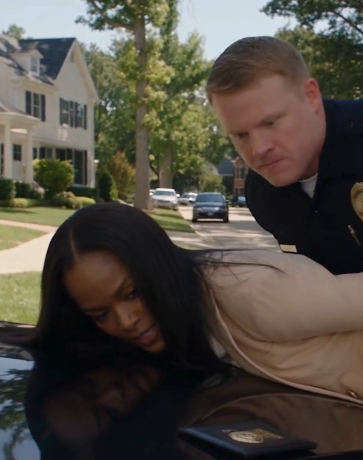
He grabbed her wrist.
Hard.
Angela inhaled sharply as he pulled her out.
Her purse slipped from the passenger seat where she had moved it earlier and fell onto the pavement.
Lip balm.
Keys.
A folded receipt.
Her wallet remained inside.
Miller turned her toward the hood.
“Hands behind your back.”
“Officer Miller, I’m complying.”
“Then stop talking.”
He pushed her against the car.
The hood was still warm beneath her palms.
One of her heels shifted on the asphalt.
Miller twisted her arm higher.
Pain ran through her shoulder.
“Get on your knees, sweetheart.”
Angela turned her head just enough to hear him clearly.
“What?”
“Women like you don't get to question me.”
For the first time, anger threatened the calm she had been protecting.
Not because she had never heard worse.
She had.
Courtrooms were full of people who said ugly things when consequences approached.
But this was different.
This man had a badge.
A weapon.
The legal authority to stop people.
And he had decided she was the problem before asking a single meaningful question.
Angela forced her voice steady.
“I am not resisting.”
“Then act like it.”
The handcuffs closed around her wrists.
Too tight.
She felt the metal immediately.
Across the street, a front door opened.
Angela recognized her neighbor.
Margaret Ellis.
Retired teacher.
Had lived there longer than Angela.
Always brought too much food to neighborhood events.
Margaret stepped onto the porch.