“The original report said ownership verified.”
Cole shook his head.
“Ryan—”
“The next morning, the report said ownership disputed.”
I felt my stomach tighten.
That was no longer about attitude.
Or ego.
Or even racial profiling by two deputies who had assumed I could not own an expensive car.
This was about documents being altered after the facts were known.
The investigator asked, “Who had access?”
Ryan answered carefully.
“Supervisors.”
“Specific names.”
Ryan did not give one immediately.
The investigator waited.
Finally, Ryan said, “The sheriff reviewed the file.”
Cole swore.
“Congratulations. You just buried yourself.”
Ryan looked at him.
“No. I buried myself when I kept quiet.”
That landed harder than anything else he had said.
The investigator sent another agent back toward the SUVs.
“Contact the team handling records preservation. Nobody at the department touches those files.”
Cole laughed.
“You think they’re just going to hand everything over?”
The investigator looked at him.
“No.”
Then he looked at me.
“That’s why the timing matters.”
I understood immediately.
If the sheriff knew the stop had gone wrong, he would know the investigation was moving.
Every minute from that point forward mattered.
Phones could disappear.
Files could be rewritten.
Vehicles could move.
Stories could align.
I looked at the shattered Bugatti.
And suddenly the damage made more sense.
Cole had not simply lost his temper.
He had needed the stop to look legitimate.
A damaged panel could be described as part of a vehicle inspection.
A broken window could be blamed on noncompliance.
A search could be justified afterward if something suspicious was found.
Except nothing had been found.
Nothing except my badge.
And that badge had frightened him because it meant the woman he had chosen to humiliate could compare his story to the evidence.
I turned toward the investigator.
“Preserve the body cameras before anything else.”
He nodded.
“Already being done.”
“Dispatch audio too.”
“Yes.”
“The registration return.”
“Yes.”
“And the time stamps from when the sheriff contacted them.”
Ryan looked at me.
Cole did not.
The investigator said, “We’ll pull all of it.”
Then he asked Ryan, “How did the sheriff contact you before the stop?”
“Radio first.”
“Recorded channel?”
Ryan shook his head.
“Private call after.”
The investigator’s eyes sharpened.
“Your personal phone?”
Ryan nodded.
Cole muttered something under his breath.
The investigator immediately held out his hand.
“Phone.”
Ryan gave it to him.
Cole did not move.
“Deputy Cole.”
Cole stared at him.
“Phone.”
Cole slowly reached into his pocket.
For one second, I thought he might refuse.
Then he handed it over.
The investigator passed both devices to another agent.
“Airplane mode. Preserve everything.”
Cole laughed again, but there was no humor left in it.
“So that’s it? I’m guilty now?”
The investigator answered calmly.
“No. It means evidence gets preserved.”
Cole looked toward me.
“This is because she’s FBI.”
I shook my head.
“No.”
He frowned.
“This is because you broke the law in front of witnesses, while wearing a body camera, after the registration told you I owned the car.”
His face tightened.
“You don’t know what I was told.”
“Then tell them.”
He said nothing.
That silence changed something.
Until then, Cole had blamed me.
Then the registration.
Then Ryan.
Then the situation.
Now he had reached the point where answering honestly might damage someone above him.
That was the first time I saw real fear.
Not fear of me.
Fear of the people who had given him instructions.
The federal investigator saw it too.
“Deputy, if you were directed to take specific action, this is your opportunity to say so.”
Cole stared at the patrol car.
Ryan spoke softly.
“Tell them.”
Cole snapped at him.
“You think they’re going to save you?”
Ryan shook his head.
“I’m not asking to be saved.”
Cole looked away.
The agent who had been making calls returned.
“We have another problem.”
The investigator sighed.
“What?”
“The three vehicles in the seizure records?”
“Yes?”
“Two are no longer at the listed impound location.”
My eyes narrowed.
“The Porsche and the Bentley?”
“Yes.”
“Where are they?”
“We don’t know yet.”
Cole closed his eyes again.
That was becoming a pattern.
Every time another fact surfaced, his body knew before his mouth did.
The investigator looked at him.
“You want to help yourself?”
Cole stayed silent.
“Then start talking before we find the cars without you.”
Cole swallowed.
“What do you want to know?”
The investigator did not smile.
“Everything.”
Cole looked toward Ryan.
Then toward me.
Then toward the Bugatti.
“I never saw anybody sell the cars.”
The investigator waited.
“But?”
Cole’s shoulders sank.
“But I knew some vehicles weren’t staying in impound.”
“Who knew?”
“I don’t know.”
“Wrong answer.”
Cole snapped his head up.
“I’m telling you the truth.”
“No. You’re telling me the smallest piece you think you can survive.”
Cole’s mouth opened.
Then closed.
The investigator continued.
“Start with your stop today.”
Cole looked at me.
“We were told to watch for her vehicle.”
“By whom?”
Cole hesitated.
“Sheriff.”
Ryan looked down.
“Why?”
“He said the driver could be involved in a federal inquiry.”
“Did he tell you she was an agent?”
“No.”
That answer interested me.
If true, it meant the sheriff knew enough to fear the investigation but may not have known my exact role.
Then I remembered the radio.
Did she find the badge?
My eyes narrowed.
“He knew about the badge by the time he called you.”
Cole looked at me.
I continued.
“So when did you tell him?”
Cole said nothing.
Ryan answered.
“After he found the case.”
The investigator turned.
“You contacted the sheriff?”
Ryan shook his head.
“Cole did.”
Cole cursed.
The investigator looked at Cole.
“What did you say?”
Cole’s face flushed.
“That she had federal identification.”
“And what did he say?”
Cole stared at the ground.
“Travis.”
Cole finally answered.
“He said not to let her leave.”
My stomach tightened.
“Why?”
“He didn’t say.”
The investigator’s voice hardened.
“And you continued detaining a federal agent after confirming her car was legally registered?”
Cole looked angry again.
“I didn’t know what was happening.”
I raised my wrists.
“You knew enough to keep me cuffed.”
He looked away.
That was the moment I stopped seeing Cole as the center of the story.
He was responsible for what he had done.
Completely.
But the person behind the radio mattered more.
Cole had been willing.
The sheriff had been directing.
And somewhere between those two facts sat at least four luxury vehicles and reports that no longer matched reality.
The investigator received another call.
He listened without speaking.
Then looked at me.
“What?”
He held up one finger.
After several seconds, he ended the call.
“They located the Porsche.”
“Where?”
“At a private storage facility.”
Ryan closed his eyes.
Cole looked sick.
“Whose unit?”
The investigator answered.
“Rented through a company connected to someone employed by the sheriff’s department.”
I felt a cold pressure behind my ribs.
“Who?”
“Not confirmed yet.”
That was the right answer.
No speculation.
No dramatic accusation before the records were checked.
We already had enough facts.
We did not need theater.
The investigator turned to his team.
“Move.”
Two agents headed for the SUVs.
Cole watched them leave.
Then he said something so quietly I almost missed it.
“You’re too late.”
The investigator stopped.
“What does that mean?”
Cole realized his mistake immediately.
“Nothing.”
I stepped closer.
“What does it mean?”
He looked at me.
For the first time, he did not look arrogant.
He looked trapped.
“They’ll move them.”
“Who?”
He shook his head.
“Cole.”
“They’ll move the cars.”
“Who will?”
He stared toward the road.
“The people who always move them.”
The investigator’s voice became very still.
“Names.”
Cole took a breath.
Then another.
“I want counsel.”
That ended the questioning.
And it should have.
The investigator nodded.
“Fine.”
Cole looked surprised.
Perhaps he had expected an argument.
But nobody there needed to force another word out of him.
We had radios.
Phones.
Body cameras.
Dispatch records.
Vehicle histories.
Witness video.
Seizure reports.
And now a deputy who had just admitted enough to make the investigation much larger.
The next several hours moved quickly.
My Bugatti was documented exactly as it sat.
Every shattered section.
Every strike.
Every broken piece.
Every mark.
Nobody touched more than necessary.
My wrists were photographed.
My shoulder was checked.
The witness transferred a preserved copy of her recording while keeping the original.
Ryan’s phone was secured.
Cole’s phone was secured.
The body-camera data was preserved.
By then, the street no longer looked like the scene of a traffic stop.
It looked like the opening edge of an investigation that had been waiting for one mistake.
Cole had made that mistake when he assumed I had no power.
The sheriff had made a bigger one.
He had assumed that destroying evidence around me would frighten me.
Instead, he had created evidence everywhere.
When I finally stood beside my damaged Bugatti without handcuffs on my wrists, Ryan approached from several feet away.
“Agent Hayes?”
I looked at him.
He seemed unsure whether he was allowed to speak.
“What?”
“I’m sorry.”
I said nothing.
He swallowed.
“I know that doesn’t fix anything.”
“No.”
“I should’ve stopped him.”
“Yes.”
He nodded.
There was no anger in his response.
Only acceptance.
“I kept telling myself that because I disagreed with him, I wasn’t part of it.”
I looked toward the broken windshield.
“You were standing there.”
“I know.”
That answer mattered more than an excuse would have.
I did not forgive him.
That wasn’t my job.
But I believed he finally understood what cooperation meant.
Not being the least aggressive person in the room.
Acting before someone gets hurt.
One of the agents called for me.
The investigator had another update.
“The Mercedes owner has been contacted.”
“Are they safe?”
“Yes.”
“What did they say?”
He looked at his notes.
“They were told the vehicle would remain held while ownership was reviewed.”
“But ownership had already been confirmed.”
“Yes.”
“Did they ever receive release paperwork?”
“No.”
“Did they know where the vehicle went?”
“No.”
I looked back at the photo of the Mercedes behind the private residence.
The owner had believed the government still held the car.
Someone else had been using it.
That changed the shape of the case again.
This was no longer questionable detention followed by sloppy paperwork.
There was now a direct gap between what an owner had been told and where the property had gone.
The investigator closed the tablet.
“We’re treating every prior seizure as potentially compromised.”
I nodded.
“What about the sheriff?”
“We’re not calling him yet.”
I understood.
If he believed Cole still controlled the scene, he might keep talking.
Or moving.
Either could become useful.
Then my work phone rang again.
This time the investigator handed it directly to me.
I answered.
“Hayes.”
A colleague’s voice came through.
“We have activity at the impound yard.”
“What kind?”
“A tow truck just entered through the rear gate.”
My eyes moved toward the investigator.
He was already watching me.
“How many vehicles are currently there?”
“We’re still counting.”
“Is the Bentley there?”
A pause.
“No.”
“The Porsche?”
“No.”
“Anything leaving?”
“Not yet.”
I looked at the shattered Bugatti.
Then at Cole.
He was seated in the back of a federal vehicle now, separated from Ryan.
He could not hear me.
“Keep eyes on the gate.”
“We are.”
The investigator stepped closer.
“What?”
I covered the phone.
“Someone just sent a tow truck into the impound yard.”
His expression hardened.
“After the radio call?”
“Yes.”
He turned immediately.
“Get another team there.”
Agents began moving.
I returned to the phone.
“Do not intervene unless authorized. Preserve movement. Plates, time stamps, driver, destination.”
“Understood.”
I ended the call.
The investigator exhaled.
“They’re reacting.”
“Yes.”
That was the most important development of the entire afternoon.
Because reactions tell you what people value.
Cole had reacted to my registration by damaging the car.
The sheriff had reacted to my badge by ordering that I not leave.
Now someone had reacted to the federal presence by moving a tow truck into the impound yard.
Every reaction narrowed the possibilities.
The investigator looked toward Cole.
“He gave us more than he realizes.”
I shook my head.
“The sheriff did.”
The investigator glanced at me.
“How?”
“He asked if they found the badge.”
He nodded slowly.
That single sentence established prior knowledge.
Not everything.
But enough.
Enough to ask how he knew.
Enough to compare phone records.
Enough to compare timestamps.
Enough to determine whether the stop had been random.
The road was nearly dark by then.
The woman who had recorded the stop had finally gone home after giving her contact information.
Before leaving, she approached me.
“I’m sorry.”
“For what?”
“I saw them pull you over and I almost kept walking.”
I looked at her.
“But you didn’t.”
She nodded.
“I didn’t know if recording would help.”
“It did.”
Her eyes moved toward my car.
“They really thought you stole that?”
“At first.”
“And then?”
I looked toward Cole.
“Then the truth stopped mattering to him.”
She pressed her lips together.
“I’m glad I stayed.”
“So am I.”
She left with her dog.
No dramatic speech.
No applause.
Just a person who had witnessed something wrong and decided not to disappear.
That was enough.
An hour later, my colleague called again.
The tow truck had left the impound yard.
It was carrying a vehicle.
Not the Bentley.
Not the Porsche.
A fifth luxury car.
A black Aston Martin.
The investigator stared at me.
“Was that in any seizure file?”
“No.”
His face tightened.
“Then we have another owner to find.”
The truck was followed.
No sirens.
No roadside interception.
Just documentation.
It drove almost twenty miles before turning into a warehouse property.
The team watching from a distance reported two other luxury vehicles already inside.
One matched the Bentley.
That was the break.
Not a confession.
Not a dramatic arrest.
A location.
A vehicle.
A chain of records.
Something that could be checked.
The investigation accelerated after that.
Not publicly.
Not dramatically.
Methodically.
Seizure records were compared with ownership records.
Release forms were compared with actual vehicle locations.
Body-camera footage was reviewed.
Dispatch logs were preserved.
Phone contacts were mapped against the timing of the stops.
And the more the investigators compared, the less isolated my experience looked.
The same language appeared repeatedly.
Ownership disputed.
Possible fraudulent registration.
Pending verification.
Administrative hold.
Words that sounded neutral when read alone.
But several owners had provided valid documentation before their vehicles disappeared from the official chain.
The system did not need every deputy to understand everything.
It only needed people willing to obey one suspicious instruction at a time.
Watch this car.
Hold this owner.
Change this wording.
Delay this release.
Move this vehicle.
Don’t ask.
That was the structure investigators began examining.
Ryan eventually gave a full statement.
Cole, through counsel, did too.
Neither man became a hero.
That mattered to me.
Ryan’s decision to cooperate did not erase the fact that he stood beside me while Cole escalated.
Cole’s later admissions did not erase the handcuffs or the shattered glass.
Cooperation could matter without rewriting what came before it.
The sheriff’s role became harder to dismiss as records accumulated.
The call before my stop existed.
The call after Cole found the badge existed.
The radio transmission existed.
The timing existed.
The altered report trail on the Mercedes existed.
The vehicle locations existed.
Nobody needed a theatrical confession.
Facts were enough.
Weeks later, I saw my Bugatti again after the damaged sections had been fully documented and repairs had begun.
For most people, a two-million-dollar car is the loudest thing in any story.
It wasn’t in mine.
The broken windshield could be replaced.
The mirror could be replaced.
The interior panel could be restored.
What mattered was why they had been broken.
Cole had looked at me and decided the car itself was proof against me.
He believed ownership had a face.
A race.
A gender.
A social category.
When the registration contradicted him, he did not reconsider.
He punished the contradiction.
And that decision exposed something bigger than his prejudice.
It exposed the system around him.
The investigation into the department continued through proper channels.
I did not control the outcome.
I was part of the evidence.
That distinction mattered.
There were administrative consequences.
There were criminal questions for investigators and prosecutors to evaluate.
There were vehicle owners who finally received explanations about what had happened to property they had been told was lawfully held.
There were records that could no longer quietly change without being compared to preserved originals.
And there were people inside the department who had to decide whether they would keep protecting the version of events they had inherited.
Ryan made his decision.
So did Cole.
So did others.
Not all at once.
Not for the same reason.
But once one person stopped pretending the paperwork was normal, everyone else had to choose whether to keep pretending too.
Months after the stop, I received a call from the woman who had recorded it.
She wanted to know whether I ever got the car fixed.
“I did.”
“Does it look the same?”
“Almost.”
She laughed.
“Almost?”
“There’s one thing I kept.”
“What?”
“The broken side mirror.”
She went quiet.
“Why?”
I looked at it sitting on a shelf in my garage.
Not as a trophy.
Not as evidence anymore.
The case had preserved what it needed.
I kept it because it reminded me of the exact moment Cole stopped trying to discover the truth and started trying to punish me for contradicting him.
“I keep it so I remember how small the first warning looked.”
She understood.
People often imagine corruption announcing itself with envelopes of cash and secret meetings.
Sometimes it begins with something much more ordinary.
A person in authority decides the facts are inconvenient.
Then someone else decides correcting him is too difficult.
Then a report changes.
Then property moves.
Then everybody involved tells themselves they only handled one small piece.
That afternoon, Cole had wanted me to learn respect.
Instead, he taught everyone watching what happens when authority expects obedience more than truth.
And the thing that finally exposed the system was not my badge.
The badge only made them afraid.
What exposed them was everything they had already done before they knew who I was.
The valid registration.
The handcuffs.
The body camera.
The witness recording.
The shattered glass.
The radio call.
The changed reports.
The missing vehicles.
Facts they had created themselves.
A few weeks after my Bugatti came back from repair, I took it out again.
Same driver.
Same registration.
Same neighborhood.
I stopped at a light and caught my reflection in the restored side glass.
For a moment, I remembered Cole’s baton coming down.
Then the light changed.
I drove forward.
Not because owning that car proved anything about me.
Not because an FBI badge made me more deserving of dignity.
But because the road had always been mine to travel.
And this time, nobody else got to decide whether I belonged on it.
The sheriff pressed the baton into Marcus Reed’s back as though the badge on his own chest gave him permission to decide who deserved dignity.
“Get on your knees.”
Marcus did not move immediately.
The deserted Georgia highway stretched behind them beneath a hard afternoon sky.
A black pickup sat on the shoulder with its driver’s door still open.
Heat shimmered above the pavement.
There were no witnesses in sight.
Only Marcus.
Sheriff Douglas Harlan.
And Harlan’s deputy, who stood a few feet away with an expression that suggested he had already decided how the story would be told afterward.
Harlan pushed the baton harder.
“Men like you don’t deserve respect in my county.”
Marcus drew one slow breath.
He had learned a long time ago that fear and anger could look almost identical from the outside.
So he gave the sheriff neither.
“My name is Marcus Reed.”
His voice stayed level.
“I haven’t broken any laws.”
Harlan laughed.
It was not the laugh of someone amused.
It was the laugh of someone who believed the person in front of him had no power.
“You think wearing a nice suit makes you important?”
The deputy looked at the truck.
“Probably borrowed that too.”
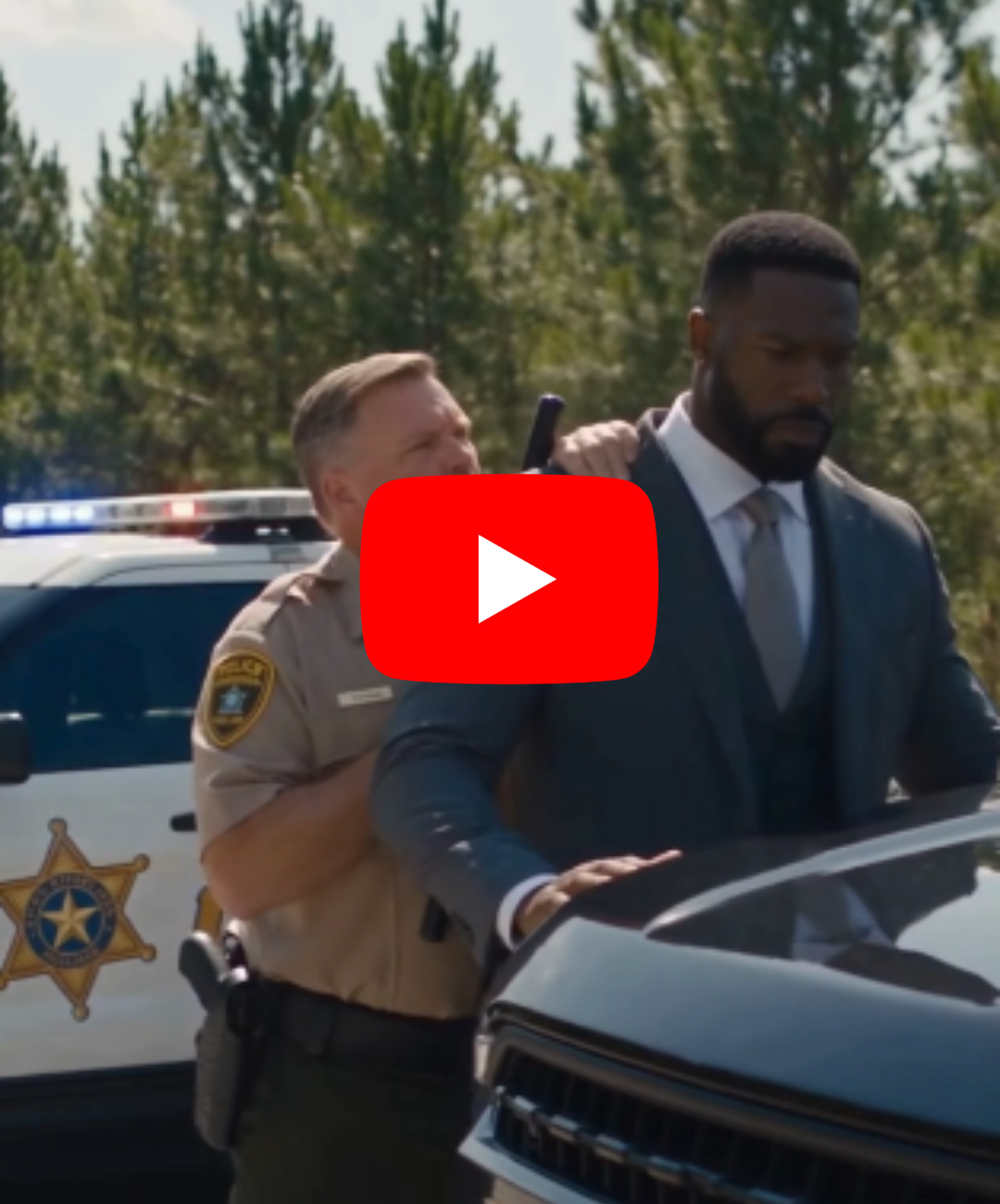
Marcus slowly raised both hands where they could see them.
He was wearing a dark suit because of where he was headed.
Not because he was trying to impress anyone.
Not because he expected to be treated differently.
He had been driving toward a federal security briefing when the patrol vehicle appeared behind him.
Red lights.
A short siren.
Then the shoulder.
Marcus had pulled over immediately.
He had followed instructions.
Hands visible.
No sudden movement.
No argument.
None of it mattered.
From the moment Sheriff Harlan stepped out of his patrol vehicle, the stop had never felt like an investigation.
It felt like a decision that had already been made.
“Sheriff,” Marcus said, “I’m asking you to step back.”
Harlan shoved him against the hood.
Metal pressed into Marcus’s ribs.
“You don’t give orders to people like me.”
Marcus’s jaw tightened.
Not from fear.
From restraint.
The deputy smirked again.
He seemed almost entertained.
Marcus stared down at the dark paint beneath his hands.
He had spent eighteen years serving his country.
Eighteen years learning discipline under pressure.
Eighteen years being taught that authority without restraint was dangerous.
But Sheriff Harlan did not know any of that.
He saw a Black man.
A nice suit.
A black pickup.
And whatever story he had already decided those things meant.
Marcus did not correct him yet.
There was no point explaining yourself to someone who had no interest in listening.
The sheriff grabbed his wrist.
Hard.
“Maybe a night in jail will teach you your place.”
Marcus turned his head slightly.
“Sheriff.”
Harlan tightened his grip.
“Your body camera is recording this.”
The deputy’s expression flickered.
Only briefly.
Harlan smiled.
Then he reached toward the camera.
“Not anymore.”
Click.
The indicator went dark.
Something inside Marcus shifted.
Not panic.
Calculation.
He understood exactly what that meant.
The sheriff had not simply lost control.
He was creating privacy.
Marcus stayed still.
Harlan raised the baton again.
That was when the headlights appeared.
At first, it was just one vehicle.
Black SUV.
Coming fast.
The deputy looked over his shoulder.
Then another appeared behind it.
And another.
Within seconds, the empty highway no longer felt empty.
Three black SUVs.
Then five.
Then eight.
They filled the road behind the patrol unit in a dark moving line.
The deputy’s smirk disappeared.
Harlan lowered the baton slightly.
The first SUV stopped.
Then the others.
Doors opened almost together.
Men and women stepped onto the pavement.
Professional clothing.
Federal credentials.
Controlled movements.
No shouting.
No confusion.
That made the scene more frightening for Harlan, not less.
One senior agent walked directly toward them.
His eyes moved first to Marcus.
Then to Harlan’s hand.
Then to the baton.
“Sheriff Harlan.”
Harlan did not answer.
The agent stopped several feet away.
“Remove your hands from Colonel Reed.”
The deputy stumbled backward.
Harlan looked from the agent to Marcus.
His grip loosened.
“Colonel?”
Marcus pushed himself away from the hood.
He straightened slowly.
Adjusted one sleeve.
Then his jacket.
No dramatic movement.
No threat.
He simply stood upright again.
Colonel Marcus Reed.
That was the name Harlan had never bothered to ask properly.
Marcus was not an ordinary businessman traveling through the state.
He was a senior Army officer.
And that morning he had been traveling to a classified federal security briefing.
Inside the truck sat a black case containing documents federal investigators had been waiting months to receive.
The sheriff looked toward the pickup.
Then toward the federal vehicles.
His face had begun to lose color.
The senior agent took one step closer.
“We’ve been investigating your department for eleven months.”
The words landed harder than a shouted accusation would have.
Harlan swallowed.
The deputy looked toward his patrol vehicle as though considering whether distance might somehow help him.
It would not.
Marcus said nothing.
He had not known exactly when the federal team would intercept him.
But he had known people were waiting for him.
He had known that if something interrupted his arrival, questions would be asked.
What Marcus had not expected was to become part of the evidence himself.
Another federal agent approached carrying a tablet.
His pace was quicker.
More urgent.
He stopped beside the senior agent.
“Sir.”
Marcus turned.
“We recovered the missing evidence.”
The highway went quiet again.
Marcus’s expression changed.
For the first time since Harlan had pulled him over, the calm in his face hardened into something colder.
“Where was it found?”
The agent glanced toward Sheriff Harlan.
Then toward the patrol unit.
“Inside his vehicle.”
Harlan stepped backward.
Just one step.
But everyone saw it.
Marcus did too.
The recovered evidence mattered far more than what had happened to him personally.
The stop.
The insults.
The baton.
The switched-off body camera.
Those things were serious.
But Marcus had spent months carrying questions that reached beyond one sheriff and one roadside encounter.
The federal investigation had not begun because of him.
It had begun because patterns had emerged.
Stops that did not make sense.
Reports that contradicted one another.
Evidence that disappeared between one location and another.
Complaints that seemed to vanish inside the same department that received them.
Marcus looked at Harlan.
Then at the badge pinned to his uniform.
The symbol meant something.
Or it was supposed to.
Authority.
Responsibility.
Public trust.
None of those things came from the metal itself.
They came from what the person wearing it chose to do.
Marcus pointed toward the sheriff’s badge.
“Now tell me something.”
Harlan said nothing.
Marcus’s voice remained controlled.
“Why has your department been stopping every Black veteran who travels this highway?”
The deputy looked at Harlan.
Not Marcus.
That reaction mattered.
The sheriff’s breathing changed.
His earlier confidence was gone.
He had spent the first minutes of the stop acting like the road belonged to him.
Now eight federal SUVs sat behind his patrol vehicle.
Investigators stood across the pavement.
His own deputy no longer looked certain whose side he wanted to be seen on.
The senior agent held out one hand toward Harlan.
“Sheriff, step away from Colonel Reed.”
Harlan obeyed.
Slowly.
Marcus rubbed his wrist once.
That was the only sign he gave that the sheriff’s grip had hurt.
The agent with the tablet looked down at the recovered file.
His expression tightened.
There was more on that screen than a single missing document.
Marcus could see that immediately.
“Open it,” Marcus said.
The agent hesitated.
Only for a second.
Then he did.
A list appeared.
Names.
Dates.
Vehicle descriptions.
Traffic stops.
Some entries contained notes.
Others appeared linked to files Marcus could not see from where he stood.
The federal investigation had been looking for a connection.
Something that turned scattered complaints into a pattern.
This looked like it.
Harlan stared at the tablet.
The blood seemed to drain from his face.
Marcus moved closer.
The first few names were unfamiliar.
Then his eyes dropped lower.
And stopped.
Everything else disappeared.
The highway.
The vehicles.
The agents.
The sheriff.
For one second there was only a name.
A name Marcus knew.
A name he had not expected to see on any active investigation.
Because the man attached to it was dead.
Marcus had attended the funeral himself.
Had stood beside the grave.
Had watched dirt fall onto the casket.
Three years earlier.
The federal agent looked at Marcus.
“Colonel?”
Marcus did not answer.